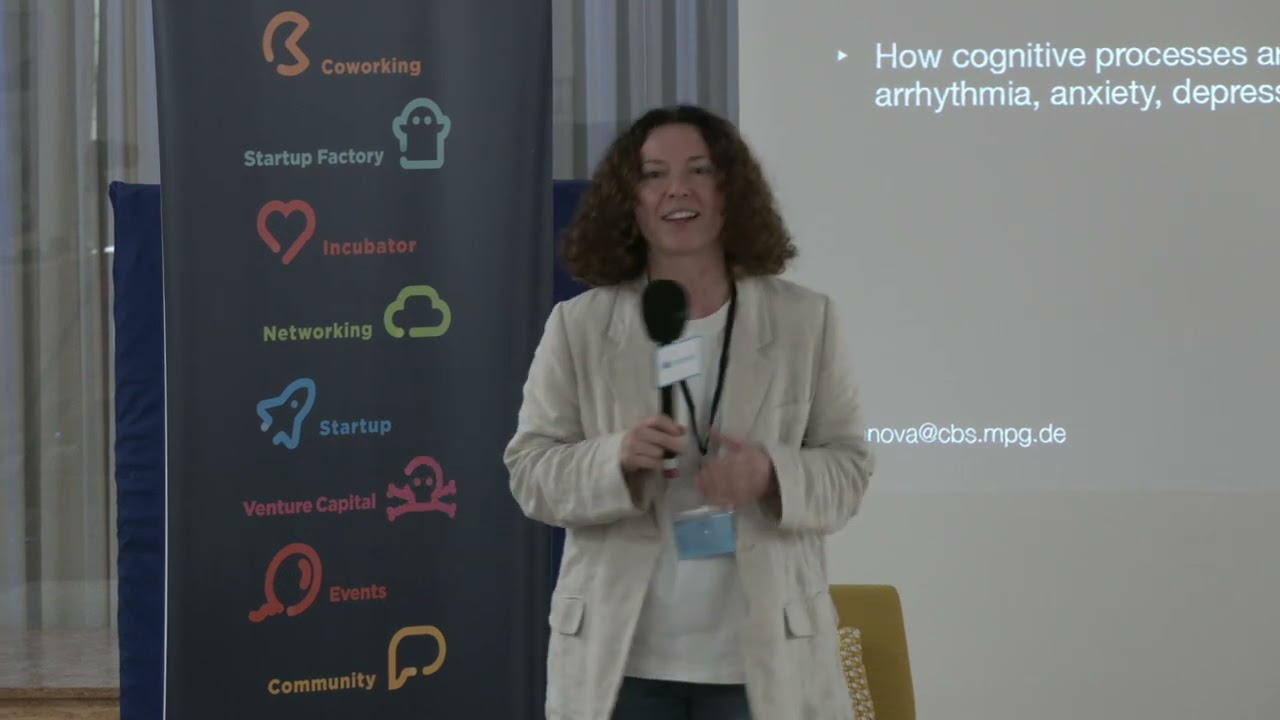
Body-Brain Waves - 27th September '24 - Talk by Maria Azanova
Keywords
Summary
158 words
Critical Evaluation
Value of the Information & Strength of the Argument
The talk provides valuable insights into the often-overlooked role of peripheral physiology in cognitive processes, specifically showing that heart rate dynamics are finely tuned to prediction and prediction error. The argumentation is solid, based on a well-designed experiment with appropriate statistical methods (mixed models) and careful consideration of cardiac phase. The speaker acknowledges the small effect sizes and the need for replication, which adds to the credibility. The link to neural activity (P300) strengthens the argument for a brain-body interaction. However, the talk is a presentation of preliminary findings, and the lack of a published peer-reviewed paper limits the strength of the claims.
Scientific Rigor, Source Quality, Title Accuracy
The scientific rigor is evident in the experimental design, statistical analysis, and the plan for a registered report. The speaker does not cite specific sources during the talk, but the description mentions the Body-Brain Waves conference and the waves-conference.com website, which may contain further references. The title accurately reflects the content, focusing on heart rate and prediction. No comments were provided for analysis.
181 words
Title / Content Match
The title accurately reflects the content: a scientific talk on body-brain interactions, specifically heart rate and prediction.
Quality & Reliability
7/10
The talk presents original research with a clear methodology, statistical modeling, and a registered report plan, but lacks detailed peer-reviewed publication and effect sizes are small.
Key Moments
Markers derived by PSI from the transcript: the creator did not define chapters.
- Introduction to the talk and research question
- Description of the probabilistic learning paradigm
- Explanation of prediction error and instantaneous heart rate changes
- Key finding: cardiac phase influences heart rate dynamics
- Association of interbeat intervals with expectation and prediction error
- Link between cardiac deceleration and P300 neural activity
- Discussion of effect sizes and future directions
- Q&A session and closing remarks
Cited Sources
- Body-Brain Waves Conference — The talk is part of the Body-Brain Waves series, and the website may provide additional information and references.
Concurring Sources
- Body-Brain Waves Conference — The conference series focuses on body-brain interactions, aligning with the talk's topic.
Contribution & Novelties
The talk contributes to the emerging field of body-brain interactions by demonstrating that instantaneous heart rate fluctuations are sensitive to prediction and prediction error on a moment-to-moment basis, and that this is modulated by the phase of the cardiac cycle. This extends previous work that focused on salient stimuli to more mundane probabilistic learning. The link to P300 provides a neural correlate, suggesting a potential mechanism. The planned registered report is a step towards more robust findings.
Pour aller plus loin :
- Predictive coding — Relevant to the framework of prediction and prediction error.
- Heart rate variability — Background on the physiological measure used.
- P300 (neuroscience) — The event-related potential linked to learning and updating.
115 words
Radar Profile
The radar profile shows a balanced performance with high scores in quality and technical level, but slightly lower in quantity and reliability, reflecting the preliminary nature of the findings and the small effect sizes.