Body-Brain Waves - 27th September '24 - Talk by Marie Loescher
Keywords
Summary
132 words
Critical Evaluation
Value of the Information & Strength of the Argument
The talk provides valuable insights into the ongoing debate on interoception and perception. The speaker clearly presents the theoretical background and derives testable predictions from each framework. The experimental design is clever, using peripersonal space to manipulate self-relevance, and the analysis is rigorous with linear mixed-effects models and source localization. The argumentation is solid, as the results support both competition and facilitation, suggesting a more nuanced relationship than previously assumed. The speaker also addresses potential confounds and controls, strengthening the validity of the findings.
Scientific Rigor, Source Quality, Title Accuracy
The speaker references relevant studies, including those by Ezra Al and Park and colleagues, but does not provide specific citations or URLs. The title accurately reflects the content. The talk is part of a scientific conference series, indicating a level of peer scrutiny. However, the lack of published details and the small sample size (37 participants) limit the generalizability. The speaker acknowledges the need for further research.
166 words
Title / Content Match
The title accurately reflects the content, focusing on body-brain interactions and specifically the influence of heart signals on perception.
Quality & Reliability
8/10
The talk presents original research with a clear hypothesis-driven approach, using established paradigms and rigorous statistical modeling. The speaker is a PhD student supervised by known researchers, and the work appears to be part of a scientific conference series. Limitations include lack of peer-reviewed publication details and small sample size.
Key Moments
Markers derived by PSI from the transcript: the creator did not define chapters.
- Introduction to the talk and the question of how body signals influence perception.
- Presentation of the competition and facilitation frameworks.
- Explanation of the heartbeat evoked potential and its role as a marker of interoceptive processing.
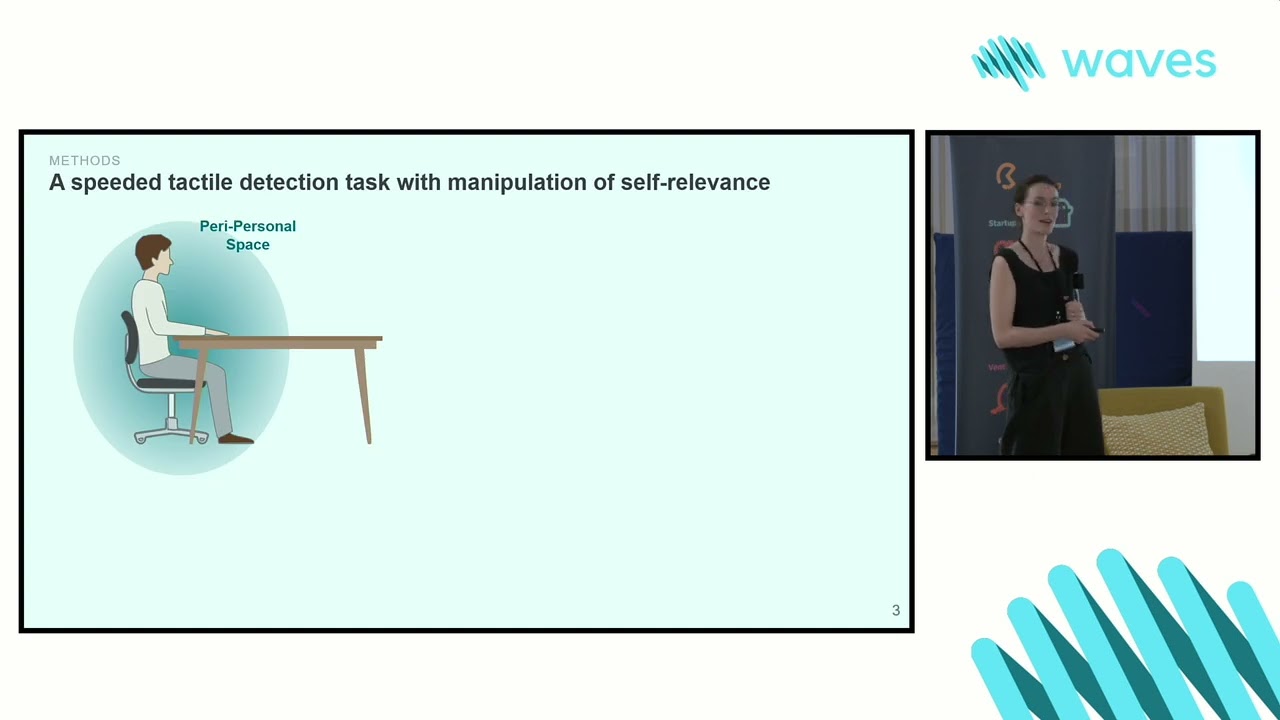
- Description of the experimental paradigm using peripersonal space to manipulate self-relevance.
- Behavioral results showing faster reaction times for near sounds.
- EEG results: HEP amplitude predicts reaction times (competition) and self-relevance effect (facilitation).
- Source localization showing distinct brain regions for the two effects.
- Conclusions and Q&A.
Cited Sources
- waves-conference.com — Official website of the Body-Brain Waves conference series.
Concurring Sources
- Park et al. (2020) — Study showing HEP amplitude positively predicts perception of faint visual stimuli, supporting facilitation.
- Al et al. (2020) — Study showing HEP amplitude negatively predicts tactile perception, supporting competition.
Dissenting Sources
- None — No discordant sources were mentioned in the talk.
Contribution & Novelties
This talk presents novel findings that simultaneously test two competing hypotheses about interoception and perception, showing that both competition and facilitation can occur independently. The use of peripersonal space as a manipulation of self-relevance is innovative. The results suggest that the brain may process cardiac signals in parallel for different purposes.
Pour aller plus loin :
- Interoception — Overview of interoception and its neural basis.
- Heartbeat evoked potential — Explanation of the HEP and its use in research.
- Peripersonal space — Definition and relevance to self-relevance.
- Anterior cingulate cortex — Brain region implicated in the facilitation effect.
97 words
Radar Profile
The radar profile shows high scores in quality of information, technical level, and global reliability, with a slightly lower score in quantity of information due to the short duration and focused scope. This indicates a technically sound and reliable presentation, though limited in breadth.
💬 No comments were provided for analysis.