Body-Brain Waves - 27th September '24 - Talk by Florian Perrin
Keywords
Summary
165 words
Critical Evaluation
Value of the Information & Strength of the Argument
The talk provides valuable insights into the neural basis of heartbeat evoked responses, a topic with limited intracranial data. The speaker clearly explains the methodology, including preprocessing steps and validation via surrogate distributions. The argumentation is logical, building from known limitations of scalp EEG to the advantages of intracranial recordings. Preliminary results are presented with appropriate caution, acknowledging the ongoing nature of the study and potential confounds. The speaker also addresses questions about artifact rejection and inter-subject variability, demonstrating scientific rigor.
Scientific Rigor, Source Quality, Title Accuracy
The talk is scientifically rigorous, with a clear research question and methodology. The speaker references prior work on HERs and intracranial studies, though specific citations are not provided in the video. The title accurately reflects the content. The Q&A session shows engagement with methodological concerns, such as the effectiveness of bipolar montage in removing cardiac artifacts. The speaker acknowledges limitations and future directions, including the need for more data and connectivity analyses. Overall, the presentation is consistent with current scientific understanding and transparent about uncertainties.
181 words
Title / Content Match
The title accurately reflects the content: a talk on body-brain interactions, specifically on heartbeat evoked responses across vigilance states.
Quality & Reliability
7/10
The talk presents preliminary findings from an ongoing intracranial EEG study, with transparent discussion of limitations and methodology. The speaker is a researcher presenting at a scientific event, and the content is consistent with current knowledge in the field, though it lacks peer review and detailed statistical reporting.
Key Moments
Markers derived by PSI from the transcript: the creator did not define chapters.
- Introduction and study aim: investigating neural networks underlying cardiac autonomic control using heartbeat evoked responses across vigilance states.
- Limitations of scalp EEG: limited spatial precision and artifact contamination.
- Advantages of intracranial EEG: better spatial and temporal resolution, less artifact contamination.
- Data description: 10 epileptic patients, 200 electrode contacts, comparison across wakefulness, N2, N3, and REM sleep.
- Preprocessing steps: bipolar montage and high-pass filtering to remove artifacts.
- Validation method: surrogate distribution analysis with 1000 random averages.
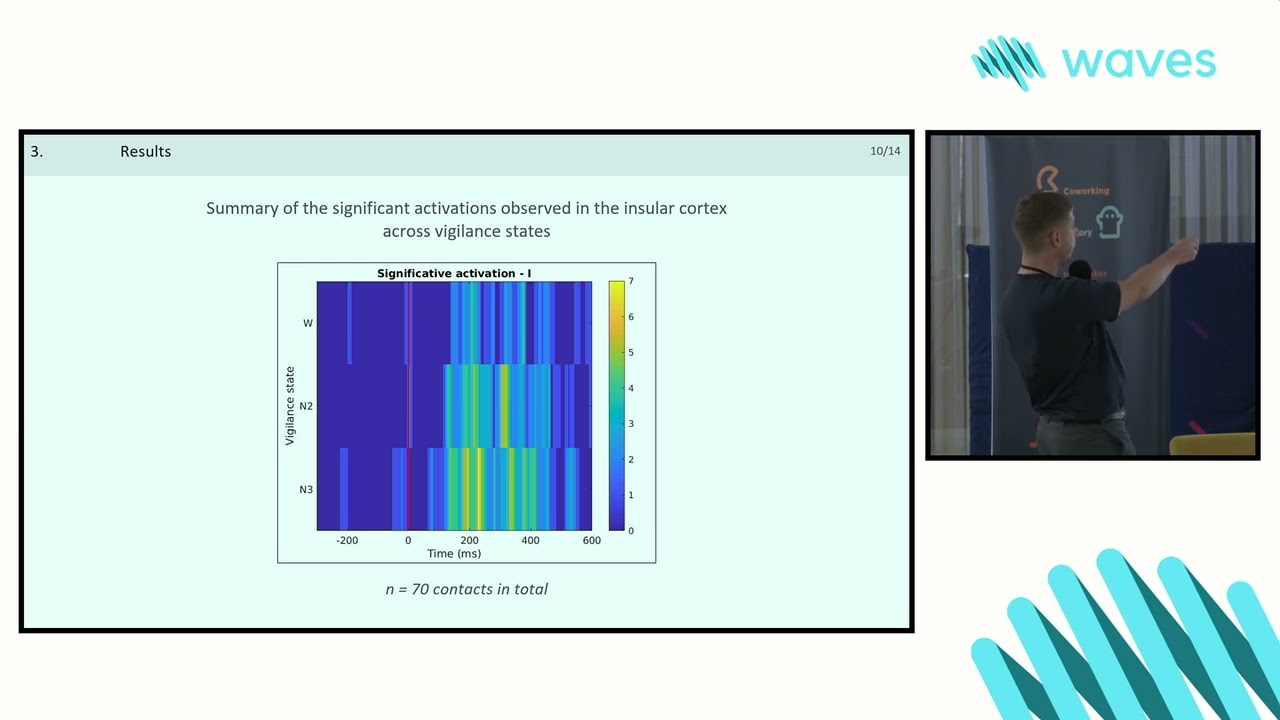
- Results: HERs found in various brain regions, with insular cortex as a main source.
- Responses across vigilance states: some regions show state-specific activity.
- Exemplar channels in posterior insular cortex: similar patterns or amplitude modulation with sleep depth.
- Conclusions and future directions: need for more data and connectivity analyses.
Cited Sources
- Body-Brain Waves conference website — Mentioned in the video description as the series of scientific events hosting this talk.
Concurring Sources
- Park et al. (2018) - Intracranial EEG study of heartbeat evoked responses — This study used intracranial EEG to investigate HERs and found involvement of the insular cortex, consistent with the speaker's findings.
Contribution & Novelties
This talk contributes to the understanding of heartbeat evoked responses by providing intracranial EEG data across vigilance states, which is scarce in the literature. The preliminary findings suggest a region-specific modulation of HERs by sleep stages, particularly in the insular cortex. The speaker’s approach of using a large dataset of 10 patients is notable, as most intracranial studies have fewer participants.
Pour aller plus loin :
- Heartbeat evoked potentials — Overview of the concept and its measurement.
- Intracranial EEG — Explanation of the technique used in the study.
- Insular cortex and interoception — Role of the insula in processing bodily signals.
101 words
Radar Profile
The radar profile shows balanced scores across all dimensions, with slightly higher scores in information quantity and quality, reflecting the detailed presentation of methodology and preliminary results. The technical level is high, indicating a specialized audience. The overall reliability is good, though the ongoing nature of the study and lack of peer review temper the score.
💬 No comments were provided for analysis.