Body-Brain Waves - 28th September '24 - Talk by Alexandrina Vasilichi
Keywords
Summary
190 words
Critical Evaluation
Value of the Information & Strength of the Argument
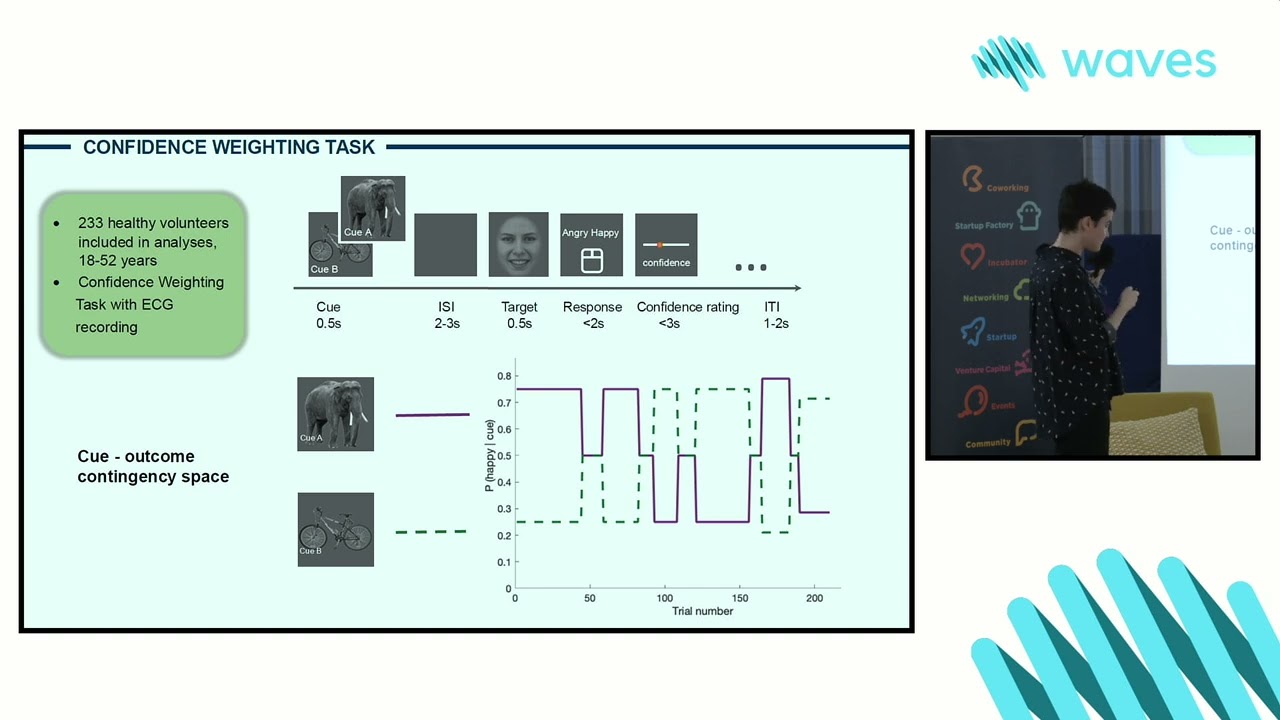
The talk presents novel research exploring the intersection of cardiac phase, affective expectations, and sensory uncertainty, an area not previously investigated. The argumentation is logical, building from established literature on priors and cardiac effects to the specific hypotheses and findings. The use of a large sample (233 participants) and tailored stimuli strengthens the study. However, the presentation is somewhat informal and lacks detailed statistical reporting, and the effects are small, limiting the strength of the conclusions. The speaker acknowledges these limitations and outlines future directions, which adds to the credibility.
Scientific Rigor, Source Quality, Title Accuracy
The talk references prior research on cardiac phase and perception, but specific citations are not provided in the video or description. The methodology appears sound, with careful task design and statistical modeling. The title accurately reflects the content, focusing on the interplay between visceral signals and sensory uncertainty. The description provides context for the Body-Brain Waves series, but no additional sources. Overall, the scientific rigor is adequate for a conference talk, but the lack of explicit citations in the video limits the ability to verify claims.
191 words
Title / Content Match
The title accurately reflects the content: a talk on body-brain interactions, specifically focusing on cardiac influences on affective expectations.
Quality & Reliability
7/10
The talk presents original research from a PhD student at a reputable institute, with a clear methodology and statistical analysis. However, the presentation is informal and lacks detailed methodological transparency, and the effects reported are small.
Key Moments
Markers derived by PSI from the transcript: the creator did not define chapters.
Cited Sources
- Body-Brain Waves Conference — Mentioned in the video description as the series hosting the talk.
Concurring Sources
- Body-Brain Waves Conference — The talk is part of this series, which focuses on body-brain interactions.
Contribution & Novelties
This research contributes to the emerging field of body-brain interactions by demonstrating that cardiac phase modulates the influence of prior expectations and sensory uncertainty on affective perception. The finding that reaction times are faster during systole for specific stimulus conditions (e.g., angry faces) aligns with and extends prior work on threat processing. The study’s use of a large sample and tailored stimuli adds robustness. Future computational modeling may provide deeper insights.
Pour aller plus loin :
- Interoception — Relevant to the concept of visceral signals influencing perception.
- Predictive coding — Framework for understanding how priors and sensory input interact.
- Cardiac cycle and perception — Review on cardiac influences on perception, though not cited in the video, it provides background.
119 words
Radar Profile
The radar profile shows a balanced performance across all dimensions, with slightly higher scores in information quantity and technical level, indicating a solid but not exceptional presentation. The fiabilite_globale score of 7 reflects the small effect sizes and lack of detailed methodological transparency.
💬 No comments were provided for analysis.