Body-Brain Waves - 27th September '24 - Talk by Weronika Potok-Szybinska
Keywords
Summary
203 words
Critical Evaluation
Value of the Information & Strength of the Argument
The talk provides valuable insights into a novel application of biofeedback for stress management. The argumentation is logically structured, building from established neuroscience (LC-pupil link) to a practical intervention. The speaker is transparent about the preliminary nature of the data and the small sample size, which enhances credibility. The discussion of variability in participants’ ability to down-regulate is important and suggests individual differences that may affect outcomes. The Q&A session adds depth, addressing methodological concerns about disentangling social stress from pain perception, showing the speaker’s openness to feedback and scientific rigor.
Scientific Rigor, Source Quality, Title Accuracy
The talk references established scientific concepts and protocols, such as the socially evaluated cold pressor test and the LC-pupil link, but does not cite specific studies or provide references in the description. The title accurately reflects the content, which is a scientific talk on body-brain interactions. The presentation is methodical, with clear explanations of the experimental design and preliminary results. The lack of formal citations is a minor weakness, but the speaker’s affiliation and the context of a scientific conference lend credibility.
188 words
Title / Content Match
The title accurately reflects the content, which is a scientific talk on body-brain interactions, specifically focusing on arousal self-regulation and stress responses.
Quality & Reliability
7/10
The talk presents preliminary data from a pilot study, with transparent discussion of limitations and open questions. The methodology is based on established protocols (socially evaluated cold pressor test) and physiological measures, but the sample size is very small and results are preliminary.
Key Moments
Markers derived by PSI from the transcript: the creator did not define chapters.
- Introduction and overview of the talk
- Explanation of stress response and locus coeruleus
- Introduction to pupil-based biofeedback and its validation
- Description of the socially evaluated cold pressor test
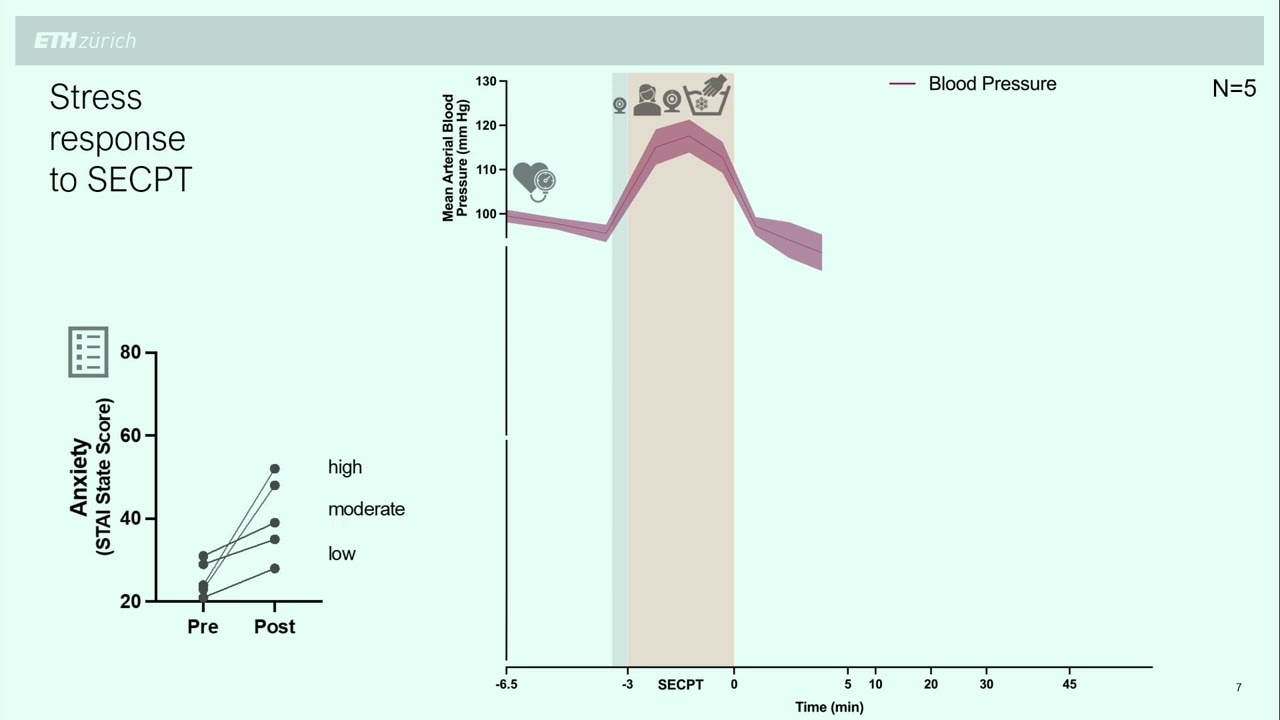
- Preliminary results showing stress induction and modulation trends
- Discussion of limitations and future directions
- Q&A session addressing methodological questions
Contribution & Novelties
The talk presents a novel application of pupil-based biofeedback for stress modulation, which is an innovative approach that could have practical implications for stress management. The preliminary data, though limited, suggest potential efficacy and warrant further investigation. The integration of established stress induction protocols with biofeedback training is a creative combination.
Pour aller plus loin :
- Locus coeruleus and noradrenergic system — Provides background on the brain region central to the talk.
- Biofeedback — Overview of biofeedback techniques, including pupil-based methods.
- Cold pressor test — Description of the stress induction protocol used.
92 words
Radar Profile
The radar profile shows balanced scores across all dimensions, indicating a solid but not exceptional presentation. The highest scores are in quality of information and technical level, reflecting the scientific depth, while the lower score in quantity of information is due to the short duration and preliminary nature of the data.