Body Brain Waves'25 - Talk by Laura Steenberg
Keywords
Summary
198 words
Critical Evaluation
Value of the Information & Strength of the Argument
The talk provides valuable insights into the gut-brain axis research, particularly from a clinical psychology perspective. The speaker shares both positive and null findings, which adds to the credibility of her argumentation. She acknowledges limitations such as small sample sizes and the need for replication. The argumentation is logical, moving from animal studies to human interventions, and she critically evaluates the evidence. However, the talk is largely based on her own research, and she does not extensively discuss conflicting studies or alternative viewpoints, which could strengthen the overall argument.
98 words
Title / Content Match
The title accurately reflects the content, which is a scientific talk on the gut-brain axis and mental health.
Quality & Reliability
7/10
The talk presents personal research findings and discusses the gut-brain axis in mental health, referencing several studies. The speaker is transparent about limitations, including small sample sizes and replication failures. However, the content is largely based on the speaker's own work and lacks systematic review of the broader literature.
Key Moments
Markers derived by PSI from the transcript: the creator did not define chapters.
- Introduction and personal anecdote about master's internship.
- Discussion of the 2004 germ-free mice study and its impact.
- Presentation of the 2015 probiotics study on cognitive reactivity.
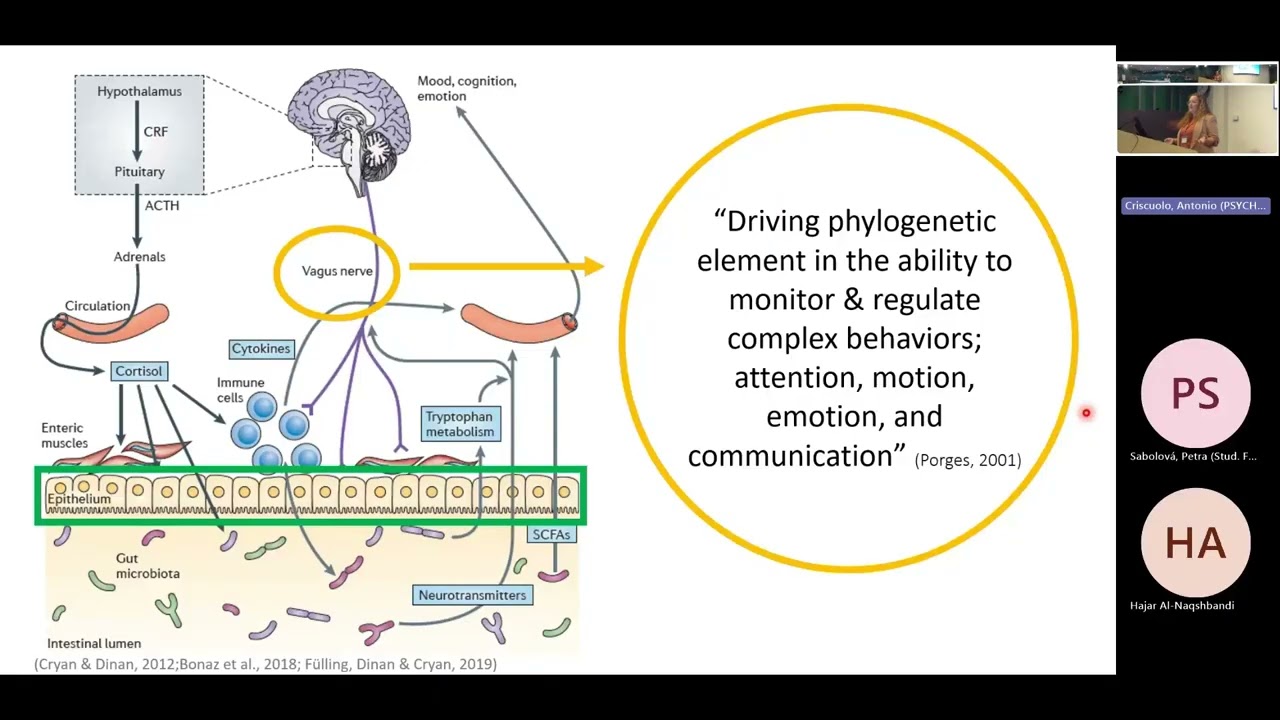
- Explanation of the vagus nerve and tVNS methodology.
- Findings on tVNS effects on social attention and emotion recognition.
- Discussion of a study showing tVNS reduces emotional intensity without physiological changes.
- Replication study of probiotics with null results and daily measures.
- Analysis of predictors of improvement, linking to risk aversion.
- Connection to generalized unsafety theory and future directions.
Cited Sources
- waves-conference.com — Official website of the Body-Brain Waves conference series, mentioned in the video description.
Concurring Sources
- waves-conference.com — Official conference website, consistent with the talk's topic.
Contribution & Novelties
The talk provides a personal and critical perspective on the gut-brain axis research, highlighting both positive and null findings. It emphasizes the importance of replication and the need to consider individual differences. The speaker introduces the concept of risk aversion as a potential moderator of probiotic effects, which is a novel angle. She also connects findings to the generalized unsafety theory of stress, offering a new framework for understanding the gut-brain axis in mental health.
Pour aller plus loin :
- Gut-brain axis — Overview of the bidirectional communication between the gut and the brain.
- Probiotic — Definition and health benefits of probiotics.
- Vagus nerve stimulation — Overview of vagus nerve stimulation techniques, including transcutaneous.
- Cognitive reactivity — Concept of cognitive reactivity in depression.
- Generalized unsafety theory of stress — Theory explaining stress responses in terms of safety perception.
138 words
Radar Profile
The radar profile shows a balanced performance across all dimensions, with slightly higher scores in information quality and reliability, reflecting the speaker's expertise and transparent reporting. The lower score in technical level suggests the content is accessible to a broad scientific audience.
💬 No comments were provided for analysis.