Body-Brain Waves - 27th September '24 - Talk by Andria Pelentriou
Keywords
Summary
169 words
Critical Evaluation
Value of the Information & Strength of the Argument
The talk presents novel findings on the modulation of slow oscillations by heartbeat-synchronized auditory stimuli. The argumentation is logical and well-structured, building from previous research to the current study. The speaker carefully explains the experimental design and controls, such as the irregular condition that replays sequences to control for variability. She acknowledges limitations, including the small cohort and the need for further analysis. The discussion of potential habituation over nights adds depth. The value lies in the potential to use cardiac-synchronized sounds to influence sleep-related processes, which could have applications in memory consolidation or even consciousness assessment. However, the results are preliminary and not yet peer-reviewed, so the argumentation is promising but not conclusive.
Scientific Rigor, Source Quality, Title Accuracy
The talk demonstrates scientific rigor through a clear methodology, including standard criteria for slow oscillation detection and appropriate statistical analyses. The speaker references prior work from her lab and a seminal study on brain-body coupling, but specific citations are not provided in the talk. The title accurately reflects the content, focusing on the influence of sound and heartbeat on slow oscillations. The talk is part of a scientific series, suggesting a peer-reviewed context. However, the lack of explicit references in the talk limits the ability to verify sources. The speaker’s transparency about limitations and future directions enhances credibility.
227 words
Title / Content Match
The title accurately reflects the content: a talk on body-brain interactions, specifically how heartbeat-synchronized sounds affect slow oscillations in sleep.
Quality & Reliability
7/10
The talk presents original research with a clear methodology, but the results are preliminary and not yet peer-reviewed. The speaker is transparent about limitations and future steps.
Key Moments
Markers derived by PSI from the transcript: the creator did not define chapters.
- Introduction to the talk and the lab's focus on body-brain interactions.
- Explanation of slow oscillations and their role in sleep.
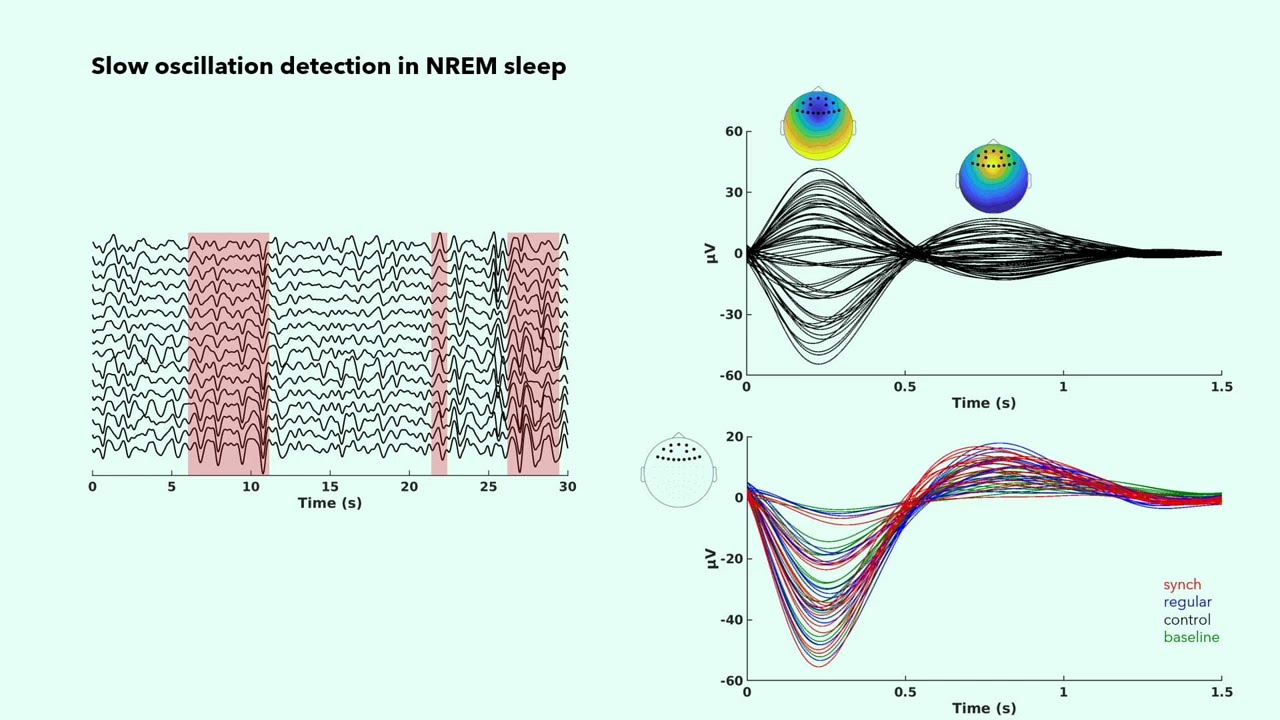
- Description of the experimental paradigm with synchronous, regular, and irregular conditions.
- Results on slow oscillation amplitude and duration.
- Findings on the latency between slow oscillation peaks and sounds, showing alignment in the synchronous condition.
- Comparison of R-peak latency and discussion of the effect being driven by sounds.
- Results across two nights, showing habituation on the second night.
- Conclusion and implications for covert consciousness.
Cited Sources
- No specific sources cited in the talk — The speaker mentions prior work from her lab and a seminal study on brain-body coupling, but no explicit references are given.
Concurring Sources
- Closed-loop auditory stimulation of slow oscillations — This study demonstrates that auditory stimulation at the peaks of slow oscillations can enhance them, supporting the idea that sounds can modulate slow oscillations.
- Heartbeat-evoked potentials and consciousness — Research showing that heartbeat-evoked potentials are modulated by consciousness states, supporting the relevance of cardiac signals in brain function.
Dissenting Sources
- No discordant sources found — No sources contradicting the findings were mentioned in the talk.
Contribution & Novelties
The talk presents original research on the modulation of slow oscillations by heartbeat-synchronized auditory stimuli during sleep. This is a novel contribution as it directly tests the causal influence of cardiac-synchronized sounds on slow oscillation dynamics, extending previous correlational findings. The results suggest that the brain may align slow oscillations with relevant auditory stimuli, potentially enhancing information processing during sleep. The study also explores habituation effects over two nights, adding a longitudinal dimension. The findings could have implications for understanding covert consciousness and developing interventions for sleep-dependent memory consolidation.
Pour aller plus loin :
- Slow oscillations in sleep — Overview of slow-wave sleep and its characteristics.
- Auditory closed-loop stimulation — Study on closed-loop auditory stimulation to enhance slow oscillations.
- Heartbeat-evoked potentials — Introduction to heartbeat-evoked potentials and their relevance to brain-body interactions.
132 words
Radar Profile
The radar profile shows high scores in quality of information and technical level, indicating a well-presented and scientifically sound talk. The quantity of information is moderate, and reliability is good but not perfect due to preliminary results. The overall balance suggests a solid contribution to the field.
💬 No comments were provided for analysis.