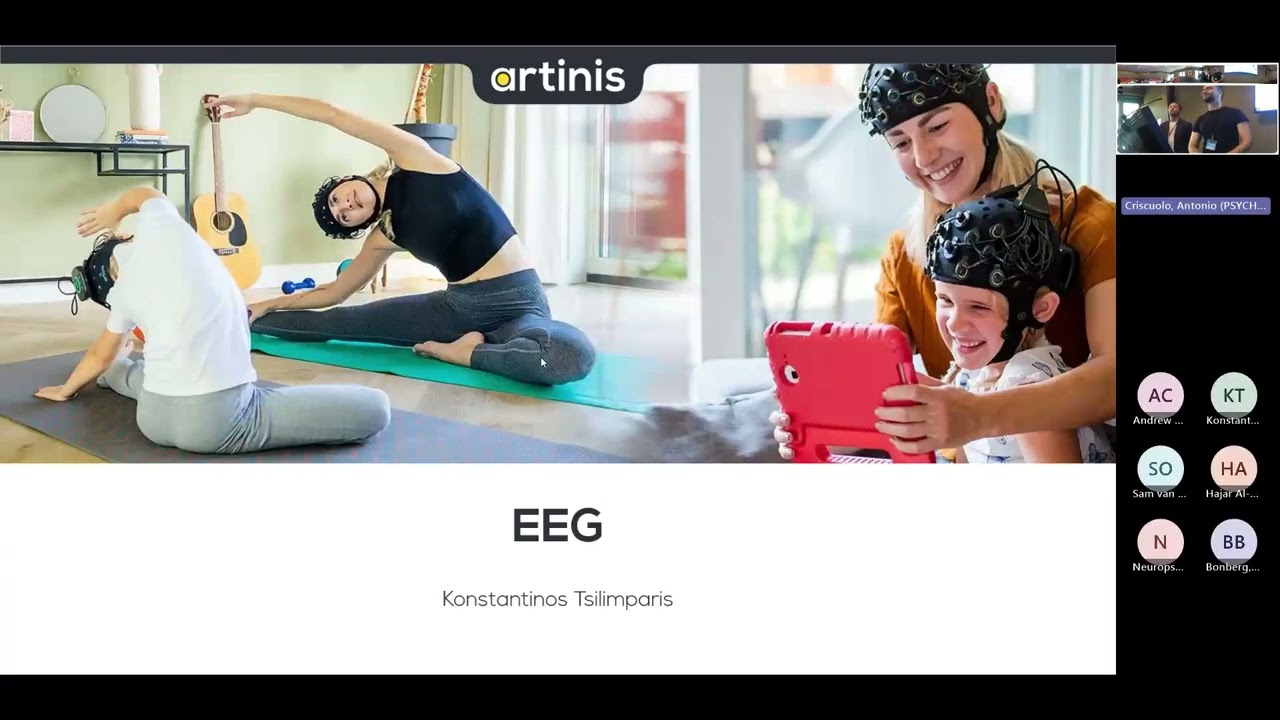
Body Brain Waves'25 - Workshop by Artinis
Keywords
Summary
161 words
Critical Evaluation
Value of the Information & Strength of the Argument
The video provides a solid introduction to fNIRS and EEG technologies, explaining the underlying principles clearly and concisely. The argumentation is coherent, with a logical progression from basic concepts to product demonstrations. The presenters effectively highlight the advantages of combining modalities, such as improved spatial and temporal resolution, and address potential challenges like synchronization and artifacts. However, the content is promotional in nature, and the argumentation is primarily aimed at showcasing Artinis’s products rather than providing an unbiased scientific review. The technical depth is appropriate for a workshop audience, but it may not satisfy experts seeking detailed methodological discussions.
Scientific Rigor, Source Quality, Title Accuracy
The workshop demonstrates a good level of scientific rigor in explaining the principles of fNIRS and EEG, with accurate descriptions of the modified Beer-Lambert law and hemodynamic response. However, no specific scientific sources are cited, and the information is based on the presenters’ expertise and company knowledge. The title accurately reflects the content, as it is a workshop presented at the Body Brain Waves'25 event. The video is well-structured and professionally presented, but the lack of external references limits its scientific depth. The description includes a link to Artinis’s website, which serves as the primary source of information.
212 words
Title / Content Match
The title accurately reflects the content, as the video is a workshop presented at the Body Brain Waves'25 event by Artinis.
Quality & Reliability
7/10
The workshop is presented by application specialists from Artinis, a company specializing in neuroimaging devices. The content is technically accurate and provides a clear overview of fNIRS and EEG technologies, their principles, and combined applications. However, it is a promotional workshop, so potential biases exist, and no peer-reviewed sources are cited.
Key Moments
Markers derived by PSI from the transcript: the creator did not define chapters.
- Introduction and presenter introductions
- Overview of Artinis company and history
- Principles of fNIRS: light absorption and hemoglobin
- Modified Beer-Lambert law and calculation of concentration changes
- Advantages and considerations of fNIRS
- Artinis fNIRS devices: Brite family and MedBrite
- EEG amplifiers: Apex and Saga
- Combining EEG and fNIRS: benefits and challenges
- Live demonstration of combined cap setup and software
- Q&A session on device customization and applications
Cited Sources
- Artinis Medical Systems — Official website of the company presenting the workshop, providing information on fNIRS and EEG devices.
Concurring Sources
- Artinis Medical Systems — The company's official website provides detailed product information and technical specifications that align with the workshop content.
Contribution & Novelties
The workshop provides a practical overview of combining fNIRS and EEG, highlighting the complementary nature of these modalities for brain research. It offers insights into the technical challenges and solutions, such as synchronization and artifact reduction, which are valuable for researchers considering multimodal neuroimaging. The demonstration of the combined cap and software provides a tangible example of the setup.
Pour aller plus loin :
- Functional near-infrared spectroscopy — Overview of fNIRS principles and applications.
- Electroencephalography — Basics of EEG and its uses.
- Modified Beer-Lambert law — The law underlying fNIRS signal processing.
- Hemodynamic response — The physiological basis of fNIRS signals.
- Hyperscanning — A technique for measuring brain activity in multiple subjects simultaneously, relevant to the applications mentioned.
118 words
Radar Profile
The radar profile shows high scores in information quantity and technical level, reflecting the workshop's detailed coverage of fNIRS and EEG principles and products. The quality and reliability scores are moderate, indicating accurate but promotional content. The overall balance suggests a useful educational resource for those new to these technologies.