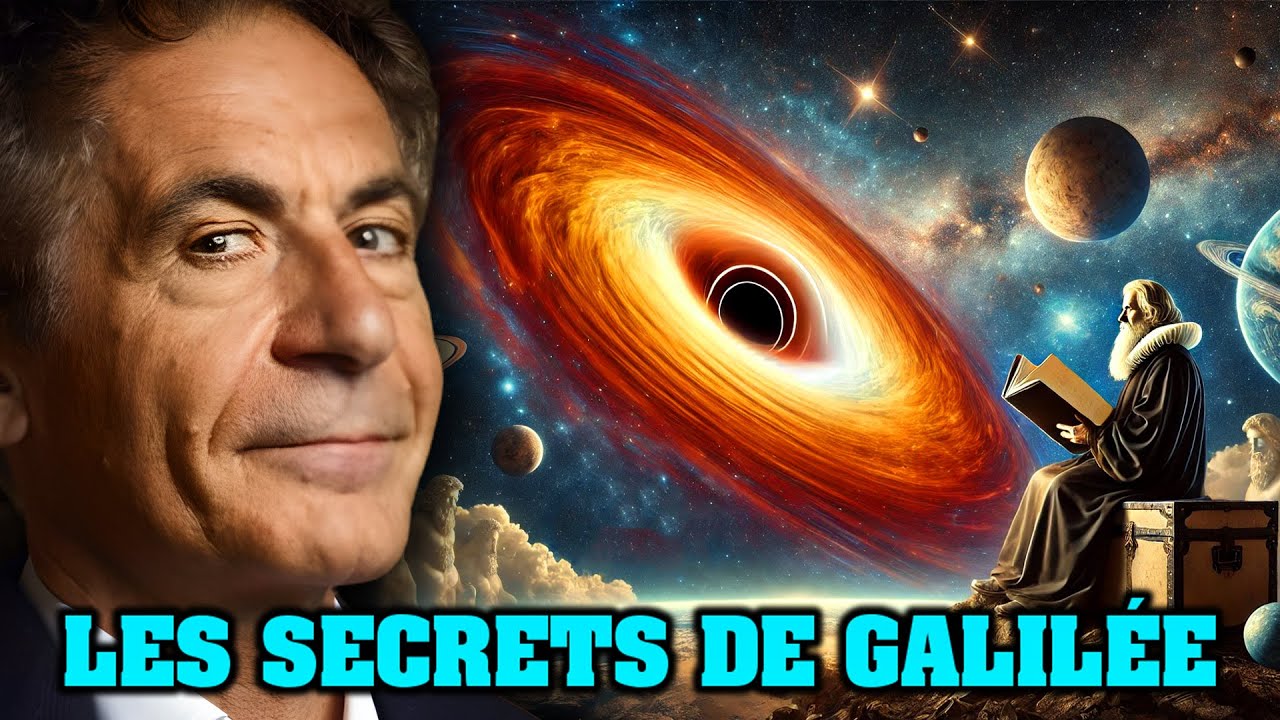
Etienne Klein - Les Secrets de Galilée !
Keywords
Summary
133 words
Critical Evaluation
The conference is a masterclass in scientific popularization, delivered by Etienne Klein, a physicist and philosopher known for his ability to make complex ideas accessible. The content is historically accurate and well-structured, tracing Galileo’s contributions from his astronomical observations to his foundational principles of physics. Klein’s argument is solid: he demonstrates how Galileo’s genius lay in his ability to think counterfactually and to trust reason over sensory experience. The talk is rich in anecdotes and philosophical insights, making it engaging for a general audience. However, as a conference, it lacks formal citations, and some interpretations are subjective, such as the emphasis on the ‘invention’ of the concept of universe. The audio quality is a noted issue, but it does not detract from the intellectual value. The title accurately reflects the content, and the talk provides a comprehensive overview of Galileo’s legacy. Overall, it is an excellent piece of science communication, though not a rigorous academic lecture.
156 words
Title / Content Match
The title accurately reflects the content: a deep dive into Galileo's life and work, revealing his 'secrets' and the profound implications of his discoveries.
Quality & Reliability
8/10
The conference is delivered by a recognized physicist and philosopher of science, Etienne Klein, known for his rigorous popularization. The content is historically accurate and well-structured, with clear explanations of Galileo's contributions. However, as a conference, it lacks formal citations and peer review, and some philosophical interpretations are subjective.
Key Moments
Markers derived by PSI from the transcript: the creator did not define chapters.
- Introduction: Klein sets the stage, mentioning Galileo's birth and death, and the significance of 1604.
- Klein explains how Galileo realized that the world hides the universe, and that physical laws often contradict observations.
- Discussion of Galileo's astronomical observations: the Moon's surface, Jupiter's moons, and the phases of Venus.
- Klein describes Galileo's use of anagrams to protect his discoveries, and Kepler's misinterpretations.
- Introduction of the principle of relativity: 'movement is as nothing' and the relativity of motion.
- Klein discusses the law of inertia, and his personal anecdote about learning it in high school.
- Klein touches on Galileo's conflict with the Church and the trial.
- Klein reflects on the philosophical implications of Galileo's work for modern science.
Cited Sources
- La Gazette Spatiale — Mentioned in the description as a source for astronomy news.
Concurring Sources
- Stanford Encyclopedia of Philosophy - Galileo Galilei — Academic source on Galileo's philosophy and science.
Dissenting Sources
Contribution & Novelties
The conference provides a fresh perspective on Galileo’s work, emphasizing his role in the invention of the concept of ‘universe’ and his methodological innovation of counterfactual thinking. Klein’s interpretation is original and thought-provoking.
Pour aller plus loin :
- Galileo Galilei — Comprehensive biography and contributions.
- Principle of relativity — Historical context and modern implications.
- Law of inertia — Newton’s first law, building on Galileo’s insights.
65 words
Radar Profile
The radar profile shows high scores in quantity and quality of information, with a moderate technical level, indicating a talk that is rich in content but accessible. The overall reliability is high, reflecting the speaker's expertise.
💬 Très positif. Sur les 30 commentaires analysés, la grande majorité exprime une admiration pour l'orateur et la qualité de l'exposé, avec quelques remarques sur la qualité du son.