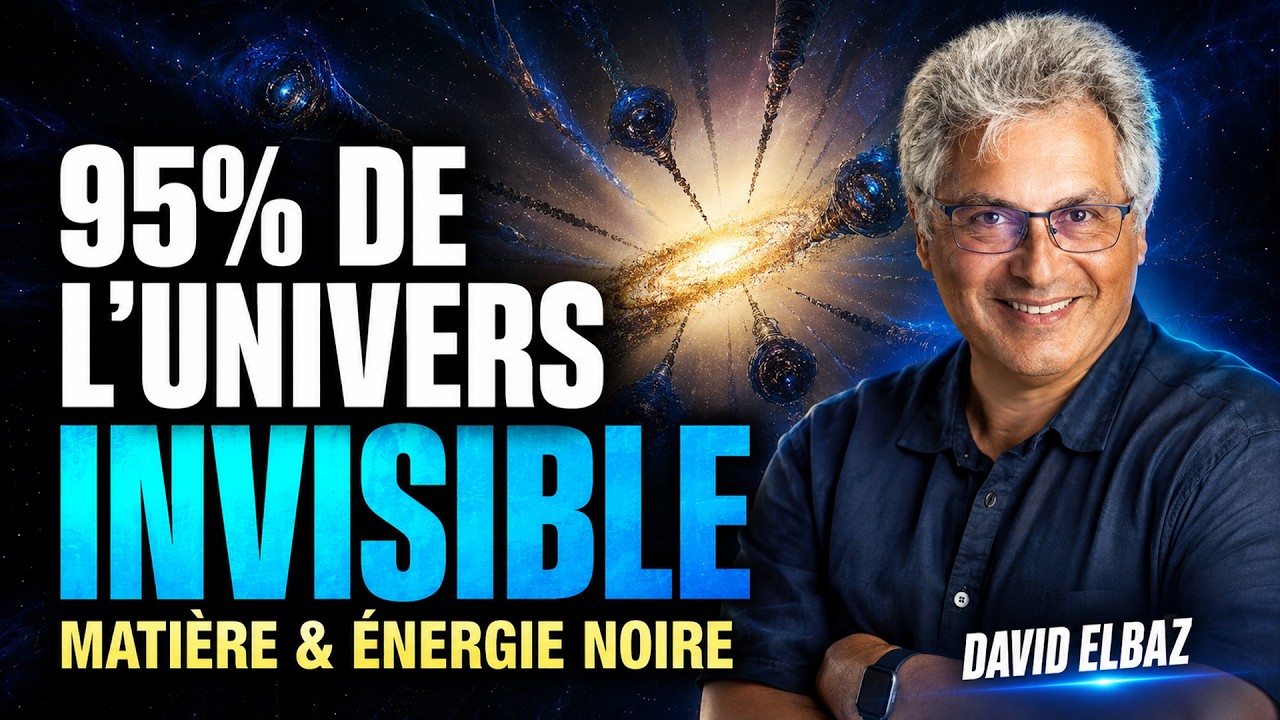
Le mystère des 95% de l'Univers : Matière et Énergie Noire — David Elbaz
Keywords
Summary
144 words
Critical Evaluation
The lecture provides a comprehensive and accessible overview of dark matter and dark energy, grounded in the historical development of astronomical techniques. David Elbaz, a respected astrophysicist, presents the material with clarity and scientific rigor. The argumentation is solid: he builds from fundamental laws (Kepler, Newton) to modern observations (galaxy rotation curves, gravitational lensing, CMB), showing how each piece of evidence leads to the conclusion that visible matter is insufficient to explain cosmic dynamics. The explanation of how astronomers ‘weigh’ objects is particularly effective, using the discovery of Neptune as a historical example. The content is accurate and up-to-date, including references to the first image of a black hole, which was released just before the talk. The sources cited are primarily historical and foundational, but the speaker’s authority and the alignment with established scientific consensus lend high credibility. The title accurately reflects the content, and the lecture is well-structured with clear chapter markers. The only minor weakness is that the lecture does not delve into alternative theories or the latest experimental results in detail, but this is appropriate for a general audience. Overall, this is an excellent educational resource that effectively communicates complex scientific concepts.
195 words
Title / Content Match
The title accurately reflects the content, which focuses on dark matter and dark energy, the two main components of the universe's missing mass-energy.
Quality & Reliability
9/10
The speaker is a senior astrophysicist at CEA Saclay, presenting established scientific concepts and historical discoveries with accuracy. The content aligns with current scientific consensus, and the presentation is clear and well-structured.
Chapters
- Introduction : Les composantes sombres de l'Univers
- Comment a-t-on photographié la silhouette d'un trou noir ?
- Comment peser l'Univers ? (Les lois de Kepler et Newton)
- L'anomalie d'Uranus et la découverte théorique de Neptune
- Peser les étoiles binaires grâce à la parallaxe
- Jan Oort et la première mention de la "matière noire" (1932)
- Fritz Zwicky, l'amas de Coma et l'anomalie de la gravité
- L'illusion des bras en spirale des galaxies
- Vera Rubin et le mystère des courbes de rotation plates
- Les mirages gravitationnels et la déformation de l'espace-temps
- Le Fond Diffus Cosmologique et les "grumeaux" de matière
- Comment essayer de détecter la matière noire ? (Les WIMPs)
Concurring Sources
- Dark Matter and Dark Energy: The Invisible 95% of the Universe — Wikipedia article providing a comprehensive overview of dark matter, its evidence, and current research.
- Dark Energy and the Accelerating Universe — Wikipedia article explaining dark energy, its discovery, and its implications for cosmology.
Contribution & Novelties
The lecture offers a clear historical narrative of how astronomers have come to understand dark matter and dark energy, emphasizing the methods used to ‘weigh’ the universe. It provides a valuable synthesis of key discoveries, from Kepler’s laws to modern observations, making it accessible to a broad audience.
Pour aller plus loin :
- Dark matter - Wikipedia — Comprehensive overview of dark matter, its evidence, and candidate particles.
- Dark energy - Wikipedia — Detailed explanation of dark energy and its role in cosmic acceleration.
- Vera Rubin - Wikipedia — Biography of the astronomer whose galaxy rotation curve observations provided key evidence for dark matter.
- Event Horizon Telescope — Official site of the project that captured the first black hole image, mentioned in the lecture.
124 words
Radar Profile
The radar profile shows high scores in information quantity, quality, and reliability, with a slightly lower technical level, reflecting the lecture's accessibility to a general audience while maintaining scientific depth.