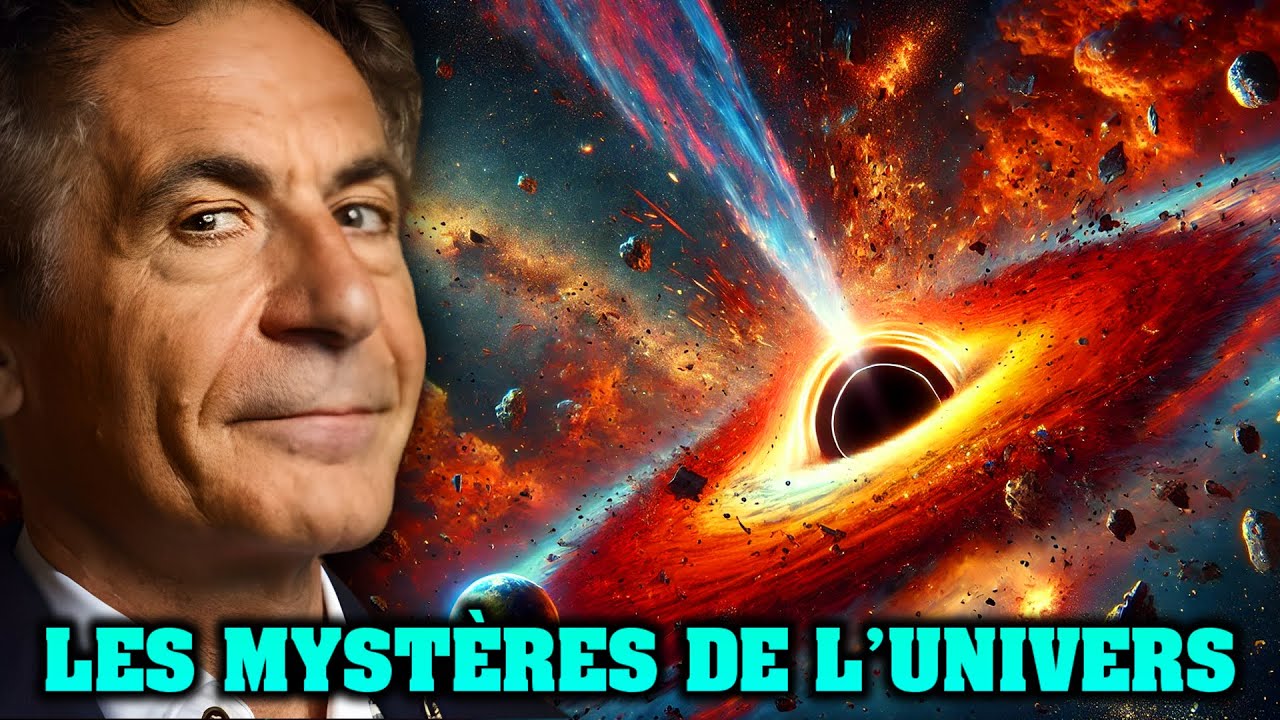
Etienne Klein - Les Mystères de l'Univers
Keywords
Summary
178 words
Critical Evaluation
The lecture by Etienne Klein is a masterclass in scientific communication, blending rigorous physics with philosophical insights. Klein’s ability to explain complex concepts such as the paradox of the night sky, gravitational waves, and dark energy in an accessible yet precise manner is commendable. He uses historical context to illustrate how scientific understanding evolves, from Kepler’s initial puzzle to modern cosmological discoveries. The argumentation is solid, grounded in well-established physics, and he clearly distinguishes between what is known, what is inferred, and what remains speculative. For instance, he explains that dark matter and dark energy are placeholders for phenomena we do not yet understand, and he discusses alternative theories like modified gravity. The lecture is well-structured, with a clear narrative that connects the apparent calm of the night sky to the violent processes occurring beyond our perception. Klein’s use of analogies, such as comparing the energy of a black hole merger to Hiroshima, makes the scale of cosmic events tangible. The sources cited are primarily his own knowledge and references to scientific missions like Euclid, which adds credibility. The title accurately reflects the content, as Klein indeed explores the mysteries of the universe. Overall, this is an excellent lecture that provides both information and inspiration, encouraging viewers to appreciate the depth of our ignorance and the excitement of scientific discovery.
220 words
Title / Content Match
The title accurately reflects the content, which explores various mysteries of the universe, including dark matter, dark energy, and the nature of cosmic violence.
Quality & Reliability
9/10
Etienne Klein, a renowned physicist and philosopher of science, delivers a rigorous yet accessible lecture. The content is scientifically accurate, well-structured, and based on established knowledge. The speaker's expertise and the absence of speculative claims enhance reliability.
Key Moments
Markers derived by PSI from the transcript: the creator did not define chapters.
- Introduction: Klein discusses the theme of sky and war, mentioning military satellites.
- Klein introduces the paradox of the night sky's darkness, referencing Kepler and Olbers.
- Explanation of how finite light speed and stellar lifetimes resolve the paradox.
- Discussion of how our limited vision hides infrared radiation, making the night sky appear dark.
- Introduction to violent cosmic events: black hole mergers and gravitational waves.
- Klein explains the detection of gravitational waves in 2016 and the energy involved.
- Introduction to dark matter and dark energy, and the Euclid telescope mission.
- Klein reflects on how scientific progress reveals our ignorance, with ordinary matter being only 4% of the universe.
- Conclusion: The universe is a place of permanent violence, contrary to ancient views.
Cited Sources
- Euclid mission — Klein mentions the Euclid telescope, launched by ESA, to study dark energy.
Concurring Sources
- Euclid mission — Klein's mention of Euclid aligns with ESA's official mission description.
Contribution & Novelties
The lecture provides a comprehensive overview of modern cosmology, emphasizing the hidden violence of the universe and the limits of human perception. It synthesizes historical paradoxes with contemporary discoveries, offering a unique perspective on how our understanding has evolved. Klein’s ability to connect philosophical reflections with hard science adds depth.
Pour aller plus loin :
- Olbers’ paradox — Historical context of the night sky paradox.
- Gravitational waves — Explanation of the phenomenon detected by LIGO.
- Dark energy — Overview of the mysterious force accelerating cosmic expansion.
86 words
Radar Profile
The radar profile shows high scores in information quantity, quality, and reliability, with a slightly lower technical level, indicating a lecture that is both informative and accessible.
💬 Très positif. Sur les 30 commentaires analysés, les spectateurs expriment une grande admiration pour la clarté et la profondeur de l'exposé, certains soulignant l'impact de la conclusion sur la nature violente de l'univers.