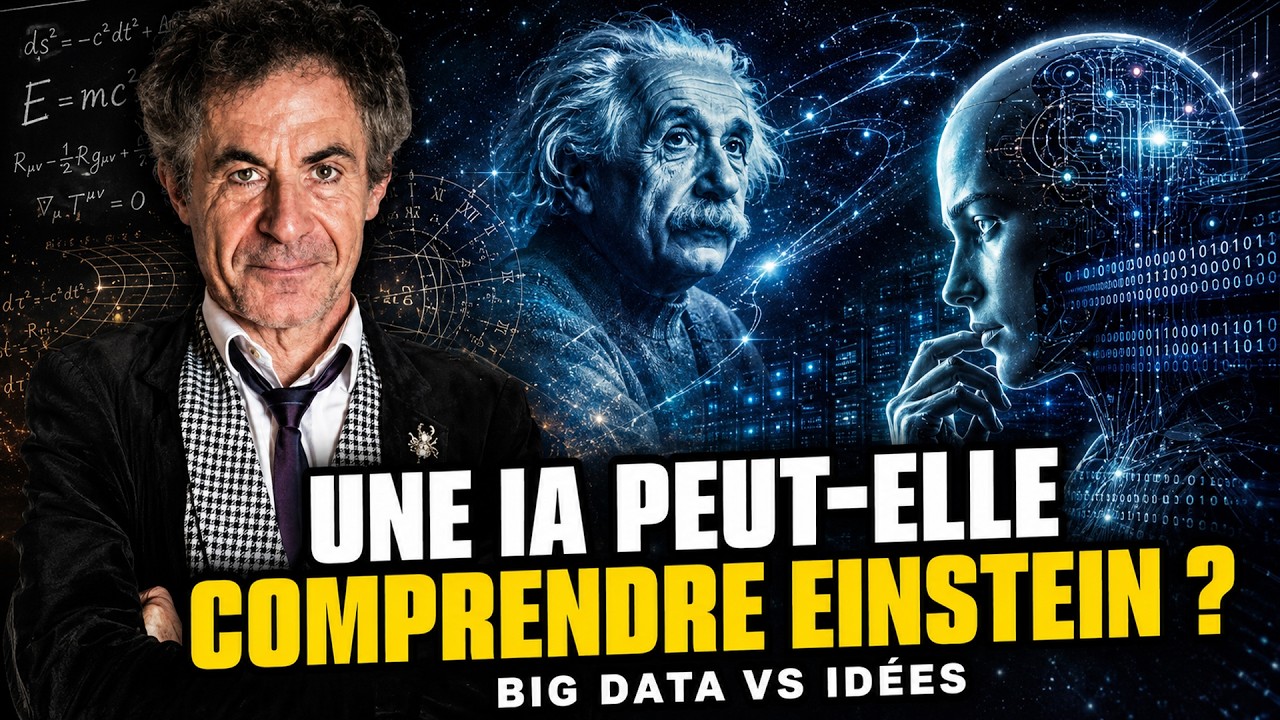
Etienne Klein - Pourquoi une IA ne pourra jamais découvrir la Relativité
Keywords
Summary
136 words
Critical Evaluation
Etienne Klein delivers a thought-provoking lecture that blends history, philosophy, and physics. His analysis of the semantic shift from ‘progress’ to ‘innovation’ is insightful, drawing on historical sources like Francis Bacon and Kant to show how our current rhetoric about innovation is rooted in a conservative view of time as corrupting. This provides a valuable perspective for engineers and scientists, encouraging them to reflect on the broader implications of their work. The discussion on Einstein’s thought experiments is compelling, illustrating how creative intuition and conceptual leaps are essential for major scientific breakthroughs. Klein’s argument that AI cannot replicate this process is persuasive, as he emphasizes the role of imagination and the ability to question fundamental assumptions. However, the lecture is somewhat disjointed, covering many topics without deep exploration of each. The title suggests a focus on AI and relativity, but these are only briefly addressed, which may disappoint viewers expecting a more detailed analysis. Additionally, while Klein’s credentials lend credibility, the lecture is an opinion piece rather than a rigorous scientific argument. The Q&A section touches on interesting philosophical questions but lacks depth. Overall, the lecture is intellectually stimulating and offers valuable insights, but it could benefit from a more structured approach and a clearer connection to the title.
209 words
Title / Content Match
The title focuses on AI and relativity, but the lecture covers broader topics including innovation, progress, and the nature of scientific discovery. The AI aspect is only a small part, making the title somewhat misleading.
Quality & Reliability
8/10
Etienne Klein, a renowned physicist and philosopher of science, delivers a well-structured lecture with historical references and philosophical depth. The content is based on his expertise and published works, though it is an opinion-based conference rather than a peer-reviewed study.
Chapters
- Introduction et présentation d'Étienne Klein
- L'abandon du mot "Progrès" au profit de "l'Innovation"
- Les origines de l'innovation (Francis Bacon et le temps corrupteur)
- Qu'est-ce que l'idée de Progrès (Kant, Condorcet, D'Alembert) ?
- Le rapport de la société aux nouvelles technologies (5G, Nucléaire)
- Le rôle des ingénieurs dans le débat public et le "Halo symbolique"
- "L'érotisme des problèmes" : Comment pense Albert Einstein ?
- Les expériences de pensée d'Einstein sur la lumière
- 1905, l'année miraculeuse et la relativité restreinte
- Le rôle du bureau des brevets dans la pensée d'Einstein
- L'idée la plus heureuse de sa vie : La chute libre
- Big Data vs Théorie : Pourquoi Galilée n'a jamais lâché d'objets de la Tour de Pise
- Une Intelligence Artificielle aurait-elle pu découvrir la relativité ?
- Le principe d'équivalence (accélération et gravitation)
- La courbure de la lumière, l'éclipse de 1919 et le périhélie de Mercure
- La relativité générale : La gravitation n'est pas une force
- FAQ 1 : Comment les ingénieurs peuvent-ils s'impliquer dans la société ?
- FAQ 2 : Le temps, l'entropie et l'irréversibilité (Boltzmann)
- FAQ 3 : La frontière entre physique, philosophie et saint Augustin
- FAQ 4 : Science, spiritualité et l'origine de l'univers
Cited Sources
- Francis Bacon - Of Innovation — Klein references Bacon's essay on innovation, which he discusses in the context of the historical meaning of the term.
- Immanuel Kant - What is Enlightenment? — Klein mentions Kant's ideas on progress and enlightenment.
- Vincent Bontems - Research on innovation — Klein mentions his colleague Vincent Bontems and their joint research on the history of the word 'innovation'.
Concurring Sources
- Albert Einstein - Relativity: The Special and General Theory — Klein's discussion of relativity aligns with Einstein's own explanations.
Dissenting Sources
- AI and scientific discovery — Some researchers argue that AI can aid in scientific discovery, contrary to Klein's claim that it cannot.
Contribution & Novelties
The lecture offers a unique perspective on the philosophical underpinnings of innovation versus progress, and argues that AI lacks the creative capacity for scientific discovery. It provides a historical context that is often missing in discussions about technology and society.
Pour aller plus loin :
- Thought experiment — Relevant to Einstein’s method.
- Principle of equivalence — Key concept in general relativity.
- Philosophy of science — Context for Klein’s arguments.
69 words
Radar Profile
The radar profile shows high scores in information quantity and quality, reflecting the depth of the lecture. The technical level is moderate, suitable for a general audience. The reliability is high due to Klein's expertise.
💬 Très positif : Les commentaires expriment une grande admiration pour Etienne Klein et la qualité de la conférence, avec des remerciements et des éloges sur sa pédagogie.