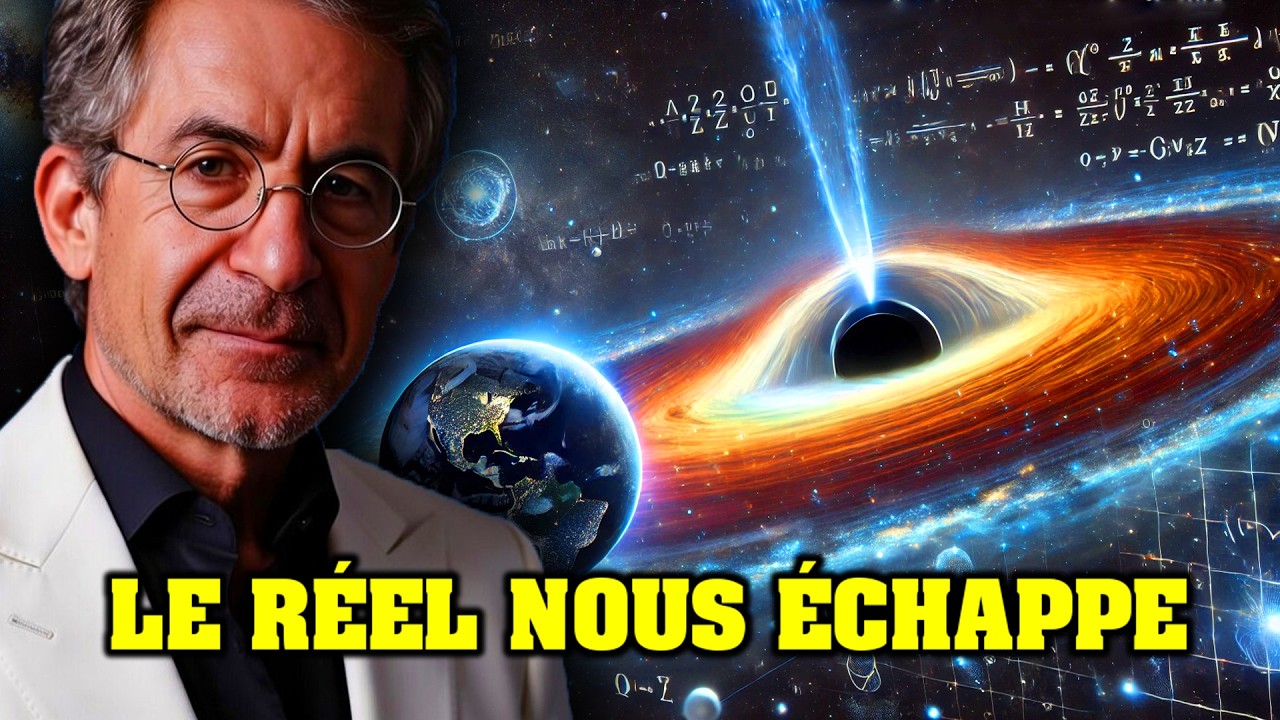
Étienne Klein : Quel avenir pour l'humanité dans l'Univers ?
Keywords
Summary
154 words
Critical Evaluation
The conference by Étienne Klein is a masterful blend of physics, philosophy, and popular science. Klein’s ability to explain complex concepts through relatable examples is commendable. He effectively demonstrates how our intuition is often at odds with physical laws, using the vacuum cleaner as a prime example: the miette is not ‘sucked’ but ‘pushed’ by air pressure differences. This illustrates a key theme: the laws of physics are hidden by the very phenomena they explain. Klein’s historical perspective, from Aristotle to Galileo, highlights the intellectual struggle required to move beyond appearances. He argues that Galileo’s genius lay in using thought experiments to imagine scenarios that contradict everyday experience, such as motion without friction. This methodological shift is crucial for scientific progress. The discussion on AI is particularly insightful; Klein correctly points out that while AI can handle vast amounts of data, it lacks the creativity to formulate novel concepts, as Einstein did with relativity. This is a nuanced view that avoids both techno-optimism and pessimism. The segment on Pangea Ultima is a sobering reminder of Earth’s long-term fate, but Klein presents it as a scientific fact rather than a doomsday prophecy. One minor critique is that the talk occasionally meanders, and some philosophical digressions may lose the audience. However, the overall coherence and depth of the content are impressive. The title, while broad, is justified by the range of topics covered. The talk is well-suited for a general audience interested in science and philosophy, but it also offers enough depth for those with a background in physics. The lack of visual aids is compensated by Klein’s engaging storytelling. In conclusion, this is a high-quality popular science lecture that successfully bridges the gap between technical physics and everyday understanding.
288 words
Title / Content Match
The title is somewhat broad and sensational, but the content does address the future of humanity in the universe, including topics like AI and Pangea Ultima.
Quality & Reliability
8/10
The speaker is a renowned physicist and philosopher, and the content is based on established physics concepts. The presentation is clear and well-structured, but it is a popular science talk rather than a peer-reviewed source.
Key Moments
Markers derived by PSI from the transcript: the creator did not define chapters.
- Introduction: Klein explains the dual meaning of 'physique' and the book's origin.
- Fosbury flop example: how physics allows jumping higher than one's center of gravity.
- Galileo's principles contradict everyday experience; the story of the bicycle and inertia.
- Ravel anecdote: inner music masks external music, metaphor for how the world masks universal laws.
- The need for thought experiments to uncover hidden laws; examples from Einstein.
- Vacuum cleaner example: the miette is pushed, not sucked, illustrating hidden forces.
- Discussion on AI: its capabilities and limitations compared to human genius.
- Pangea Ultima: the future supercontinent and its implications for humanity.
- The Moon as a 'hard drive' preserving traces of humanity.
- Science vs. research: the confusion and its impact on our relationship with truth.
Cited Sources
- Le meilleur d'Etienne Klein — Amazon affiliate link to books by Étienne Klein, likely including the book discussed.
- Le meilleur d'Aurélien Barrau — Amazon affiliate link to books by Aurélien Barrau, possibly related to cosmology.
- Le meilleur de Hubert Reeves — Amazon affiliate link to books by Hubert Reeves, astrophysicist.
- Le meilleur de Stephen Hawking — Amazon affiliate link to books by Stephen Hawking.
Concurring Sources
- Galileo Galilei — Klein's discussion of Galileo's principles aligns with established historical accounts.
- Pangaea Ultima — The concept of Pangea Ultima is a well-known scientific hypothesis.
Dissenting Sources
- No discordant sources found — The content is consistent with mainstream physics and philosophy.
Contribution & Novelties
The talk offers a fresh perspective on how physics challenges our intuition, using vivid examples. It bridges the gap between abstract laws and everyday phenomena, making complex ideas accessible. The discussion on AI’s limitations in scientific creativity is particularly relevant. The concept of Pangea Ultima provides a long-term view of Earth’s future, which is rarely discussed in popular science.
Pour aller plus loin :
- Galileo Galilei — For more on the father of modern science and his methods.
- Thought experiment — To understand the role of thought experiments in physics.
- Pangea Ultima — For details on the future supercontinent.
- Artificial intelligence — To explore the capabilities and limits of AI.
110 words
Radar Profile
The radar profile shows high scores in information quantity and quality, reflecting the depth and accuracy of the content. The technical level is moderate, suitable for a general audience, while reliability is high due to the speaker's expertise.
💬 No comments were provided for analysis.