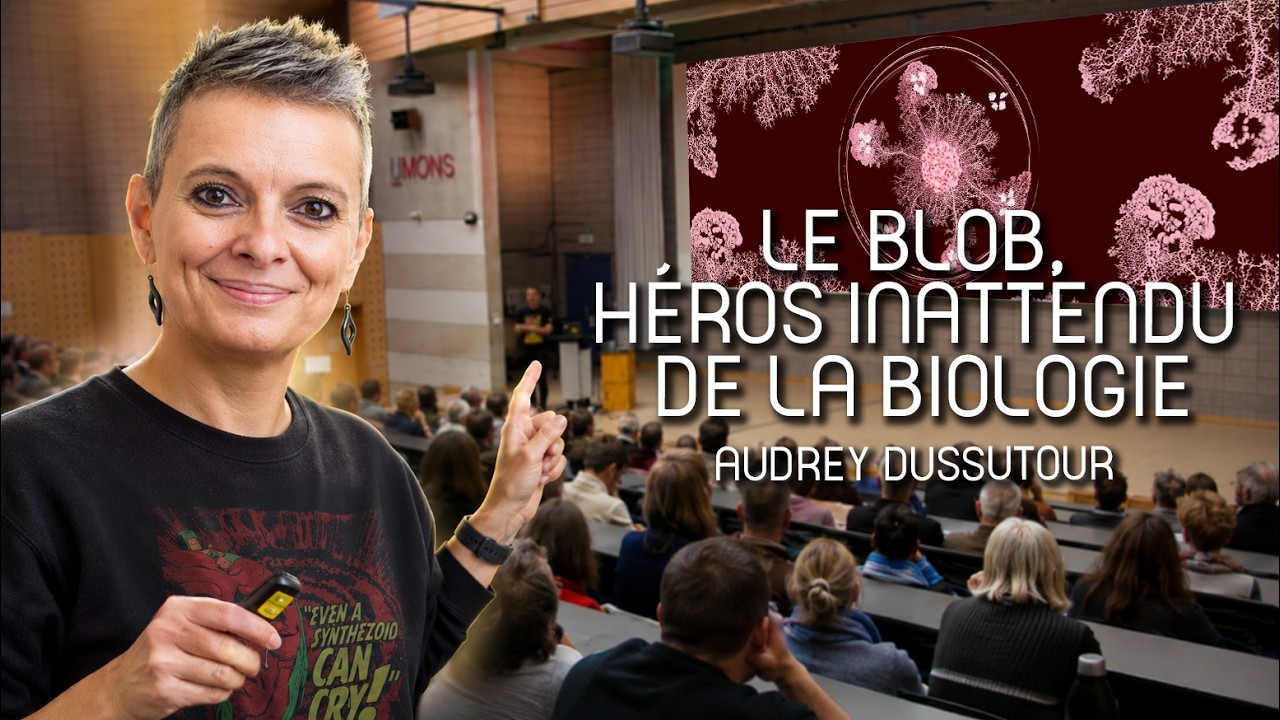
Le Blob est-il intelligent ?
Keywords
Summary
187 words
Critical Evaluation
Value of the Information & Strength of the Argument
The talk provides valuable insights into the blob’s biology and cognitive abilities, supported by the speaker’s expertise and research. The argumentation is solid, with clear explanations and examples. Dussutour effectively communicates complex scientific concepts in an accessible manner, using anecdotes and visual aids. She also addresses common misconceptions and provides evidence for the blob’s intelligence, such as habituation experiments and the ability to solve mazes. The talk is well-structured and engaging, making a strong case for the blob as a model organism in cognitive research.
94 words
Title / Content Match
The title accurately reflects the content, as the talk explores the blob's cognitive abilities and intelligence, concluding that while it lacks a brain, it exhibits learning and memory.
Quality & Reliability
9/10
The speaker is a CNRS research director and recognized specialist in animal behavior, with a strong track record of publications on the blob. The talk is a science communication lecture, but the content is accurate and well-supported by her expertise. The presentation is engaging and accessible, but the scientific depth is moderate, with some simplifications for a general audience.
Key Moments
Markers derived by PSI from the transcript: the creator did not define chapters.
- Introduction and anecdote about the blob in Texas
- Explanation of the blob's classification and biology
- Description of the blob's life cycle and reproduction
- Discussion of the blob's abilities: learning, memory, and problem-solving
- Experiments on habituation and memory transfer
- The blob in space: ISS experiments
- Educational applications and citizen science
- Conclusion and Q&A session
Cited Sources
- Audrey Dussutour's research profile — Mentioned as the speaker's professional background
Concurring Sources
- Audrey Dussutour's research on slime molds — CNRS profile confirming her expertise
Contribution & Novelties
The talk provides a comprehensive overview of the blob’s biology and cognitive abilities, synthesizing current research and presenting it in an accessible way. It highlights recent findings on learning and memory in a brainless organism, which challenges traditional notions of intelligence. The speaker also discusses the blob’s potential applications in education and materials science.
Pour aller plus loin :
- Physarum polycephalum on Wikipedia — Overview of the species and its characteristics.
- Slime mold on Wikipedia — General information on slime molds, including their classification and behavior.
- Amoebozoa on Wikipedia — Details on the group to which the blob belongs.
- Audrey Dussutour’s publications — Note: URL not verified; search for her publications on Google Scholar.
114 words
Radar Profile
The radar profile shows high scores in information quality and reliability, with moderate technical level and quantity. This indicates a well-balanced talk that is scientifically sound but accessible to a general audience.
💬 No comments were provided for analysis.