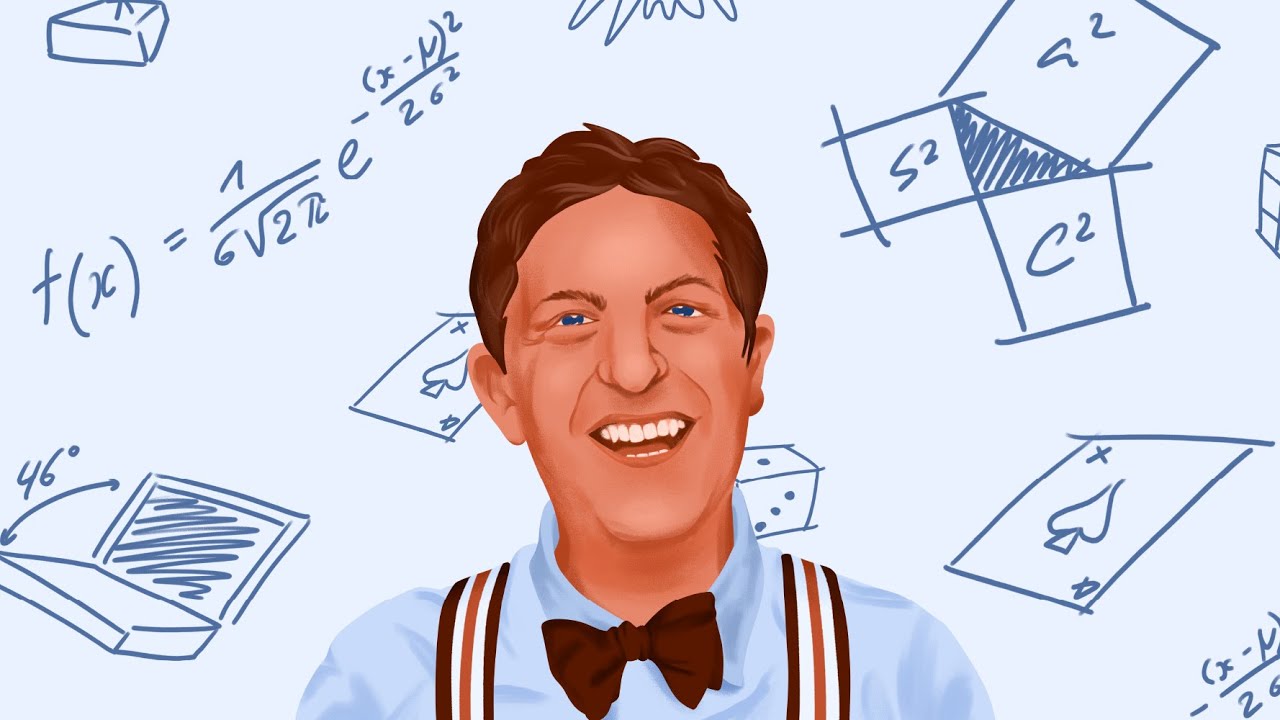
42 Fun Facts pour (enfin !) adorer les maths
Keywords
Summary
173 words
Critical Evaluation
Value of the Information & Strength of the Argument
The talk provides a valuable introduction to several mathematical concepts, particularly the notion of different sizes of infinity, which is often counterintuitive. Houdart’s argumentation is clear and engaging, using relatable examples and audience participation to illustrate abstract ideas. He effectively demonstrates that mathematics is not a cold, rigid discipline but a tool for understanding the world and a source of wonder. The historical anecdotes add depth and context, making the content more memorable.
Scientific Rigor, Source Quality, Title Accuracy
The scientific rigor is generally high, with accurate explanations of concepts like bijections and countable infinities. Houdart cites historical figures such as Georg Cantor and Leopold Kronecker, and references the origin of mathematical notation. The title accurately reflects the content, as the talk is indeed a collection of fun facts about mathematics. The speaker’s credentials as a former math teacher and science communicator lend credibility to the presentation.
156 words
Title / Content Match
The title accurately reflects the content: a collection of fun facts and anecdotes designed to make mathematics appealing.
Quality & Reliability
8/10
The speaker is a former math teacher and science communicator with a strong background. The content is largely accurate and well-explained, with occasional simplifications for a general audience. The talk is based on the speaker's book and includes historical anecdotes and mathematical concepts.
Key Moments
Markers derived by PSI from the transcript: the creator did not define chapters.
- Introduction and presentation of the speaker's background.
- Explanation of the significance of the number 42 and reference to Douglas Adams.
- Discussion on the difference between digits and numbers, and the Indian origin of numerals.
- Introduction to counting without numbers using pebbles, origin of the word 'calculation'.
- Introduction to Georg Cantor and the concept of different sizes of infinity.
- Demonstration that there are as many even numbers as natural numbers via bijection.
- Discussion on countable and uncountable infinities, and the countability of rational numbers.
- Further examples and anecdotes about mathematical history and notation.
- Conclusion and emphasis on the playful side of mathematics.
Cited Sources
- 42 Fun Facts pour (enfin !) adorer les maths — The book by Manu Houdart that the conference is based on.
- Very Math Trip — The speaker's show, mentioned as his main activity.
Concurring Sources
- Georg Cantor — Wikipedia article on Cantor, whose work on infinity is discussed in the talk.
- Countable set — Wikipedia article explaining countable sets, a key concept in the talk.
Contribution & Novelties
The talk offers a fresh and engaging perspective on mathematics, making it accessible and enjoyable for a general audience. It highlights the historical and cultural aspects of mathematical concepts, such as the origin of numerals and the story of Cantor. The use of visual aids and audience interaction enhances the learning experience.
Pour aller plus loin :
- Georg Cantor — Background on the mathematician who developed set theory and the concept of different infinities.
- Countable set — Explanation of countable and uncountable sets, central to the talk’s discussion.
- The Hitchhiker’s Guide to the Galaxy — The novel that popularized the number 42 as the answer to life, the universe, and everything.
111 words
Radar Profile
The radar profile shows high scores in quantity and quality of information, with a moderate technical level, indicating a well-balanced presentation suitable for a general audience. The reliability is also high, reflecting the speaker's expertise.
💬 No comments were provided for analysis.