Organiza tus recursos digitales
Keywords
Summary
176 words
Critical Evaluation
Value of the Information & Strength of the Argument
The video provides valuable practical guidance on prompt engineering, a crucial skill for effective AI use. The instructor clearly explains the three techniques and their applications, supported by real-world examples from students. The argumentation is coherent and builds logically from basic concepts to more advanced techniques. The inclusion of an expert video adds depth, though the discussion remains at an introductory level. The interactive format enhances engagement and reinforces learning through peer experiences.
Scientific Rigor, Source Quality, Title Accuracy
The scientific rigor is moderate: the content is accurate but not deeply technical. The instructor cites established techniques and mentions specific AI tools (ChatGPT, Claude, Gemini) without providing detailed sources. The embedded video by Nicolás Franco is a credible source, but no formal references are given. The title ‘Organiza tus recursos digitales’ does not accurately reflect the content, which is about prompt engineering, potentially misleading viewers. The video is well-structured and pedagogically sound, but lacks citations and in-depth analysis.
167 words
Title / Content Match
The title 'Organiza tus recursos digitales' is somewhat misleading as the video focuses on prompt engineering, not on organizing digital resources. However, it may refer to organizing AI resources effectively.
Quality & Reliability
7/10
The video is a structured educational session on prompt engineering, presenting established techniques (zero-shot, few-shot, chain-of-thought) and comparing AI tools. The content is accurate and pedagogically sound, though it lacks in-depth technical detail and relies on anecdotal examples. The embedded expert video adds credibility, but the overall scientific depth is moderate.
Key Moments
Markers derived by PSI from the transcript: the creator did not define chapters.
- Introduction and class rules
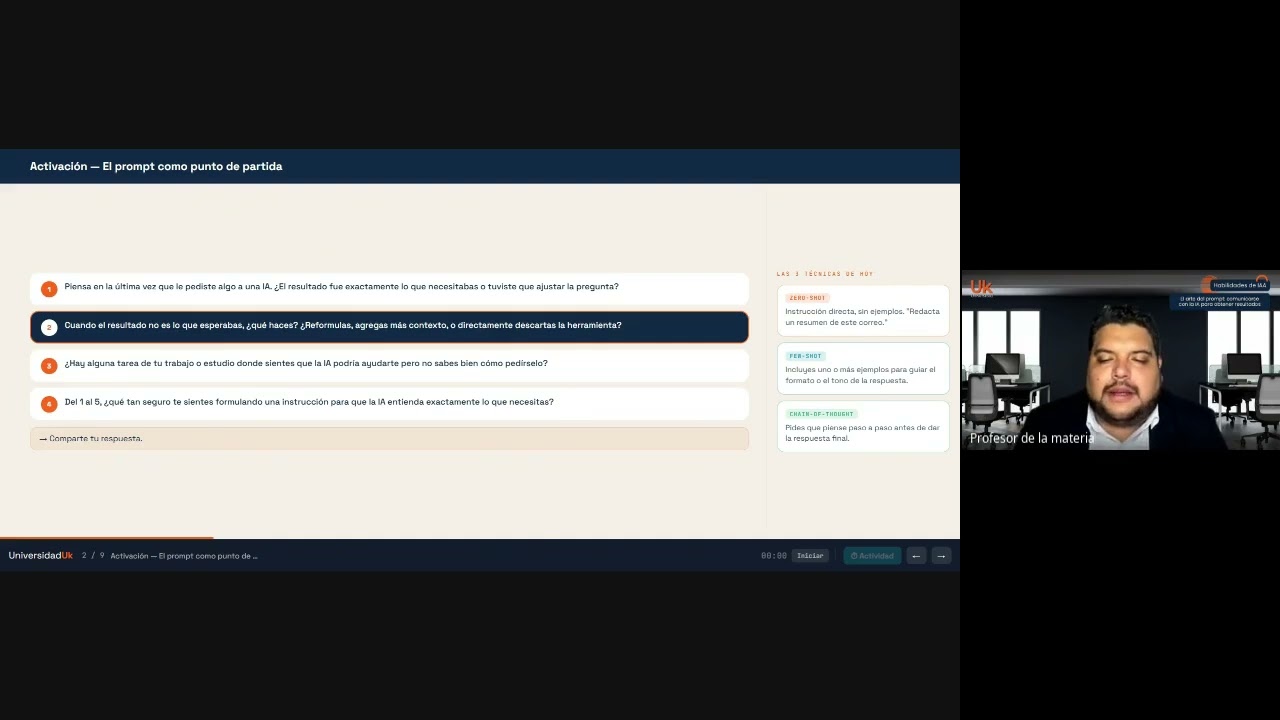
- Introduction to prompt engineering and its importance
- Activity: sharing experiences with AI prompts
- Explanation of zero-shot, few-shot, and chain-of-thought techniques
- Discussion on diagnosing and comparing prompting techniques
- Embedded video: 'Will AI surpass human intelligence?' by Nicolás Franco
- Comparison of AI tools (ChatGPT, Claude, Gemini) responses
- Wrap-up and final recommendations
Cited Sources
- Nicolás Franco video on AI vs human intelligence — Embedded video shown during the class to stimulate reflection on AI capabilities.
Concurring Sources
- OpenAI Prompt Engineering Guide — Official guide from OpenAI on best practices for prompt engineering, aligning with the techniques discussed.
Dissenting Sources
- Critique of chain-of-thought prompting — Some researchers argue that chain-of-thought may not always improve reasoning and can be inconsistent, contrasting with the video's positive portrayal.
Contribution & Novelties
The video offers a practical, classroom-based approach to learning prompt engineering, emphasizing interactive participation and real-world examples. It provides a clear comparison of three prompting techniques and demonstrates their application across different AI platforms. The inclusion of an expert video adds a philosophical dimension, encouraging critical thinking about AI’s potential.
Pour aller plus loin :
- Prompt engineering guide — Comprehensive resource on prompt engineering techniques.
- Chain-of-thought prompting paper — Original research on chain-of-thought prompting.
- Zero-shot learning — Overview of zero-shot learning in AI.
83 words
Radar Profile
The radar profile shows balanced scores across information quantity, quality, and reliability, with a lower technical level. This indicates a well-rounded introductory tutorial that is reliable and informative but not deeply technical, suitable for beginners.
💬 No comments were provided for analysis.