Fuentes confiables y cómo evaluarlas
Keywords
Summary
160 words
Critical Evaluation
Value of the Information & Strength of the Argument
The video provides practical insights from students and the professor about real-world AI usage, highlighting common issues like bias, privacy concerns, and ethical dilemmas. The argumentation is based on personal experiences and anecdotal evidence rather than rigorous scientific studies, which limits its depth. However, the discussion is valuable for raising awareness and encouraging critical thinking about AI’s societal impact. The professor’s guidance is pragmatic, emphasizing the need for verification and ethical judgment, but the lack of concrete examples or data weakens the overall argumentation.
Scientific Rigor, Source Quality, Title Accuracy
The video does not cite specific academic sources or studies, relying instead on personal anecdotes and general knowledge. The title ‘Fuentes confiables y cómo evaluarlas’ is not fully accurate, as the content focuses more on AI ethics and bias than on evaluating sources. The video includes a clip from an executive (Efraín) but does not provide his full name or credentials, reducing its reliability. The discussion is more conversational than scientific, with no formal citations or references. The title-content alignment is weak, as the video does not systematically address how to evaluate reliable sources.
193 words
Title / Content Match
The title 'Fuentes confiables y cómo evaluarlas' (Reliable sources and how to evaluate them) is somewhat misleading, as the video primarily discusses AI biases, privacy, and ethics, not specifically source evaluation. The title is only partially aligned with the content.
Quality & Reliability
6/10
The video is a university lecture on responsible AI, focusing on biases, privacy, and ethics. It includes student interactions and a video by an executive, but lacks formal citations and rigorous scientific depth. The content is practical and experiential, but not highly reliable for technical accuracy.
Key Moments
Markers derived by PSI from the transcript: the creator did not define chapters.
- Introduction and session rules
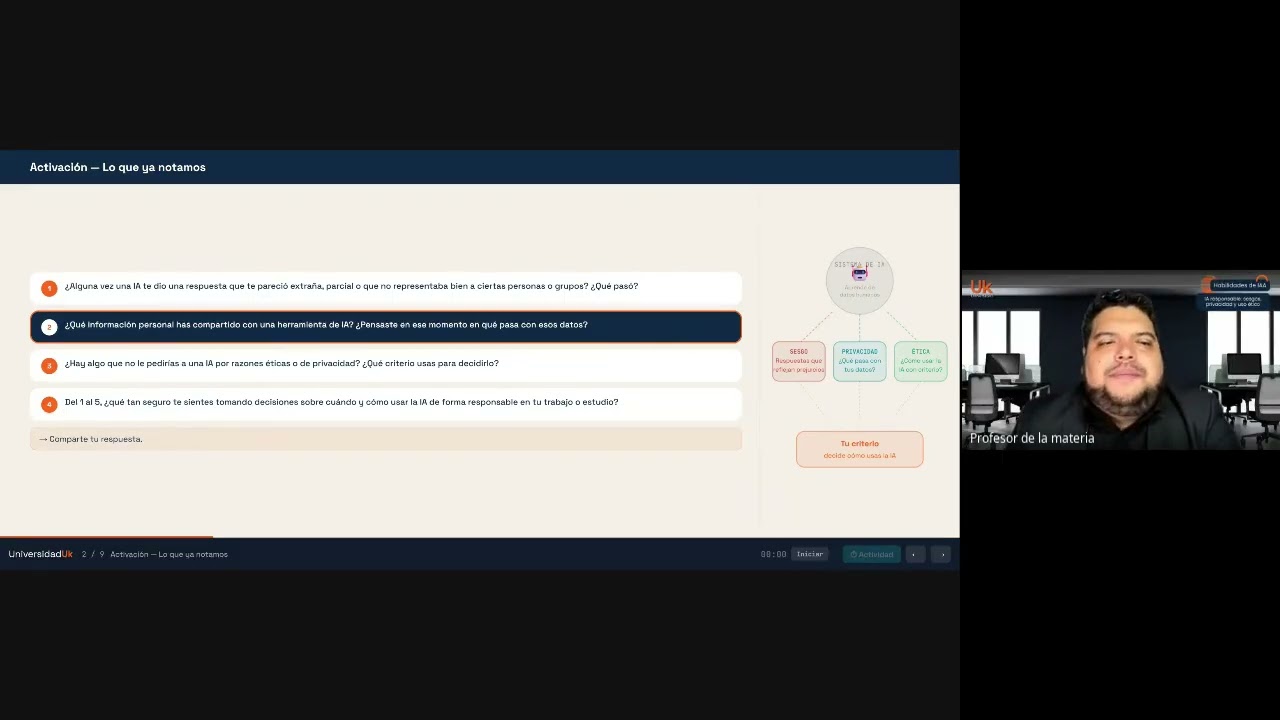
- Discussion on AI giving strange or biased responses
- Students share experiences with sharing personal information with AI
- Discussion on ethical boundaries and what not to ask AI
- Student examples of using AI for work and the importance of verification
- Introduction to algorithmic bias and a video by an executive
- Video on AI replicating human decisions and responsibilities
- Conclusion on forming ethical criteria and detecting risks
Cited Sources
- Video by Efraín (executive from Google, Disney, TikTok) — Shown during the lecture to illustrate algorithmic bias
Concurring Sources
- AI Ethics — General principles of AI ethics align with the video's discussion.
- Algorithmic bias — The video's discussion on bias is consistent with this concept.
Contribution & Novelties
The video offers a practical, classroom-based perspective on responsible AI, emphasizing real-world experiences and ethical considerations. It highlights the importance of critical thinking and verification when using AI tools. The discussion on privacy and bias is relevant but not novel, as these topics are widely covered in AI ethics literature.
Pour aller plus loin :
- AI Ethics — Overview of ethical issues in AI.
- Algorithmic bias — Explanation of biases in AI systems.
- Data privacy — Concepts and regulations related to data protection.
83 words
Radar Profile
The radar profile shows moderate scores across all dimensions, indicating a balanced but not highly rigorous content. The video is more practical than technical, with moderate information quantity and quality, and a moderate reliability score.
💬 Sur les 0 commentaires analysés, aucune tendance n'est disponible.