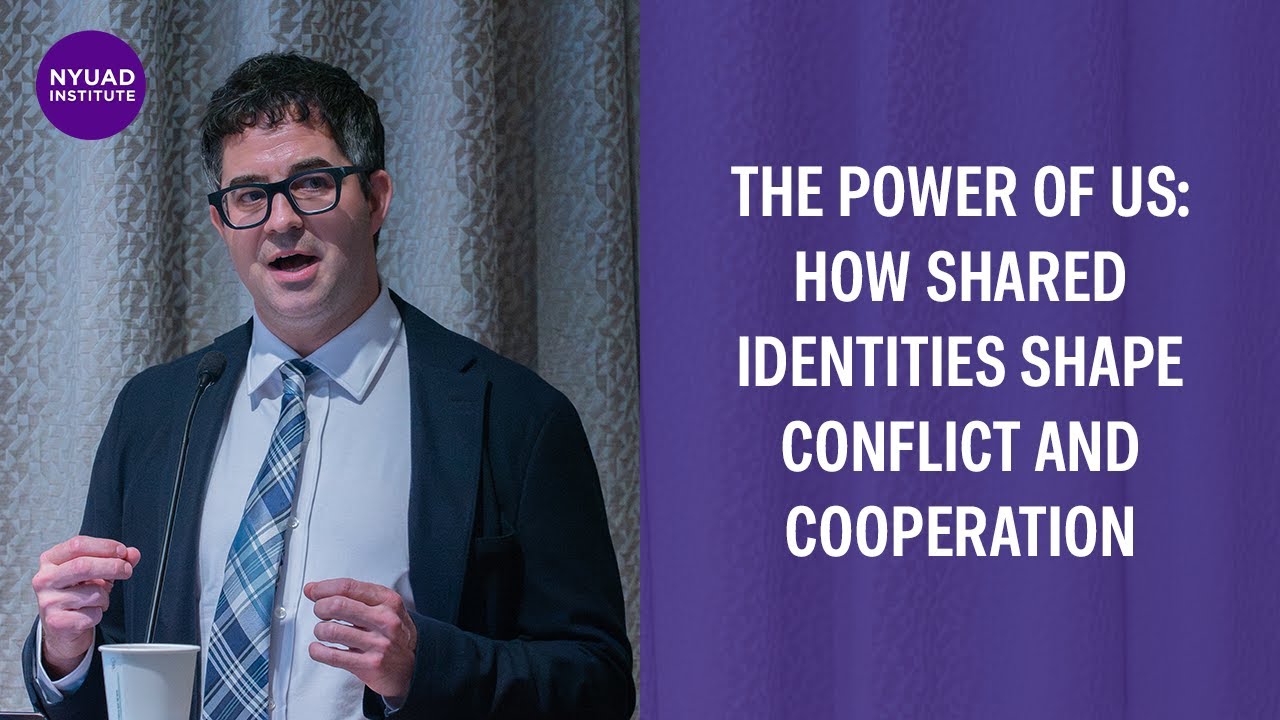
The Power of Us: How Shared Identities Shape Conflict and Cooperation
Keywords
Summary
156 words
Critical Evaluation
Value of the Information & Strength of the Argument
The talk provides valuable insights into the psychological mechanisms of group identity and their implications for societal issues. Van Bavel effectively argues that identity is a powerful lens through which we perceive the world, influencing our emotions, beliefs, and actions. He supports his claims with a mix of classic studies (e.g., Tajfel) and his own research, including neuroimaging data. The argumentation is coherent and persuasive, though some claims are simplified for a general audience. The use of real-world examples (e.g., the Dassler brothers, COVID-19) makes the content relatable and compelling.
Scientific Rigor, Source Quality, Title Accuracy
The talk demonstrates strong scientific rigor, drawing on peer-reviewed research and established theories. Van Bavel cites specific studies and authors, such as Tajfel and E.O. Wilson, and references his own publications. The sources are credible and relevant. The title accurately reflects the content, focusing on the dual role of shared identities in fostering cooperation and conflict. The talk is well-structured and the speaker’s expertise is evident. However, as a public lecture, it lacks detailed citations and some nuances are lost.
185 words
Title / Content Match
The title accurately reflects the content, focusing on how shared identities influence conflict and cooperation.
Quality & Reliability
8/10
The speaker is a renowned professor of psychology and neuroscience at NYU, with extensive publications and awards. The talk is based on established research in social psychology and cognitive science, including his own peer-reviewed studies. However, it is a public lecture aimed at a general audience, so some simplifications and anecdotal evidence are present.
Key Moments
Markers derived by PSI from the transcript: the creator did not define chapters.
- Introduction of the speaker by Michael Perugan, highlighting Van Bavel's credentials.
- Story of the Dassler brothers and the creation of Adidas and Puma, illustrating arbitrary group divisions.
- Discussion of Henri Tajfel's minimal group paradigm and its implications for discrimination.
- Van Bavel's research showing that group identity can override racial bias in evaluations and memory.
- Application of identity dynamics to political polarization, noting increased outgroup animosity.
- How identity influences belief in misinformation, with examples from COVID-19 and fake news.
- The role of social media in amplifying outrage and spreading false information, introducing the MAD model.
- Conclusion on harnessing shared identities for positive cooperation and addressing global challenges.
Cited Sources
- NYUAD Institute — Mentioned in the description as the organizing body for the talk.
- 19 Washington Square North — Venue of the talk, mentioned in the introduction.
- NYUAD Institute Event Mailing List — Provided in the description for audience to stay informed.
Concurring Sources
- Tajfel, H., & Turner, J. C. (1979). An integrative theory of intergroup conflict. — Classic work on social identity theory, consistent with the talk's themes.
- Van Bavel, J. J., & Pereira, A. (2018). The partisan brain: An identity-based model of political belief. — Research on how identity shapes political beliefs, aligning with the talk's arguments.
Dissenting Sources
- No discordant sources found. — The talk is based on well-established research and does not present controversial claims.
Contribution & Novelties
The talk synthesizes existing research on social identity and applies it to contemporary issues like polarization and misinformation. Van Bavel presents his own studies, including neuroimaging work, showing that group identity can override racial bias. He introduces the MAD model (Motivation, Amplification, Dissemination) to explain the spread of outrage on social media. The talk offers a hopeful perspective on using shared identities to foster cooperation.
Pour aller plus loin :
- Social Identity Theory — Foundational theory by Henri Tajfel and John Turner.
- Minimal group paradigm — Experimental method used to study ingroup favoritism.
- The Power of Us: Harnessing Our Shared Identities to Improve Performance, Increase Cooperation, and Promote Social Harmony — Book by Jay Van Bavel and Dominic Packer (note: URL is a placeholder, not verified).
126 words
Radar Profile
The radar profile shows high scores in information quantity and quality, reflecting the speaker's expertise and the depth of content. The technical level is moderate, suitable for a general audience. The overall reliability is high due to the credible sources and peer-reviewed research cited.
💬 Sur les 0 commentaires analysés, aucune tendance n'est disponible.