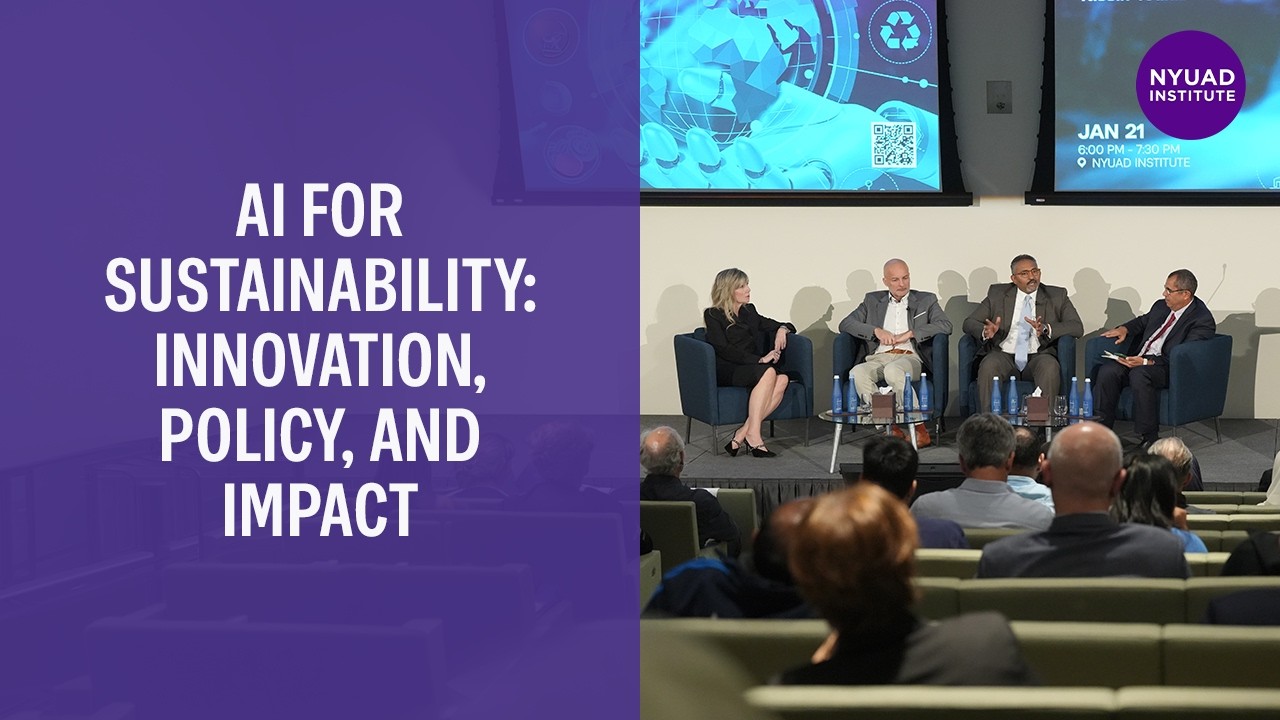
AI for Sustainability: Innovation, Policy, and Impact
Keywords
Summary
169 words
Critical Evaluation
Value of the Information & Strength of the Argument
The value of the information lies in its practical insights from industry experts. Dr. Freissmuth’s keynote provides a compelling vision of AI as a catalyst for sustainability, using concrete examples like life cycle assessment and carbon nanotube applications. The panel discussion adds depth by addressing the paradox of AI’s resource consumption and its potential to solve environmental challenges. The argumentation is generally sound, though some claims lack rigorous evidence. For instance, the assertion that AI can simulate plasma for fusion energy ’thousand times faster’ is plausible but not detailed. The speakers effectively argue that AI is not just a tool but a necessary component for sustainable development, and they stress the importance of governance and ethical considerations. However, the discussion remains at a high level, with limited technical depth, and some statements are more aspirational than evidence-based.
Scientific Rigor, Source Quality, Title Accuracy
The scientific rigor is moderate. The speakers reference concepts like planetary boundaries, life cycle assessment, and carbon capture, but they do not provide specific citations or data sources. The title accurately reflects the content, which covers AI’s role in sustainability, policy, and impact. The discussion is well-structured, but the lack of formal references reduces its scientific credibility. The panelists are credible professionals, but their statements are largely anecdotal or based on general knowledge. The event is designed for a broad audience, which may explain the lack of technical depth. Overall, the content is informative but not rigorously sourced.
250 words
Title / Content Match
The title accurately reflects the content, which covers AI applications in sustainability, policy implications, and impact across sectors.
Quality & Reliability
7/10
The discussion features expert speakers with relevant backgrounds, but it is a panel discussion with limited depth and no formal citations. Claims are plausible but not rigorously verified.
Key Moments
Markers derived by PSI from the transcript: the creator did not define chapters.
- Introduction by moderator Yassin Yassin, setting the stage for the discussion.
- Keynote by Dr. Harald Freissmuth begins, introducing the concept of 'sustainability by design'.
- Dr. Freissmuth discusses AI's role in life cycle assessment and the complexity of quantifying product impacts.
- Panel discussion starts; Amro Zakaria highlights the paradox of AI's resource consumption and benefits.
- Christen Bear shares insights on AI companies moving to the UAE and the region's role as an AI hub.
- Discussion on AI's potential in fusion energy and the importance of policy and governance.
- Closing remarks and call for collaboration between stakeholders.
Cited Sources
- NYUAD Institute Research — Mentioned as the host institution for the event.
- NYUAD Institute Event Mailing List — Provided for audience to stay informed about future events.
Concurring Sources
- International Energy Agency (IEA) — Referenced indirectly for predictions on energy consumption and AI data centers.
Contribution & Novelties
The event provides a timely overview of AI’s applications in sustainability, emphasizing the concept of ‘sustainability by design’ and the need for systemic change. It highlights the UAE’s role as a leader in AI and sustainability, offering a regional perspective. The discussion underscores the importance of integrating AI into policy and finance for sustainable development.
Pour aller plus loin :
- Industry 5.0 — Contextualizes the human-centric and sustainable approach to industry.
- Life-cycle assessment — Explains the methodology for assessing environmental impacts.
- Carbon nanotube — Discusses the material properties and potential applications mentioned in the keynote.
95 words
Radar Profile
The radar profile shows moderate scores across all dimensions, with slightly higher scores in information quantity and quality. The technical level is lower, reflecting the broad audience. The overall reliability is moderate, consistent with a panel discussion format.