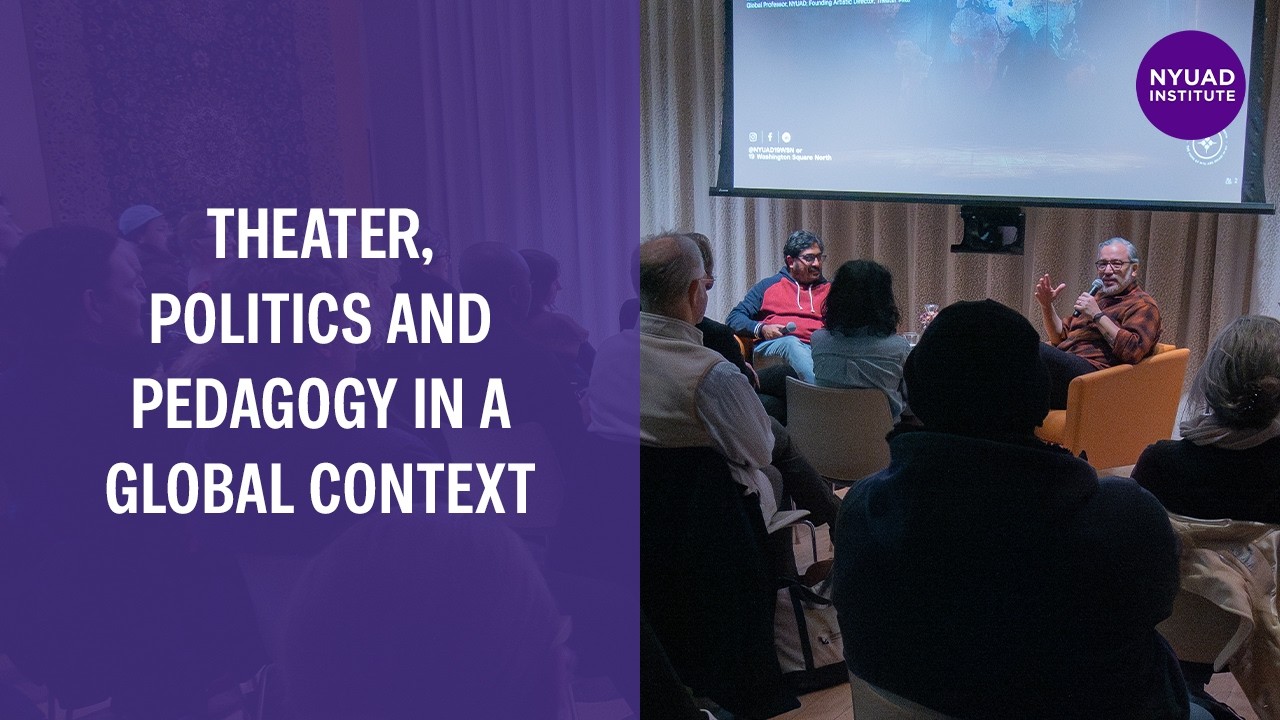
Theater, Politics and Pedagogy in a Global Context
Keywords
Summary
167 words
Critical Evaluation
Value of the Information & Strength of the Argument
The value of the information lies in the unique perspectives of two seasoned theater artists who have navigated cross-cultural and interdisciplinary landscapes. Their arguments are built on personal experience and professional practice, offering insights into the practical challenges of theater-making in global contexts. However, the argumentation is largely anecdotal, lacking systematic evidence or theoretical frameworks. The speakers engage in a dynamic exchange, but the discussion remains at an exploratory level rather than providing concrete solutions or rigorous analysis.
Scientific Rigor, Source Quality, Title Accuracy
The scientific rigor is moderate; the speakers are credible experts, but they do not cite specific sources or studies. The quality of sources is limited to their own publications and institutional affiliations. The title accurately reflects the content, focusing on theater, politics, and pedagogy in a global context. The discussion is coherent and well-structured, but it lacks empirical grounding. No comments were provided for analysis.
158 words
Title / Content Match
The title accurately reflects the content, which centers on theater, politics, and pedagogy within a global framework.
Quality & Reliability
8/10
The conversation features two established theater practitioners and educators with extensive international experience. They provide personal insights and professional reflections, but the content is largely anecdotal and lacks empirical evidence or citations. The institutional context (NYUAD) adds credibility, but the discussion is not peer-reviewed.
Key Moments
Markers derived by PSI from the transcript: the creator did not define chapters.
- Introduction of speakers and topic by Katherine Corey.
- Ruben Polendo introduces the concept of 'borderlandness' and its relevance to his identity and work.
- Abhishek Majumdar shares personal stories about borders in South Asia and the fluidity of identity.
- Discussion on the arbitrary nature of disciplinary and cultural divisions in theater.
- Ruben Polendo reflects on the evolution of his work and the importance of building rather than conforming.
- Abhishek Majumdar talks about his journey from the Indian Ensemble to Nalanda Arts Studio and the concept of family in theater.
- Challenges of building theater programs in resource-rich environments like NYU Abu Dhabi.
- Discussion on the redefinition of the playwright/director role to include building and community engagement.
- The role of theater in conflict zones and its political impact.
- Closing reflections on the future of theater education and global collaboration.
Cited Sources
- NYU Abu Dhabi Institute — Mentioned as the organizing institution for the talk.
- 19 Washington Square North — Venue for the event, described as a gateway for scholarly connectivity.
- NYUAD Institute Mailing List — Provided for audience to stay informed about future events.
Concurring Sources
- Theatre Across Borders — Book by Abhishek Majumdar, referenced as a key publication.
- Theater Mitu — Company founded by Ruben Polendo, mentioned as an example of global theater practice.
Contribution & Novelties
The conversation offers a unique perspective on theater pedagogy from two practitioners who have worked across multiple cultural and disciplinary borders. It challenges conventional divisions in theater and emphasizes the importance of building inclusive, community-oriented practices. The dialogue provides practical insights into the challenges of theater education in a globalized context, particularly in the Middle East.
Pour aller plus loin :
- Theatre Across Borders — Abhishek Majumdar’s book, central to the discussion.
- Theater Mitu — Ruben Polendo’s company, exemplifying cross-cultural collaboration.
- Applied Theatre — A field related to theater’s social and political impact, relevant to the discussion.
97 words
Radar Profile
The radar profile shows high scores in quantity and quality of information, reflecting the rich experiential content. The technical level is moderate, as the discussion is accessible but not deeply theoretical. Reliability is high due to the speakers' expertise, though the lack of citations slightly lowers it.