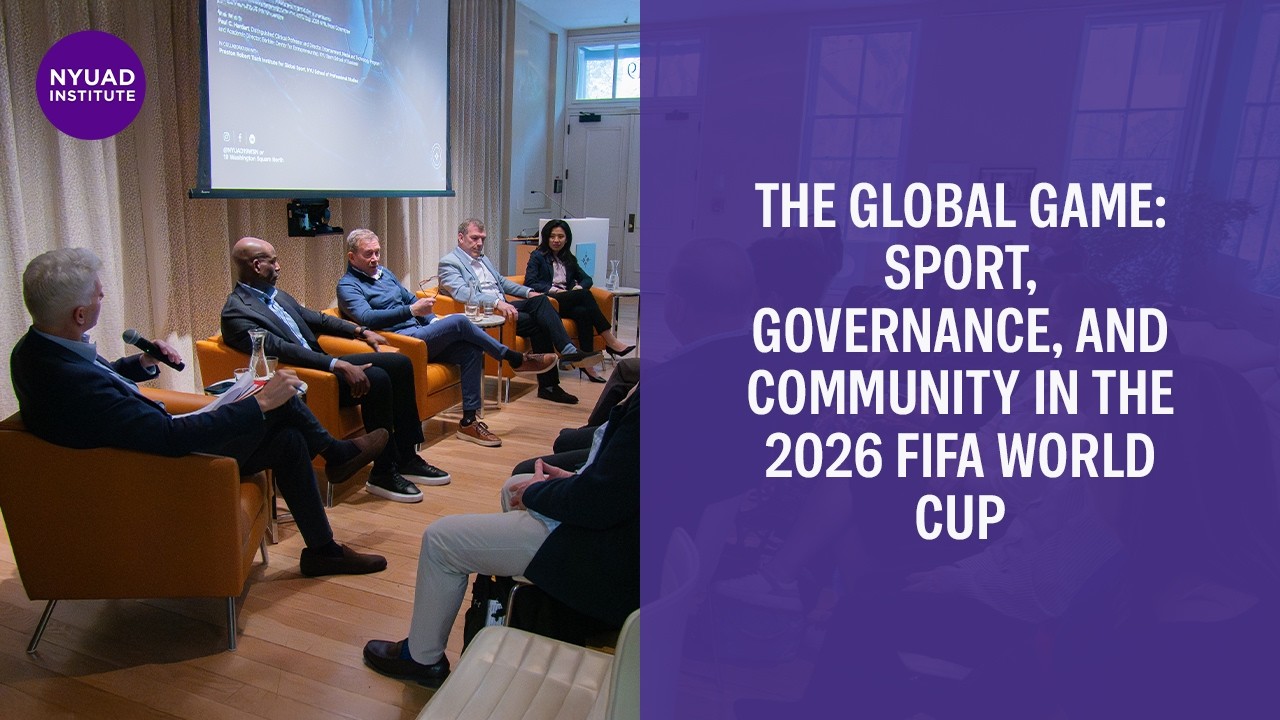
The Global Game: Sport, Governance, and Community in the 2026 FIFA World Cup
Keywords
Summary
163 words
Critical Evaluation
Value of the Information & Strength of the Argument
The panel provides valuable insider perspectives on the operational, political, and commercial aspects of hosting a mega-event like the World Cup. The arguments are grounded in direct experience: Bruce Revman’s detailed account of the bid and preparation process, Sophia Cai’s political analysis based on her reporting, and Dominic Curran’s insights into brand strategy. The discussion is coherent and well-moderated, with each panelist contributing distinct expertise. However, the arguments are largely anecdotal and lack empirical data or formal citations, which limits their generalizability. The panel does not engage deeply with potential criticisms or negative impacts of hosting the World Cup, such as cost overruns or displacement, which would have strengthened the argumentation.
Scientific Rigor, Source Quality, Title Accuracy
The panel demonstrates a high level of expertise, with participants directly involved in World Cup organization, sports business, and political journalism. However, the discussion is informal and does not reference specific studies or reports, relying instead on personal experience and general knowledge. The title accurately reflects the content, covering sport, governance, and community aspects. The sources cited in the description are institutional links to NYUAD, which are relevant but not directly used to support the discussion. Overall, the scientific rigor is moderate, typical of a panel discussion rather than a formal academic presentation.
219 words
Title / Content Match
The title accurately reflects the discussion on sport, governance, and community aspects of the 2026 World Cup.
Quality & Reliability
7/10
Panel of experts with direct involvement in World Cup organization, sports business, and political reporting. Provides insider perspectives but lacks formal citations or data sources.
Key Moments
Markers derived by PSI from the transcript: the creator did not define chapters.
- Introduction of panelists and moderator by Paul Hardart.
- Bruce Revman discusses the origin story of the World Cup bid and the host committee's journey.
- Irv Smalls Jr. shares his personal journey from American football to soccer and founding FC Harlem.
- Sophia Cai analyzes the political dynamics between the Trump administration, FIFA, and host cities.
- Dominic Curran explains the commercial value of the World Cup for global brands.
- Discussion on the expansion to 48 teams and its implications for the host region.
- Bruce Revman details the five-borough fan engagement plan and the responsibility of the host committee.
- Irv Smalls Jr. talks about the impact on local communities and youth interest in soccer.
- Concluding remarks on the transformative power of the World Cup and the shift to celebration once matches begin.
Cited Sources
- NYU Abu Dhabi Institute — Mentioned as the organizing institution for the panel.
- 19 Washington Square North — Venue for the event.
- NYUAD Institute Mailing List — Promoted for upcoming events.
Concurring Sources
- FIFA World Cup 2026 — Provides factual background on the tournament's expansion and host cities.
Dissenting Sources
- Cost overruns and social impacts of mega-events — Contrasts with the panel's largely positive portrayal by highlighting potential negative consequences.
Contribution & Novelties
The panel offers a unique multi-stakeholder perspective on the 2026 World Cup, combining insights from sports business, political journalism, host city operations, and community sports development. It highlights the complex interplay between global governance, local engagement, and commercial interests, providing a nuanced view of mega-event hosting. The discussion of the political dynamics with the Trump administration and FIFA’s diplomatic efforts is particularly timely and adds depth to the understanding of sports diplomacy.
Pour aller plus loin :
- FIFA World Cup — Overview of the tournament’s history and structure.
- Sports Diplomacy — Concept of using sport to influence international relations.
- Mega-event — Academic perspective on large-scale events and their societal impacts.
110 words
Radar Profile
The radar profile shows moderate to high scores across all dimensions, with a slight dip in technical level, reflecting the panel's accessible yet informed discussion. The balance between information quantity and quality indicates a well-rounded presentation.