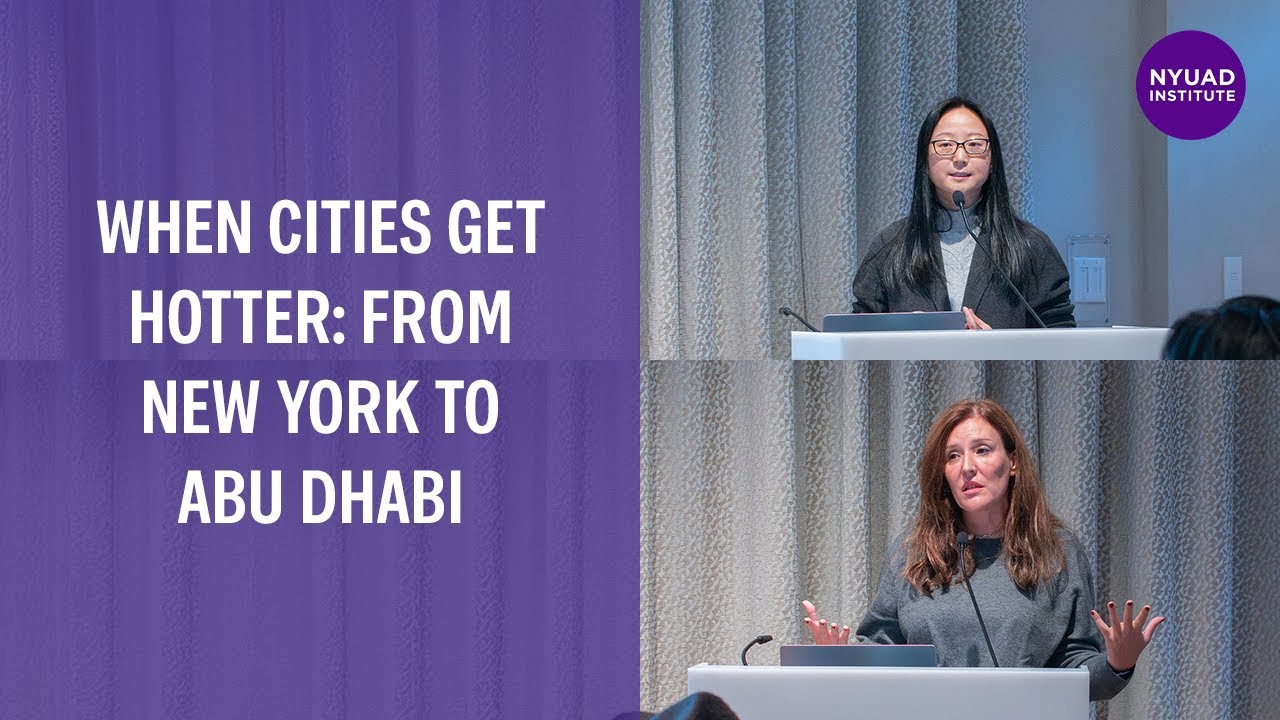
When Cities Get Hotter: From New York to Abu Dhabi
Keywords
Summary
184 words
Critical Evaluation
Value of the Information & Strength of the Argument
The talk provides valuable insights into urban heat dynamics in contrasting climates, using original research data. The argumentation is solid, grounded in physical principles and empirical observations. The speakers effectively explain complex concepts like the Stefan-Boltzmann law and remote sensing without oversimplifying. They present quantitative evidence, such as Abu Dhabi’s urban area tripling and land reclamation equivalent to four Manhattans, to support their claims. The comparison between New York and Abu Dhabi is particularly illuminating, highlighting how UHI effects can differ based on background climate and urban design. The discussion of cooling effects from vegetation and water in desert cities offers practical lessons for sustainable urban planning.
Scientific Rigor, Source Quality, Title Accuracy
The talk demonstrates scientific rigor through the use of established methods (remote sensing, LST analysis) and data from reputable sources like NASA and IPCC. However, specific citations for the research presented are not provided in the talk, and the sources listed in the description are mostly institutional links rather than direct references to the studies mentioned. The title accurately reflects the content, focusing on the comparative analysis of urban heat in New York and Abu Dhabi. The speakers are credible experts in their fields, which enhances the reliability of the information. The talk is a public lecture, so it lacks the peer-review process, but the methodology and data appear sound.
232 words
Title / Content Match
The title accurately reflects the content, which compares urban heat in New York and Abu Dhabi.
Quality & Reliability
8/10
The talk is delivered by two academics with relevant expertise, and presents data from their own research. However, it is a public lecture without peer review, and some claims lack detailed citations.
Key Moments
Markers derived by PSI from the transcript: the creator did not define chapters.
- Introduction to the talk and speakers by Michael Purugganan.
- Yi Yin presents the climate spiral and global warming trends.
- Explanation of the urban heat island effect and its causes.
- Introduction to remote sensing and the Stefan-Boltzmann law.
- Rita Leal Sousa presents Abu Dhabi's urban expansion and land reclamation.
- Analysis of land surface temperature patterns in Abu Dhabi.
- Comparison of LST between Abu Dhabi and New York City.
- Correlation of land cover changes with temperature trends.
- Discussion of vegetation effects and implications for urban planning.
Cited Sources
- NYU Abu Dhabi Institute — Mentioned as the organizing institution.
- 19 Washington Square North — Venue for the talk.
- NYUAD Institute Mailing List — Encouraged for updates on future events.
Concurring Sources
- IPCC Sixth Assessment Report — Referenced for climate change trends and extreme heat.
Contribution & Novelties
The talk provides a comparative analysis of urban heat islands in a temperate city (New York) and a desert city (Abu Dhabi), using remote sensing data. It highlights how urban greening and water features can mitigate heat in extreme climates, offering lessons for sustainable urban design. The research quantifies urban expansion and land cover changes over decades, linking them to temperature trends.
Pour aller plus loin :
- Urban heat island — Overview of the phenomenon and its causes.
- Land surface temperature — Definition and measurement methods.
- Stefan-Boltzmann law — Physical principle underlying thermal remote sensing.
- Abu Dhabi urban planning — Context on the city’s development and climate.
107 words
Radar Profile
The radar profile shows high scores in information quantity, quality, and reliability, with a slightly lower technical level, indicating a well-balanced presentation that is accessible yet scientifically sound.
💬 No comments were provided for analysis.