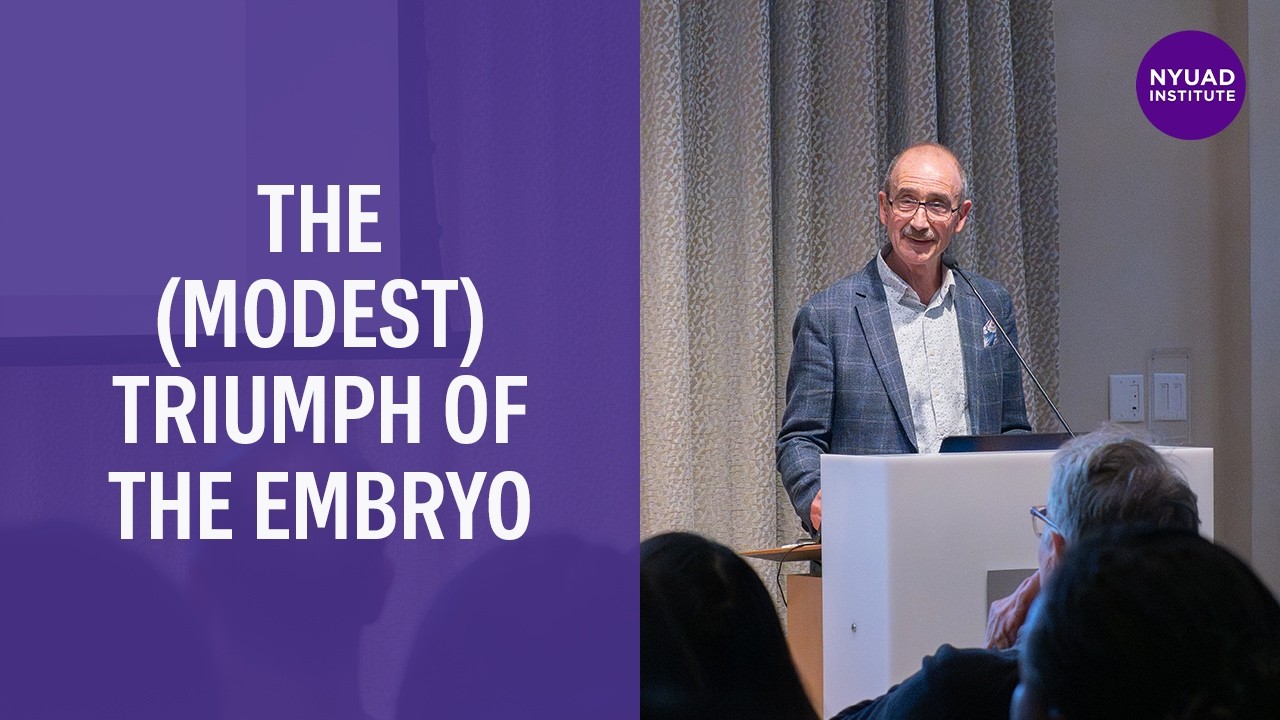
The (Modest) Triumph of the Embryo
Keywords
Summary
111 words
Critical Evaluation
Value of the Information & Strength of the Argument
The lecture provides a valuable perspective on developmental biology, integrating historical and conceptual insights. Duboule’s argument is well-structured, using examples like the German Pavilion and the hourglass model to illustrate constraints. He effectively challenges the finalistic view of development and emphasizes the role of internal constraints in evolution. The argumentation is solid, though some points could benefit from more detailed evidence.
Scientific Rigor, Source Quality, Title Accuracy
The talk demonstrates scientific rigor, referencing key historical figures and concepts accurately. However, it lacks explicit citations to specific studies or papers, relying on general knowledge. The title accurately reflects the content, which is a critical examination of embryonic development. The lecture is well-organized and the speaker’s expertise is evident.
126 words
Title / Content Match
The title accurately reflects the content, which discusses the constraints and limitations of embryonic development, challenging the notion of a 'triumph' and instead presenting a more modest view.
Quality & Reliability
8/10
The talk is delivered by a renowned professor of genetics and evolution, with a strong historical and conceptual basis. The content is well-structured, referencing key figures and concepts in embryology and evolution. However, it is a public lecture without detailed citations or peer-reviewed references, and some claims are presented without direct evidence.
Key Moments
Markers derived by PSI from the transcript: the creator did not define chapters.
- Introduction by Claude Desplan, introducing Denis Duboule and his work on Hox genes.
- Duboule begins his talk, discussing the concept of the embryo as a miracle and introducing the idea of constraints.
- Discussion of Aristotle's contribution to embryology and his finalistic view.
- Introduction of the hourglass model and the resemblance of vertebrate embryos.
- Discussion of Diderot and the concept of a prototype animal.
- Meckel's observations on syndromes and the impossibility of certain monstrosities.
- Geoffroy Saint-Hilaire's classification of monstrosities and the idea of internal laws.
- Discussion of the evolution of digits and the repurposing of existing genes.
- Conclusion: the embryo's development is constrained and not a triumph, but a modest result of evolutionary history.
Cited Sources
- NYUAD Institute — The institute hosting the lecture.
- 19 Washington Square North — A venue for NYUAD Institute events.
- NYUAD Institute Mailing List — Sign-up for upcoming events.
Concurring Sources
- The Triumph of the Embryo — Book by Lewis Wolpert, referenced in the talk.
Contribution & Novelties
The lecture offers a novel perspective on embryonic development by emphasizing the role of constraints and the limitations of evolutionary possibilities. It synthesizes historical ideas with modern genetics, providing a comprehensive view of how development and evolution are intertwined. The talk challenges the common perception of the embryo as a triumphant constructor, instead presenting it as a system that operates within strict boundaries.
Pour aller plus loin :
- Hox genes — Key genes in development, central to the talk’s background.
- Evolutionary developmental biology — The field that studies the link between development and evolution.
- Hourglass model — A model of embryonic development mentioned in the talk.
106 words
Radar Profile
The radar profile shows high scores in information quantity, quality, and reliability, with a moderate technical level. This indicates a well-informed and credible lecture that is accessible to a general audience, with a strong emphasis on conceptual understanding rather than technical detail.