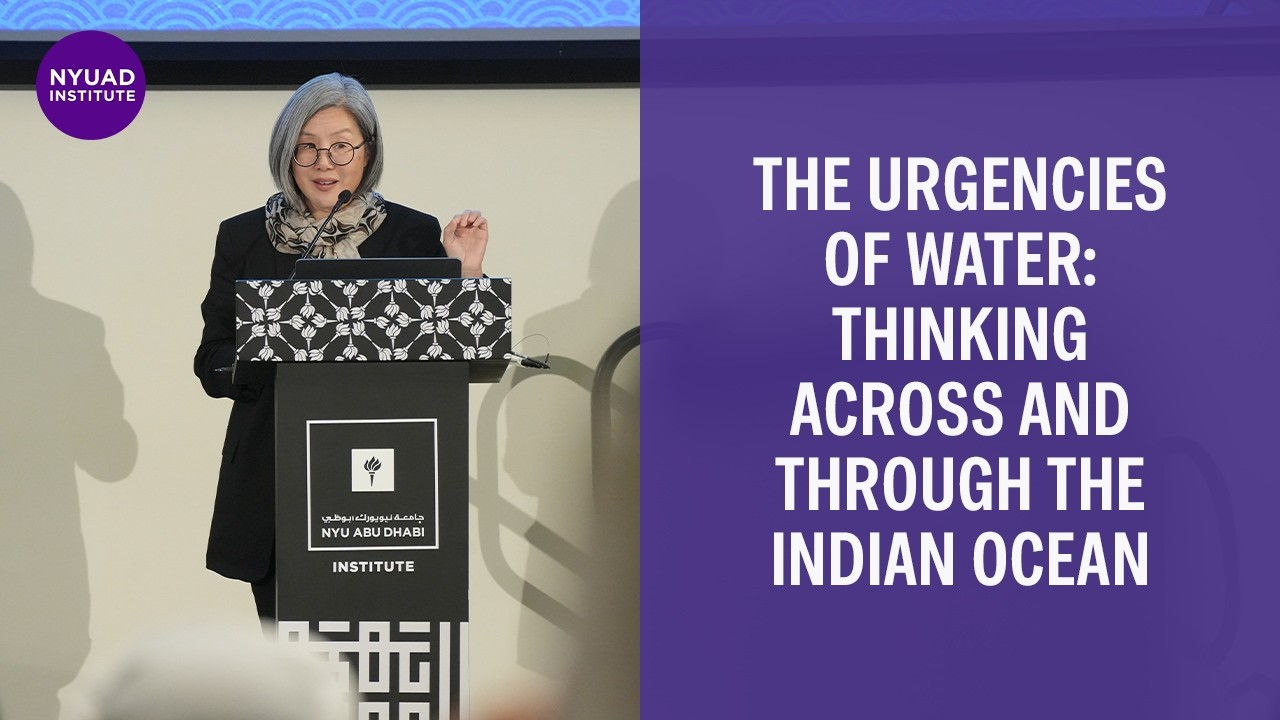
The Urgencies of Water: Thinking Across and Through the Indian Ocean
Keywords
Summary
178 words
Critical Evaluation
Value of the Information & Strength of the Argument
The talk offers valuable insights by bridging two scholarly traditions: the long-standing focus on oceanic connectivity and the newer critical ocean studies emphasizing environmental and ontological dimensions. Um’s argument is well-structured, using two concrete objects to illustrate theoretical points. She effectively critiques the limitations of both approaches while advocating for a more nuanced understanding. The argumentation is solid, drawing on established scholars like Melody Jue, Philip Steinberg, and Kimberly Peters, and grounding her claims in specific historical examples. However, some interpretations are speculative, such as the cause of the plate’s ‘mistake,’ which she acknowledges. Overall, the value lies in its interdisciplinary perspective and the call for a more integrated oceanic scholarship.
Scientific Rigor, Source Quality, Title Accuracy
The talk demonstrates strong scholarly rigor, referencing key works in ocean studies and maritime history. Um cites specific scholars and books, such as Melody Jue’s ‘Wild Bloom Media’ and works by Steinberg and Peters, providing a solid foundation. The sources are credible and relevant. The title accurately reflects the content, which explores different ways of understanding the Indian Ocean through objects, highlighting tensions between trade and ecological perspectives. The talk is well-organized and the arguments are clearly presented. However, as an expert opinion, it lacks the systematic verification of a peer-reviewed study. The title is appropriate and does not overpromise.
226 words
Title / Content Match
The title accurately reflects the content, which explores different ways of understanding the Indian Ocean through objects, highlighting tensions between trade and ecological perspectives.
Quality & Reliability
8/10
The speaker is a recognized scholar (Associate Director at Getty Research Institute) with relevant publications. The talk is well-structured, draws on established academic literature, and uses specific historical objects to support arguments. However, it is an opinion/expert talk without peer review, and some claims are speculative (e.g., the wet sketch).
Key Moments
Markers derived by PSI from the transcript: the creator did not define chapters.
- Introduction by Morris Pomerance, director of NYUAD Institute, introducing the speaker Nancy Um.
- Nancy Um begins her talk, thanking the organizers and setting the context of the Indian Ocean.
- Discussion of the rise of critical ocean studies and key scholars like Melody Jue.
- Contrast between 'dry' scholarship (connectivity) and 'wet' scholarship (environmental immersion).
- Introduction of the first object: a Chinese porcelain plate with a Swedish coat of arms.
- Detailed analysis of the plate's journey from Sweden to China and the 'mistake' of the water-damaged sketch.
- Discussion of the plate as a 'mistake plate' and its implications for understanding agency and water.
- Introduction of the second object: a shipwreck from the South China Sea, recovered in the late 1990s.
- Analysis of the shipwreck's cargo and its significance for understanding maritime trade and risk.
- Conclusion: Um calls for a more integrated approach to oceanic studies, acknowledging both connectivity and environmental dimensions.
Cited Sources
- NYUAD Institute Research — Mentioned in the description as the institute's research page, providing context for the talk's host.
- NYUAD Institute Event Mailing List — Mentioned in the description for signing up to stay informed of upcoming events.
Concurring Sources
- Wild Bloom Media by Melody Jue — Referenced in the talk as a key work in critical ocean studies, proposing diving as a scholarly disposition.
- The Corrupting Sea by Peregrine Horden and Nicholas Purcell — Mentioned as a milestone in oceanic studies, focusing on the Mediterranean.
- The Black Atlantic by Paul Gilroy — Referenced as a foundational work in oceanic studies, exploring the Atlantic as a space of cultural exchange.
Dissenting Sources
- Philip Steinberg and Kimberly Peters on 'wet ontology' — They critique the 'dry' approach to oceans, arguing for a focus on oceans as deep volumes rather than flat surfaces, which contrasts with the connectivity-focused scholarship.
Contribution & Novelties
The talk offers a novel perspective by using material objects to bridge the gap between ‘dry’ and ‘wet’ oceanic scholarship. It challenges the dichotomy between viewing oceans as conduits for trade and as environments, suggesting that objects can embody both perspectives simultaneously. This approach enriches the field of ocean studies by providing a tangible way to think about the intersection of human activity and ecological forces.
Pour aller plus loin :
- Blue Humanities — A related concept that encompasses interdisciplinary study of oceans and water in the humanities.
- Indian Ocean trade — Historical context for the maritime trade networks discussed in the talk.
- Material culture — The study of objects as evidence of human behavior and beliefs, central to the talk’s methodology.
122 words
Radar Profile
The radar profile shows high scores in quality and reliability, reflecting the speaker's expertise and well-supported arguments. The quantity of information is moderate, as the talk is focused on specific examples rather than a broad survey. The technical level is moderate, accessible to a general academic audience. Overall, the profile indicates a solid, credible presentation.
💬 No comments were provided for analysis.