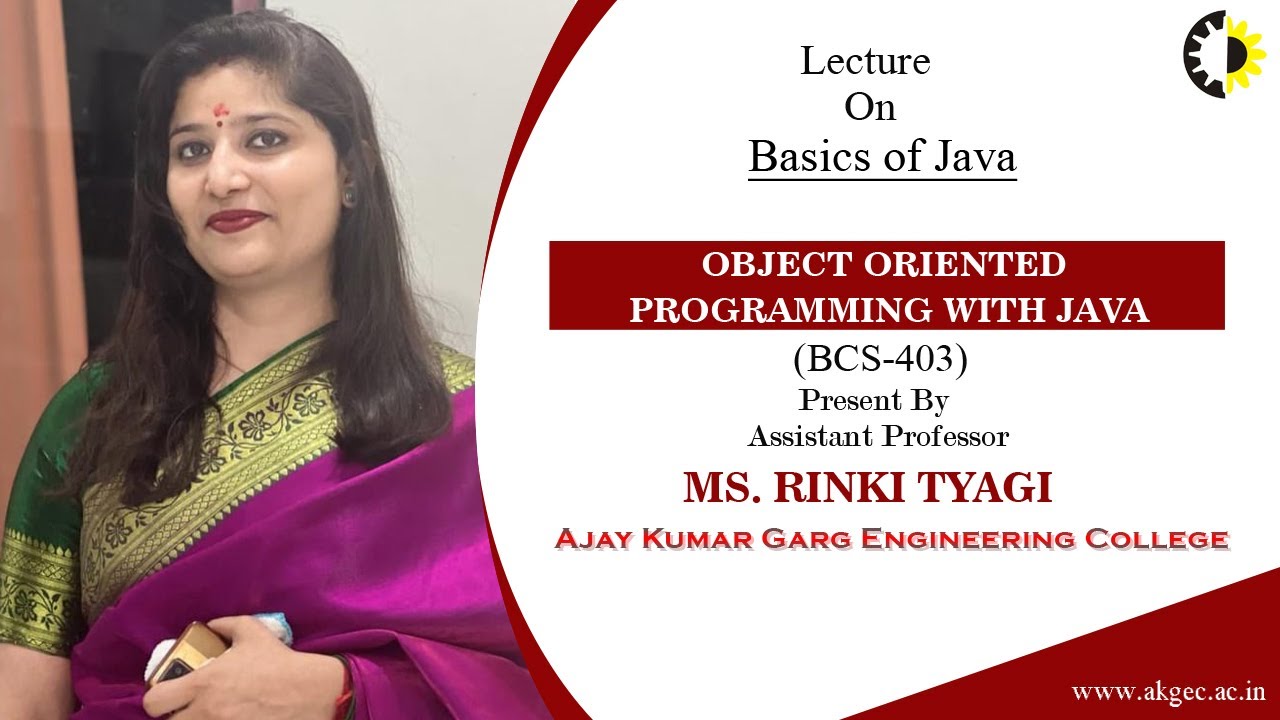
BASICS OF JAVA | OBJECT ORIENTED PROGRAMMING WITH JAVA | LECTURE 01 BY MS. RINKI TYAGI |AKGEC
Keywords
Summary
172 words
Critical Evaluation
Value of the Information & Strength of the Argument
The lecture provides a clear and structured introduction to Java and OOP concepts, using relatable analogies (e.g., pen, car, capsule) to explain abstract ideas. The argumentation is logical and builds from basic definitions to more complex comparisons. However, the depth is limited; for instance, the explanation of bytecode and JVM is simplified, and the comparison with C++ contains some inaccuracies (e.g., claiming C++ is platform independent without nuance). The value lies in its accessibility for beginners, but it does not offer deep technical insights or critical analysis.
Scientific Rigor, Source Quality, Title Accuracy
The lecture does not cite external sources; it relies on the instructor’s knowledge. The title accurately reflects the content, which is a basic tutorial on Java and OOP. The information is generally accurate but occasionally oversimplified or imprecise (e.g., the distinction between portability and platform independence is somewhat confused). The lecture is part of a structured course, but the lack of citations and the presence of minor technical inaccuracies reduce its scientific rigor. No comments were provided for analysis.
181 words
Title / Content Match
The title accurately reflects the content: a lecture on Java basics and OOP concepts.
Quality & Reliability
6/10
The lecture provides a basic but accurate overview of Java features, OOP concepts, and a simple program structure. However, it contains some inaccuracies (e.g., 'C++ is platform independent' is misleading, 'Java is portable but not platform independent' is confused, and some statements about C++ are oversimplified). The content is suitable for beginners but lacks depth and precise technical details.
Key Moments
Markers derived by PSI from the transcript: the creator did not define chapters.
- Introduction and overview of the lecture
- History of Java: developed by Sun Microsystems, acquired by Oracle
- Why learn Java: OOP, platform independence, portability
- Explanation of bytecode and JVM
- Features of Java: simple, secure, robust, multi-threaded
- Applications of Java: desktop, web, enterprise, mobile
- Introduction to OOP concepts: object, class, inheritance, polymorphism, abstraction, encapsulation
- Difference between object-based and object-oriented languages
- Comparison of Java and C++
- Basic Java program structure and explanation of main method
Cited Sources
- AKGEC Official Website — Institution providing the lecture
- Object Oriented Programming with Java Playlist — Series of lectures this video belongs to
Concurring Sources
- Java (programming language) - Wikipedia — Confirms basic facts about Java's history and features.
- Object-oriented programming - Wikipedia — Supports the OOP concepts discussed.
Dissenting Sources
- C++ - Wikipedia — The lecture claims C++ is platform independent, which is misleading; C++ is not inherently platform independent, though it can be compiled for different platforms.
Contribution & Novelties
The lecture serves as an introductory tutorial for beginners, providing a structured overview of Java and OOP concepts. Its main contribution is pedagogical, using analogies to make abstract concepts accessible. However, it does not present new research or advanced insights. For further exploration, the following resources are recommended:
Pour aller plus loin :
- Java (programming language) - Wikipedia — Comprehensive overview of Java’s history, features, and ecosystem.
- Object-oriented programming - Wikipedia — Detailed explanation of OOP principles and paradigms.
- Java Virtual Machine - Wikipedia — In-depth look at JVM architecture and bytecode execution.
- Oracle Java Documentation — Official Java documentation for further learning.
103 words
Radar Profile
The radar profile shows moderate scores across all dimensions, with a slightly lower technical level, reflecting the introductory nature of the lecture. The balance between information quantity and quality is adequate for a beginner tutorial, but the lack of depth and minor inaccuracies prevent higher scores.