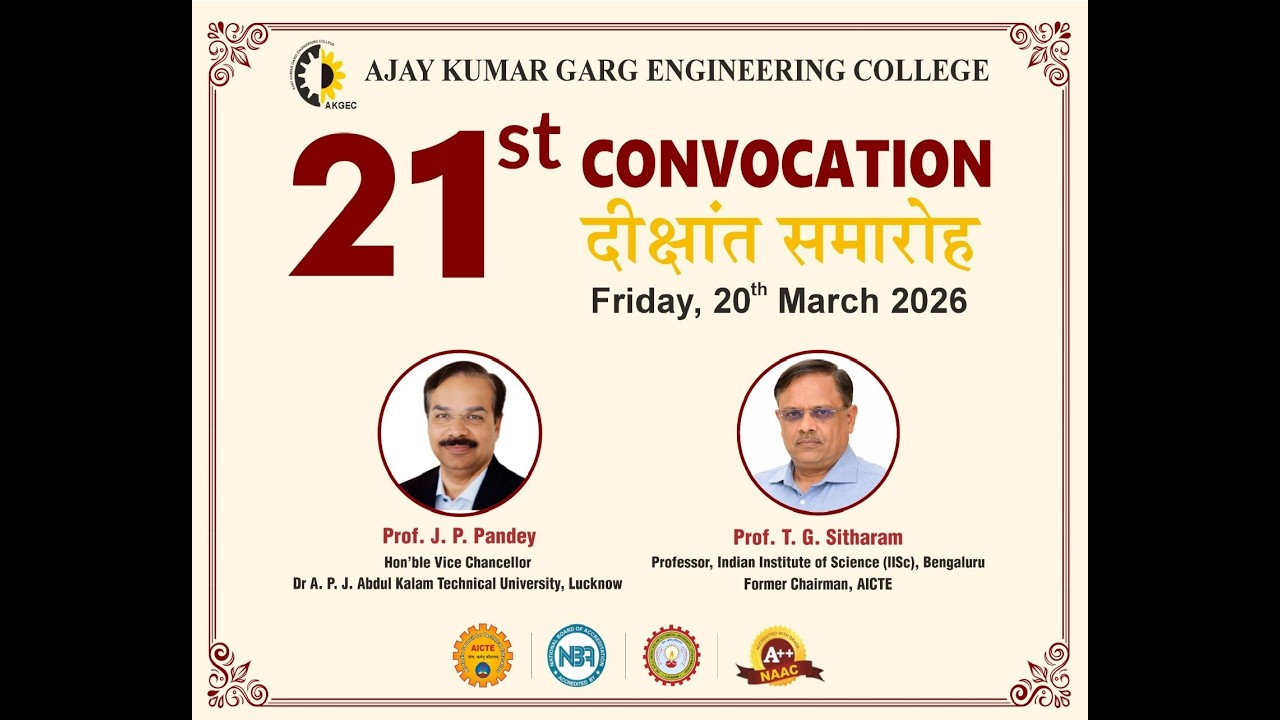
21ST ANNUAL CONVOCATION || AKGEC || 2026
Keywords
Summary
151 words
Critical Evaluation
Value of the Information & Strength of the Argument
The video provides a comprehensive overview of AKGEC’s achievements and initiatives, which is valuable for prospective students, parents, and stakeholders. The information is presented through official reports and speeches, lending it a degree of authority. However, the argumentation is largely promotional, focusing on positive statistics and accolades without critical analysis or independent verification. The claims are supported by institutional data but lack external validation or discussion of challenges.
Scientific Rigor, Source Quality, Title Accuracy
The video is an official institutional recording, so the primary source is AKGEC itself. The information is presented as factual, but the lack of independent sources or critical perspective limits its scientific rigor. The title accurately reflects the content, and the video is well-structured, but the promotional nature and absence of external references reduce its overall reliability.
140 words
Title / Content Match
The title accurately describes the content: the 21st annual convocation of AKGEC held in 2026.
Quality & Reliability
6/10
The video is an official institutional recording of a convocation ceremony, providing factual information about the institution's achievements and statistics. However, it is primarily ceremonial and promotional, lacking independent verification or critical analysis.
Key Moments
Markers derived by PSI from the transcript: the creator did not define chapters.
- Academic procession and ceremonial start
- Lamp lighting and Saraswati Vandana
- University anthem and welcome address
- Introduction of chief guest and vice chancellor
- Annual report presentation begins
- Academic achievements and exam results
- Student achievements in hackathons and competitions
- Placement statistics and highest packages
- Patents and startup initiatives
- Chief guest's convocation address
- Degree conferral and closing remarks
Cited Sources
- AKGEC Official Website — Official website of Ajay Kumar Garg Engineering College, referenced in the video description for more information about the institution.
Concurring Sources
- AKGEC Official Website — The official website likely contains similar information about the college's achievements and programs, corroborating the video's claims.
Contribution & Novelties
The video provides an official record of AKGEC’s 21st convocation, offering insights into the institution’s achievements, strategic initiatives, and vision for the future. It highlights specific programs like the Center of Excellence in Additive Manufacturing and the DGCA-approved drone academy, which are notable developments in Indian engineering education. The chief guest’s address adds perspective on the role of technical education in India’s growth.
Pour aller plus loin :
- AICTE (All India Council for Technical Education) — Official body for technical education in India, relevant to the context of the chief guest’s role.
- Dr. A.P.J. Abdul Kalam Technical University — The university to which AKGEC is affiliated, providing context on the academic framework.
- National Education Policy 2020 — Government policy shaping higher education in India, relevant to the institution’s future plans.
130 words
Radar Profile
The radar profile shows moderate scores in information quantity and quality, with a low technical level, reflecting the ceremonial and non-technical nature of the content. The reliability score is moderate, consistent with an official institutional source that is not independently verified.