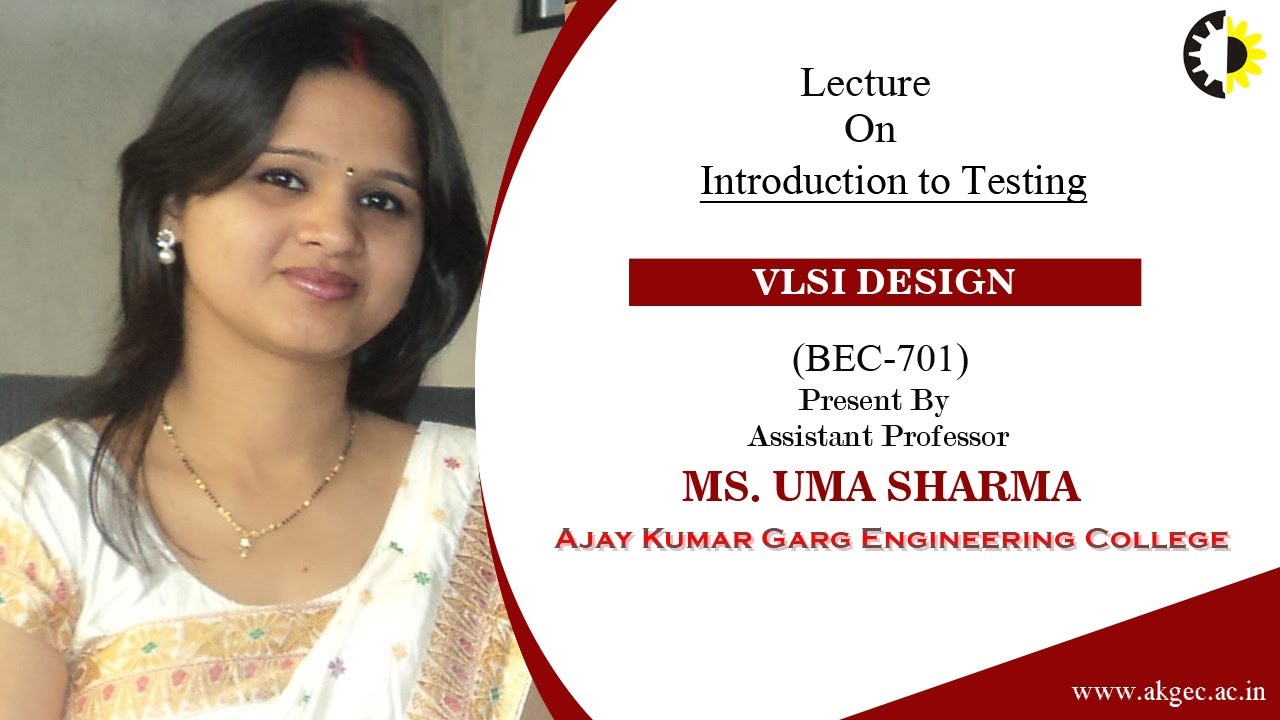
INTRODUCTION TO TESTING | VLSI DESIGN | LECTURE 01 BY MS. UMA SHARMA | AKGEC
Keywords
Summary
138 words
Critical Evaluation
Value of the Information & Strength of the Argument
The lecture provides a clear and systematic introduction to VLSI testing, covering essential concepts and techniques. The argumentation is logical, starting with the need for testing, then explaining DFT methods, fault modeling, and testability metrics. The use of examples, such as the NOR gate layout and AND gate controllability, helps illustrate abstract concepts. However, the presentation lacks depth in certain areas, such as the mathematical foundations of fault simulation and ATPG, and does not provide concrete case studies or quantitative data. The value lies in its pedagogical clarity for beginners, but it may not offer new insights for experienced practitioners.
Scientific Rigor, Source Quality, Title Accuracy
The lecture is scientifically sound in its basic definitions and classifications, but it does not cite specific academic sources or references. The content aligns with standard VLSI testing textbooks, but the lack of citations reduces its scholarly rigor. The title accurately reflects the content, which is an introductory lecture on VLSI testing. The description provides links to the institution’s website and a playlist, but these are not direct sources for the technical content. Overall, the lecture is suitable for educational purposes but would benefit from referencing authoritative texts or papers.
205 words
Title / Content Match
The title accurately reflects the content, which is an introductory lecture on VLSI testing.
Quality & Reliability
6/10
The lecture provides a clear and structured introduction to VLSI testing, covering fundamental concepts such as DFT techniques, fault models, and controllability/observability. However, it lacks depth in mathematical rigor and does not cite specific academic sources, relying on general knowledge. The presentation is suitable for beginners but may not satisfy advanced learners.
Key Moments
Markers derived by PSI from the transcript: the creator did not define chapters.
- Introduction and overview of the lecture
- Importance of VLSI testing and cost implications
- Introduction to DFT techniques: scan design, BIST, boundary scan, test point insertion
- Design verification process and its role
- Definitions of defect, error, and fault
- Fault models: stuck-at, stuck-on, stuck-off, bridging
- Controllability and observability concepts with examples
- Example circuit illustrating controllability and observability
- Conclusion and summary of key points
Cited Sources
- AKGEC Official Website — Institution's official website, providing background on the lecturer and college.
- VLSI DESIGN Playlist — Playlist containing related lectures on VLSI design.
Concurring Sources
- Design for Testability (Wikipedia) — Provides a comprehensive overview of DFT techniques, aligning with the lecture's content.
- Built-in Self-Test (Wikipedia) — Explains BIST in detail, consistent with the lecture's description.
- Boundary Scan (Wikipedia) — Describes boundary scan testing, matching the lecture's coverage.
Contribution & Novelties
The lecture provides a concise and accessible introduction to VLSI testing, making it a useful starting point for students. It consolidates key concepts such as DFT techniques, fault models, and testability metrics in a single session. However, it does not introduce novel ideas or advanced methodologies, as the content is standard in VLSI textbooks.
Pour aller plus loin :
- Design for Testability (Wikipedia) — Overview of DFT principles and techniques.
- Built-in Self-Test (Wikipedia) — Detailed explanation of BIST methodology.
- Boundary Scan (Wikipedia) — IEEE 1149.1 standard and its applications.
- Automatic Test Pattern Generation (Wikipedia) — Introduction to ATPG algorithms and fault simulation.
102 words
Radar Profile
The radar profile shows moderate scores across all dimensions, indicating a balanced but not exceptional lecture. The strongest aspect is the clarity of information, while technical depth and source rigor are relatively lower, reflecting the introductory nature of the content.
💬 No comments were provided for analysis.