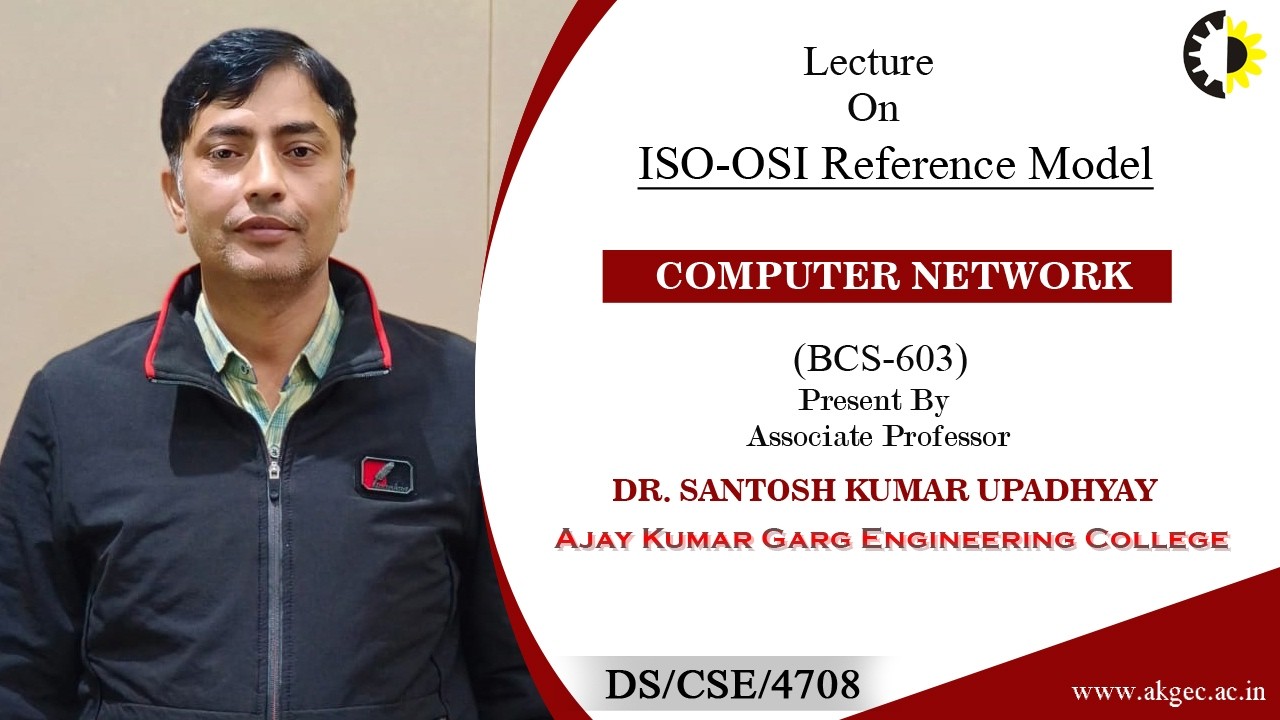
ISO-OSI REFERENCE MODEL | COMPUTER NETWORK | LECTURE 01 BY DR. SANTOSH KUMAR UPADHYAY | AKGEC
Keywords
Summary
125 words
Critical Evaluation
Value of the Information & Strength of the Argument
The lecture provides a clear, structured overview of the OSI model, which is valuable for beginners. The speaker systematically goes through each layer, explaining its role and associated protocols. However, the argumentation is largely descriptive and lacks critical analysis or real-world examples. The speaker does not delve into the rationale behind the layered architecture or compare it with alternative models in detail. The explanation of encapsulation and decapsulation is brief and could be enhanced with a concrete example. Overall, the content is informative but not particularly insightful.
Scientific Rigor, Source Quality, Title Accuracy
The scientific rigor is moderate. The speaker relies on standard networking knowledge, but no specific sources are cited within the lecture. The description provides links to the college website and a playlist, but these are not direct references to the content. The title accurately reflects the content, and the lecture is well-structured. However, there are minor inaccuracies, such as incorrect port numbers for FTP (should be 21, not 25) and HTTP (should be 80, which is correct). The speaker also states that ISO was established in 1947, which is correct, but the OSI model was introduced in the late 1970s, which is accurate. Overall, the lecture is reliable for introductory purposes but lacks depth and citations.
218 words
Title / Content Match
The title accurately reflects the content, which is a lecture on the ISO-OSI reference model.
Quality & Reliability
6/10
The lecture provides a structured overview of the OSI model, but lacks depth and contains minor inaccuracies (e.g., port numbers for FTP and HTTP are incorrect). The content is based on standard networking knowledge, but no sources are cited beyond the institution's website and playlist.
Key Moments
Markers derived by PSI from the transcript: the creator did not define chapters.
- Introduction and overview of the lecture
- Explanation of the seven layers of the OSI model
- Discussion on the Physical layer and transmission modes
- Data Link layer functions: framing, MAC addressing, error control
- Network layer: routing and logical addressing
- Transport layer: TCP and UDP, segmentation
- Session, Presentation, and Application layers summary
Cited Sources
- AKGEC Official Website — Institution's official website, providing background on the college.
- Computer Network Playlist — Playlist containing related lectures on computer networks.
Concurring Sources
- OSI model - Wikipedia — Provides a detailed and accurate description of the OSI model, consistent with the lecture's content.
Dissenting Sources
- RFC 1122 — The lecture mentions that FTP uses port 25, but RFC 1122 and standard IANA assignments specify FTP uses port 21. This is a minor discrepancy.
Contribution & Novelties
This lecture serves as a basic introduction to the OSI model, which is a standard topic in computer networking education. It does not present new research or novel insights, but it consolidates existing knowledge in an accessible format for students. The lecture’s contribution lies in its pedagogical approach, breaking down the seven layers and their functions in a systematic manner.
Pour aller plus loin :
- OSI model - Wikipedia — Provides a comprehensive overview of the OSI model, including history and detailed layer functions.
- TCP/IP model - Wikipedia — Contrasts the OSI model with the TCP/IP suite, which is more commonly used in practice.
- RFC 1122 — Defines the requirements for Internet hosts, relevant to the transport and network layers.
120 words
Radar Profile
The radar profile shows moderate scores across all dimensions, indicating a balanced but not exceptional lecture. The quantity of information is adequate, but the quality and technical depth are limited, reflecting its introductory nature. The reliability is moderate due to minor inaccuracies and lack of citations.
💬 No comments were provided for analysis.