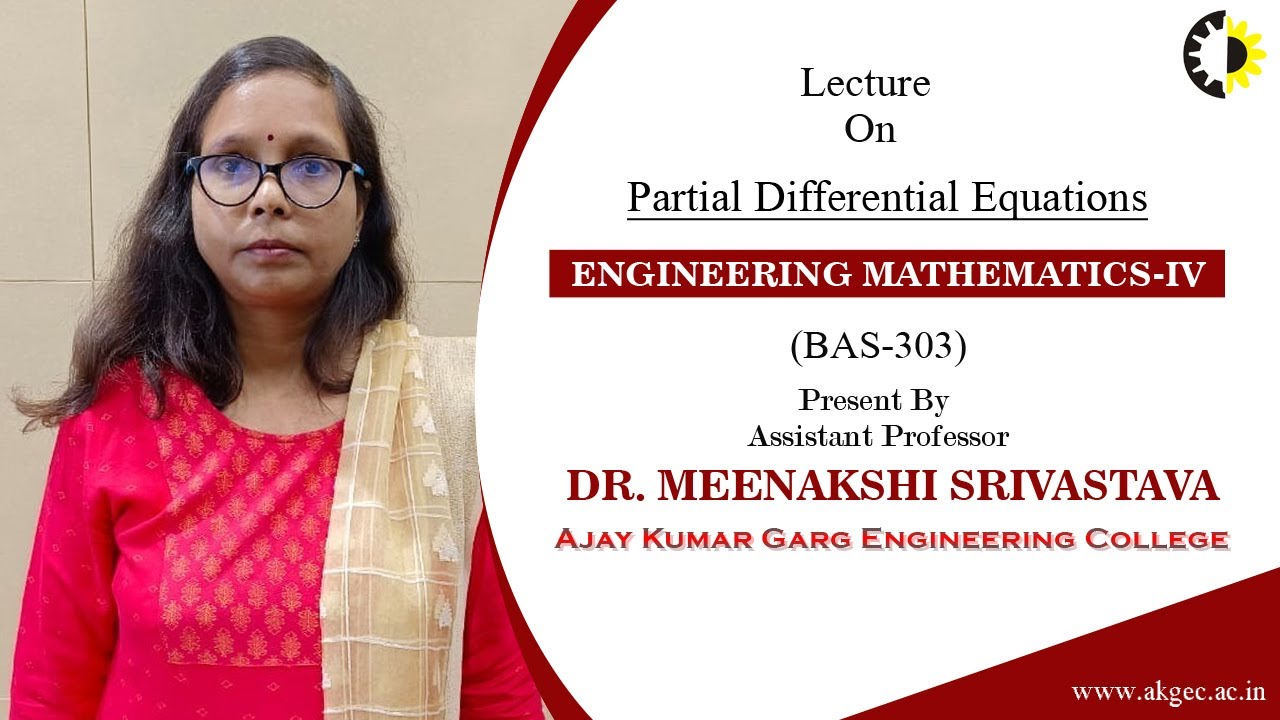
PARTIAL DIFFERENTIAL EQUATIONS |ENGINEERING MATHEMATICS- IV |LECTURE 01 BY DR. MEENAKSHI SRIVASTAVA
Keywords
Summary
189 words
Critical Evaluation
Value of the Information & Strength of the Argument
The lecture provides a solid introduction to solving first-order linear PDEs using Lagrange’s method. The value lies in its step-by-step approach, which is beneficial for students new to the topic. The argumentation is clear and logical: the instructor defines the problem, explains the method, and then applies it to examples of increasing complexity. The use of both grouping and multiplier methods is well-justified, and the instructor carefully explains why one method is chosen over the other in each case. The mathematical reasoning is sound, and the solutions are correct. However, the lecture could benefit from a more formal derivation of the auxiliary equations and a discussion of the conditions under which Lagrange’s method is applicable. Overall, the content is valuable for its pedagogical clarity and practical focus.
Scientific Rigor, Source Quality, Title Accuracy
The lecture is scientifically rigorous in its mathematical content, with correct procedures and solutions. However, it does not cite any external sources or references, which is typical for a tutorial lecture. The title accurately reflects the content, as it clearly indicates the topic (Partial Differential Equations) and the course (Engineering Mathematics-IV). The lecture is part of a larger playlist, which is referenced in the description. The lack of citations is not a major issue for a tutorial, but it limits the ability to verify the information independently. The video quality is low, with poor audio and visual clarity, which may hinder comprehension. The description provides links to the institution’s website and the playlist, but no specific references to textbooks or academic papers.
264 words
Title / Content Match
The title accurately reflects the content: a lecture on partial differential equations, specifically focusing on Lagrange's method for first-order linear PDEs.
Quality & Reliability
7/10
The lecture is a clear and structured tutorial on solving first-order linear PDEs using Lagrange's method. The mathematical steps are correct and well-explained, but the video quality is low (audio and visual) and there are minor notational inconsistencies (e.g., using 'p' for both the variable and the derivative). The content is standard and aligns with typical engineering mathematics curricula.
Key Moments
Markers derived by PSI from the transcript: the creator did not define chapters.
- Introduction to the lecture and course context.
- Definition of linear partial differential equations of first order.
- Explanation of Lagrange's equation and its form.
- Working rule for Lagrange's method: auxiliary equations and steps.
- First example: solving y^2 p - xy q = xz - 2y using grouping method.
- Second example: solving (mz - ny)p + (nx - lz)q = ly - mx using multiplier method.
- Third example: solving y^2(x+y)p + x^2(x+y)q = (x^2+y^2)z using both methods.
- Conclusion and summary of the lecture.
Cited Sources
- AKGEC Official Website — Institution website for the college offering the course.
- Engineering Mathematics-IV Playlist — Playlist containing all units of the course.
Concurring Sources
- Partial differential equation - Wikipedia — General reference for PDEs, consistent with the lecture's content.
- Lagrange's method - Wikipedia — Detailed explanation of the method taught in the lecture.
Contribution & Novelties
The lecture provides a clear and structured introduction to solving first-order linear PDEs using Lagrange’s method, which is a fundamental topic in engineering mathematics. It offers step-by-step solutions to three examples, demonstrating both the grouping and multiplier methods. The novelty lies in the pedagogical approach, which breaks down the method into simple steps and emphasizes the choice of method based on the structure of the equation. However, the content is standard and does not introduce new mathematical concepts.
Pour aller plus loin :
- Partial differential equation - Wikipedia — Provides a broad overview of PDEs, including classification and solution methods.
- Lagrange’s method - Wikipedia — Explains the method for solving first-order linear PDEs.
- Method of characteristics - Wikipedia — A related technique for solving PDEs, which is often used in more advanced contexts.
133 words
Radar Profile
The radar profile shows a balanced performance across all dimensions, with slightly higher scores in information quantity and quality, reflecting the lecture's comprehensive coverage and correct mathematical content. The technical level is moderate, suitable for undergraduate students, and the overall reliability is good, though the lack of citations and low video quality are minor drawbacks.