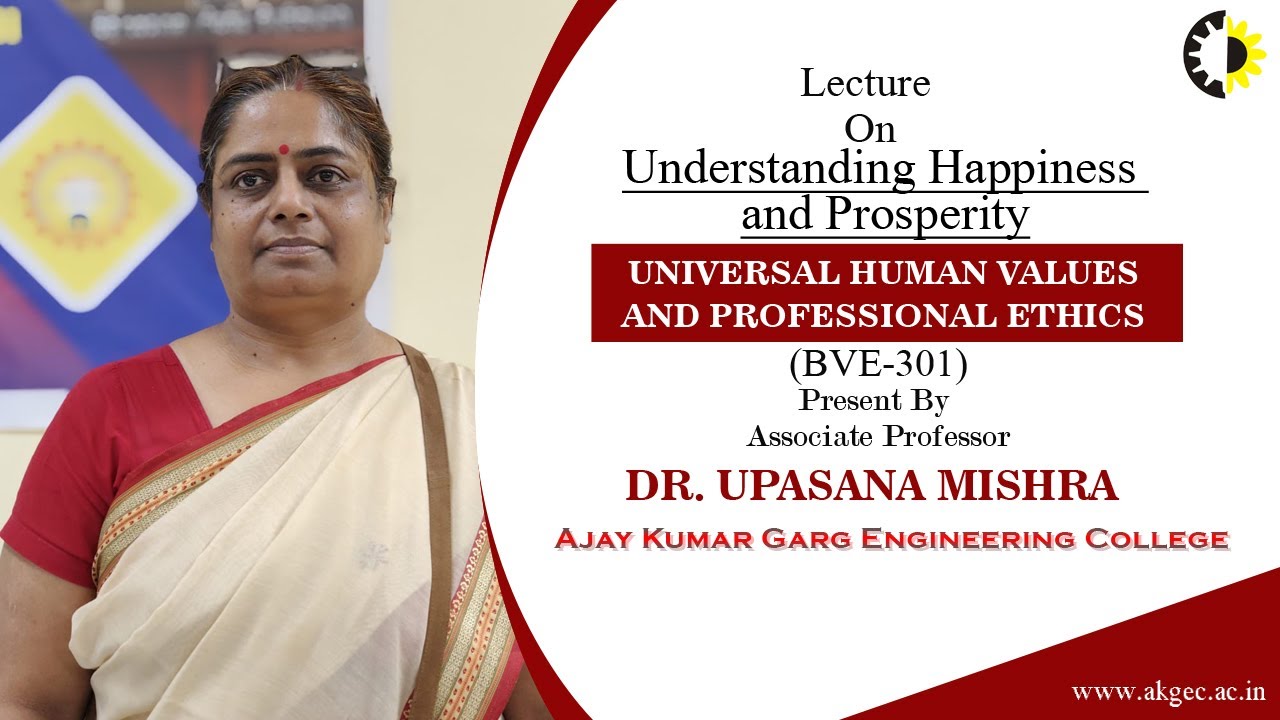
UNDERSTANDING HAPPINESS AND PROSPERITY PART-01 | UHVAPE | LECTURE 02 BY DR UPASANA MISHRA | AKGEC
Keywords
Summary
142 words
Critical Evaluation
Value of the Information & Strength of the Argument
The lecture offers a valuable philosophical perspective on happiness and prosperity, challenging materialistic notions and advocating for a holistic understanding based on harmony. The argumentation is structured around a clear definition and logical progression, using relatable examples like searching for a document in an organized vs. disorganized cupboard. However, the reasoning is largely introspective and lacks empirical support or engagement with alternative philosophical or psychological frameworks. The argument relies on natural acceptance as a self-evident criterion, which may not be universally convincing. The value lies in its pedagogical approach, encouraging self-reflection and critical examination of societal conditioning.
Scientific Rigor, Source Quality, Title Accuracy
The lecture does not cite any external sources or references, relying solely on the instructor’s reasoning and examples. The title accurately reflects the content, which is an introductory lecture on happiness and prosperity within a course on human values. The lack of citations and empirical evidence limits the scientific rigor, but the lecture is consistent with the course’s philosophical orientation. The description provides links to the institution’s website and a playlist of related lectures, which serve as contextual resources but do not substantiate the claims made.
198 words
Title / Content Match
The title accurately reflects the content, which focuses on understanding happiness and prosperity as part of a university course on human values.
Quality & Reliability
6/10
The lecture presents a coherent conceptual framework for happiness and prosperity based on harmony and natural acceptance, but it lacks empirical evidence, citations, and rigorous argumentation. The reasoning is largely introspective and relies on anecdotal examples, which limits its scientific reliability.
Key Moments
Markers derived by PSI from the transcript: the creator did not define chapters.
- Introduction to the lecture and the topic of happiness and prosperity.
- Definition of happiness as a state of harmony or synergy.
- Example of searching for a document to illustrate harmony and disharmony.
- Discussion on the continuity of happiness and the four levels of being.
- Critique of common programs for happiness, such as tasty food and entertainment.
- Exploration of societal conditionings about happiness, such as 'I will be bored if always happy'.
- Discussion on the notion that accumulating physical facilities leads to happiness.
- Conclusion and preview of the next lecture on prosperity.
Cited Sources
- AKGEC Official Website — Institution providing the course and lecture.
- UHVAPE Playlist — Playlist containing related lectures on Universal Human Values and Professional Ethics.
Concurring Sources
- AKGEC Official Website — Institution providing the course and lecture.
- UHVAPE Playlist — Playlist containing related lectures on Universal Human Values and Professional Ethics.
Contribution & Novelties
The lecture provides a novel pedagogical framework for understanding happiness and prosperity within the context of human values, emphasizing harmony and natural acceptance. It challenges materialistic and sensational notions of happiness, offering a holistic perspective that integrates individual, familial, societal, and natural dimensions. The approach encourages self-exploration and critical evaluation of societal conditioning, which is a valuable contribution to ethics education.
Pour aller plus loin :
- Natural acceptance — Concept central to the lecture, though the Wikipedia article may not directly address this specific usage.
- Happiness economics — Field studying the relationship between economic factors and happiness, relevant to the critique of material accumulation.
- Positive psychology — Scientific study of human flourishing, offering empirical perspectives on happiness.
117 words
Radar Profile
The radar profile shows moderate scores across all dimensions, with slightly higher scores in quantity of information and fiabilité globale, reflecting the lecture's structured content but lack of empirical grounding. The low technical level indicates the content is accessible to a general audience, while the moderate quality and fiabilité suggest a need for more rigorous sourcing.