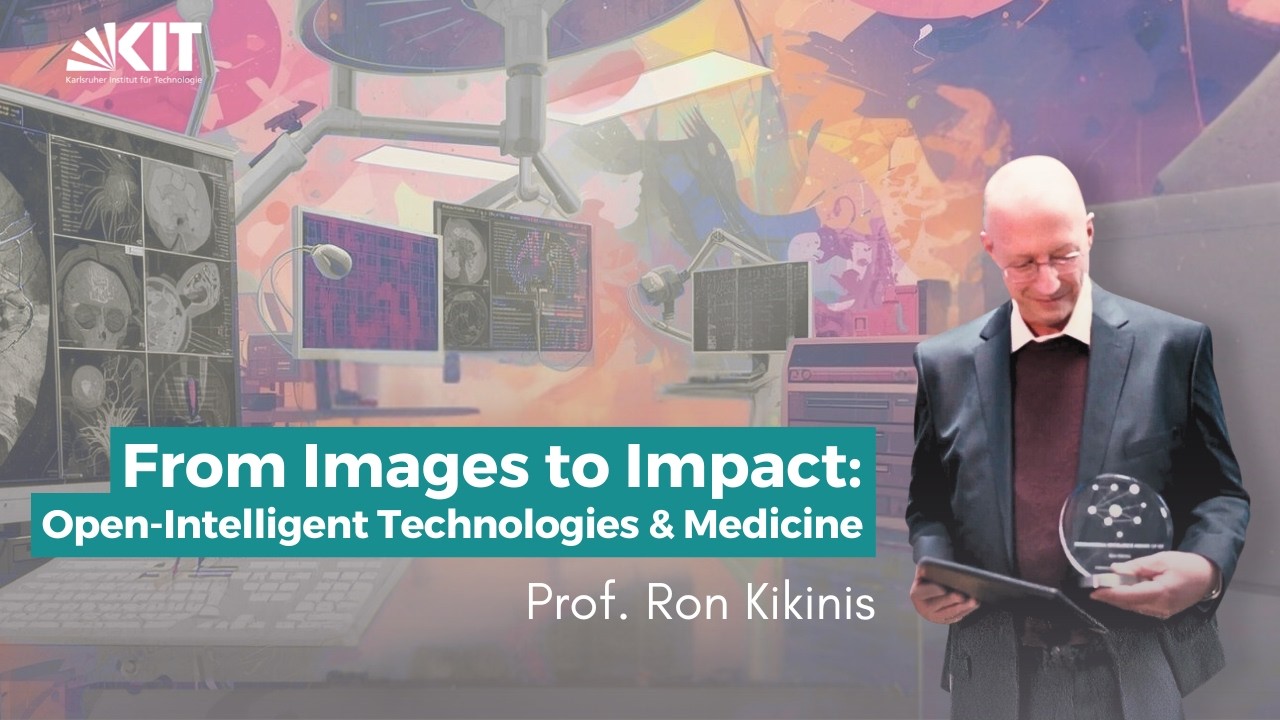
Prof. Ron Kikinis: From Image to Impact Open-Intelligent Technologies & Medicine
Keywords
Summary
138 words
Critical Evaluation
Value of the Information & Strength of the Argument
The talk provides valuable insights into the practical challenges of translating medical imaging research into clinical tools. Kikinis argues convincingly for the need for sustainable software platforms and community-driven development, drawing on his extensive experience. He illustrates his points with concrete examples, such as the development of 3D Slicer and the importance of project weeks for collaboration. The argumentation is coherent and grounded in real-world experience, though it is more narrative than systematic.
Scientific Rigor, Source Quality, Title Accuracy
The talk is based on the speaker’s personal expertise and experience, which lends it authority but also limits its rigor as it lacks formal citations. The title accurately reflects the content, which focuses on the impact of open-source technologies in medicine. The description provides a link to the KIT International Excellence Grants page, which is relevant but not a direct source for the talk’s claims. No comments were provided for analysis.
159 words
Title / Content Match
The title accurately reflects the content, which covers the journey from medical imaging to impactful clinical applications through open-source technologies.
Quality & Reliability
8/10
The speaker is a leading expert with decades of experience in medical image computing, and the talk is based on his personal experience and established projects. However, it is a subjective account without formal citations or peer-reviewed references.
Key Moments
Markers derived by PSI from the transcript: the creator did not define chapters.
- Introduction: motivation and overview of the talk.
- Early work in medical imaging and the barrier to using research algorithms.
- Development of 3D Slicer and the National Alliance for Medical Image Computing.
- Analysis paradigms: cohort analysis vs. subject-specific analysis.
- Example of diffusion tensor imaging and tractography in 3D Slicer.
- 3D Slicer as an open-source platform and ecosystem with extensions and project weeks.
- Role of AI and deep learning in segmentation, and the need for large datasets.
- Image Data Commons and large-scale processing of CT data.
- Connecting 3D Slicer to devices for image-guided interventions and augmented reality.
Cited Sources
- KIT International Excellence Grants — Referenced in the video description as a source for more information about the speaker and the program.
Concurring Sources
- 3D Slicer — The software platform discussed in the talk.
- Image Data Commons — The data repository mentioned in the talk.
Contribution & Novelties
The talk provides a first-hand account of the development of 3D Slicer and the challenges of translating research into clinical practice. It highlights the importance of open-source platforms and community building in medical imaging. The speaker’s perspective on the evolution of analysis paradigms and the role of AI is valuable for understanding the field’s trajectory.
Pour aller plus loin :
- 3D Slicer — Official website of the open-source software platform.
- Image Data Commons — NIH initiative for sharing medical imaging data.
- National Alliance for Medical Image Computing (NA-MIC) — Consortium that contributed to the development of 3D Slicer.
98 words
Radar Profile
The radar profile shows high scores in quality and reliability, reflecting the speaker's expertise, but lower scores in quantity and technical depth, as the talk is a high-level overview rather than a detailed technical exposition.