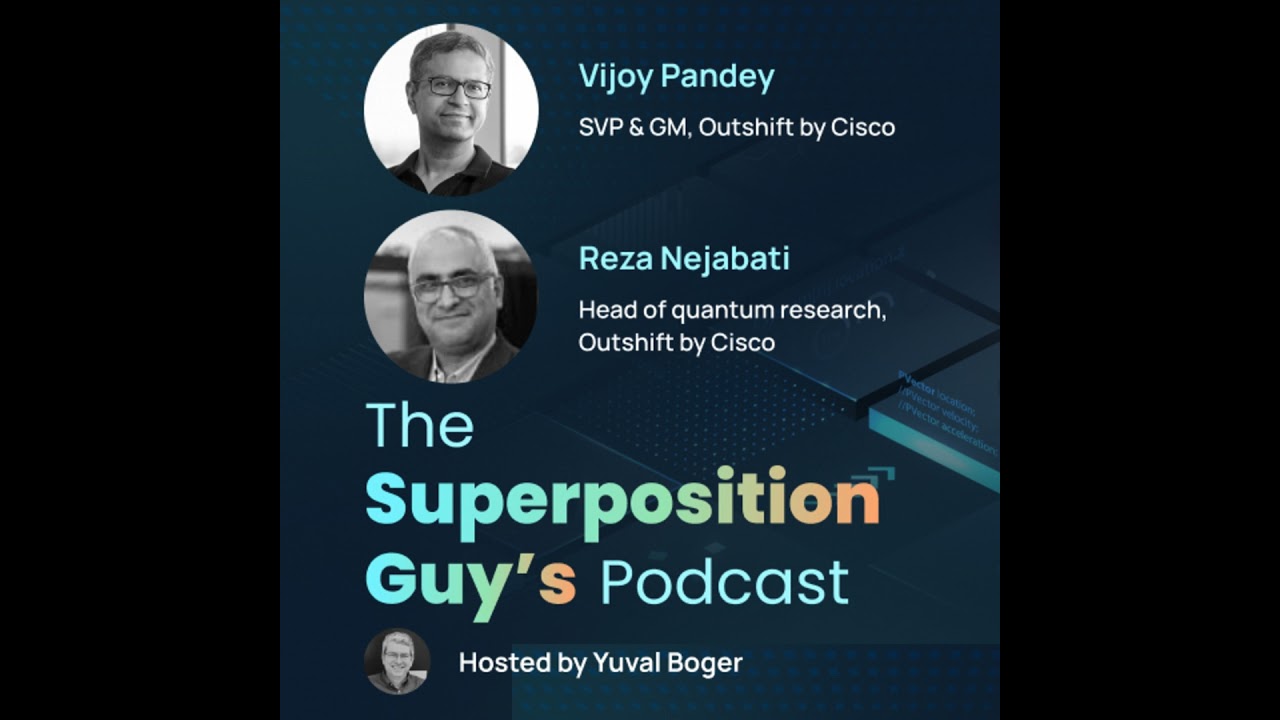
Cisco quantum networking with Vijoy Pandey and Reza Nejabati
Keywords
Summary
173 words
Critical Evaluation
Value of the Information & Strength of the Argument
The value of the information is high for those interested in the strategic direction of quantum networking. The guests provide a clear rationale for Cisco’s focus on networking rather than QPUs, arguing that scale-out combined with scale-up will accelerate progress. They emphasize the importance of making networking simple and pushing complexity to the edge, which is a compelling argument. The discussion is well-structured, with each point building on the previous one. However, the argumentation is largely based on their own perspective and lacks independent evidence or comparison with alternative approaches. The claims about the chip’s performance and the feasibility of scale-out are not backed by specific data or references, which limits the strength of the argumentation.
Scientific Rigor, Source Quality, Title Accuracy
The scientific rigor is moderate. The guests are credible experts, but the conversation is more of an expert opinion than a rigorous scientific presentation. They mention their research prototype and software stack but do not provide detailed technical specifications or peer-reviewed references. The title accurately reflects the content, which is an interview about Cisco’s quantum networking strategy. The description provides context and links, but no specific sources are cited within the video. The lack of external references and the promotional tone reduce the overall rigor.
216 words
Title / Content Match
The title accurately reflects the content: an interview with Cisco's quantum networking leaders discussing their strategy and technology.
Quality & Reliability
7/10
The discussion features two senior Cisco executives with deep expertise in networking and quantum research. They provide credible insights into Cisco's strategic approach, but the content is largely forward-looking and promotional, with limited technical detail or external validation.
Key Moments
Markers derived by PSI from the transcript: the creator did not define chapters.
- Introduction and guest introductions
- Discussion on Cisco's focus on scale-out vs scale-up
- Introduction of the entanglement source chip
- Explanation of the chip's design and telecom wavelength
- Discussion on the compiler and software stack
- Explanation of transducers and modality conversion
- Discussion on distance and repeaters
- Discussion on commercial availability and design partners
- Discussion on classical use cases and roadmap
- Personal insights and dinner with quantum greats
Cited Sources
- Cisco Outshift — Mentioned as the incubation group within Cisco that is working on quantum and other adjacent technologies.
Concurring Sources
- Cisco Outshift — Official page for Cisco's incubation group, which aligns with the discussion about their quantum efforts.
Contribution & Novelties
The video provides insight into Cisco’s strategic approach to quantum networking, emphasizing a scale-out architecture and the development of room-temperature, telecom-band entanglement sources. It introduces a specific chip design based on ring resonators and discusses the importance of transducers and a compiler for distributed quantum computing. The discussion highlights the potential for near-term classical applications, which is a novel angle for a networking company.
Pour aller plus loin :
- Quantum internet — Overview of quantum networking concepts.
- Entanglement swapping — Key technique for quantum repeaters.
- Quantum teleportation — Fundamental protocol for distributed quantum computing.
- Ring resonator — Technology underlying the chip discussed.
- Quantum compiler — Context for the compiler mentioned.
110 words
Radar Profile
The radar profile shows a balanced performance across all dimensions, with slightly higher scores in information quantity and quality, reflecting the depth of the discussion. The technical level is moderate, indicating that the content is accessible to a general audience with some background in quantum computing.