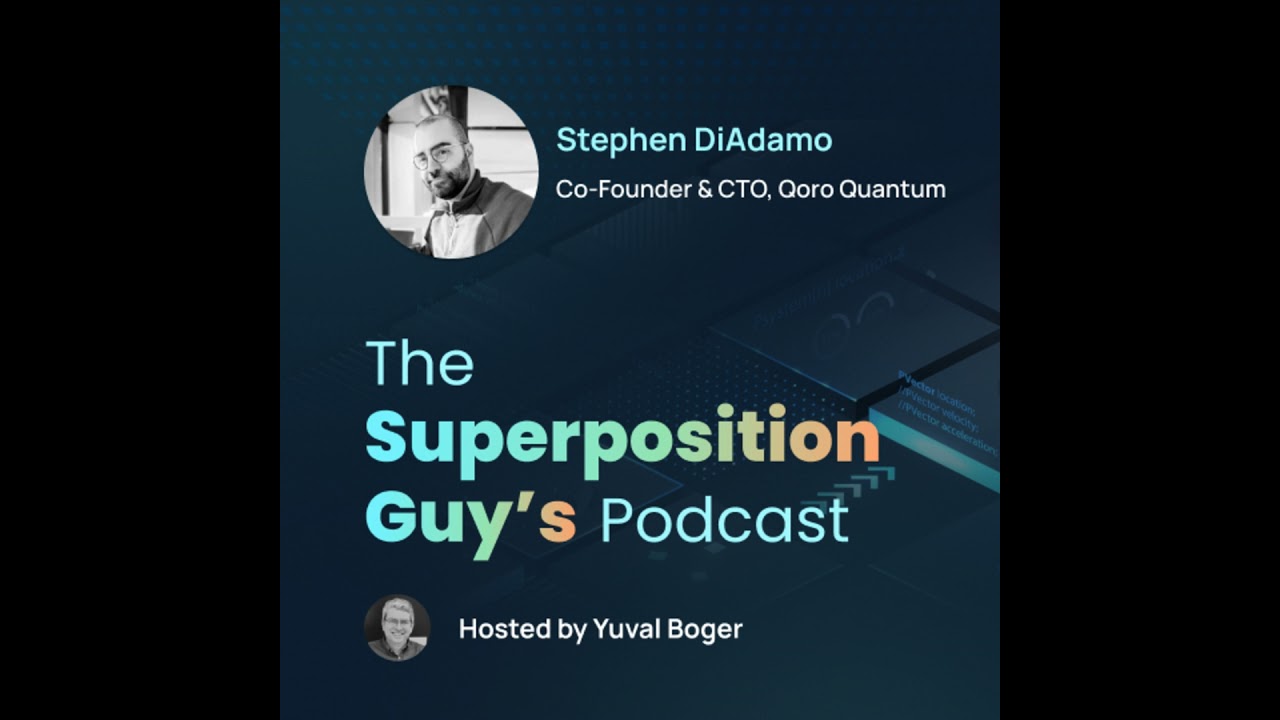
Stephen DiAdamo, co-founder and CTO of Qoro Quantum
Keywords
Summary
175 words
Critical Evaluation
Value of the Information & Strength of the Argument
The value of the information is high for those interested in the practical aspects of quantum computing middleware. The discussion provides concrete details about Qoro’s architecture, including the Divi SDK, circuit serialization, parallelization, and the orchestrator’s decision-making process. The argumentation is coherent and well-structured, with DiAdamo clearly explaining the rationale behind each design choice. He effectively argues for the necessity of multi-QPU centers for resilience, using a real-world example of an IBM outage. The claims are plausible and grounded in the company’s experience, though some are promotional in nature.
Scientific Rigor, Source Quality, Title Accuracy
The scientific rigor is moderate. The discussion is based on the founder’s expert opinion and company experience, not on peer-reviewed research. No specific sources are cited in the video, but the description mentions the CESGA proof of concept and the CUNQA platform, which are concrete references. The title accurately reflects the content, and the interview stays on topic. The lack of external citations limits the ability to verify claims independently, but the technical details provided are consistent with current quantum computing practices.
186 words
Title / Content Match
The title accurately reflects the content: an interview with Stephen DiAdamo, CTO of Qoro Quantum, focusing on their middleware platform.
Quality & Reliability
7/10
The interview presents a coherent and technically plausible description of Qoro's middleware approach, with specific technical details (e.g., 12 simulation methods, integration with SLURM, CESGA pilot). However, claims such as '150,000 lines of code to 20' are marketing-oriented and not independently verifiable. The discussion is expert opinion rather than peer-reviewed research.
Key Moments
Markers derived by PSI from the transcript: the creator did not define chapters.
- Introduction and overview of Qoro Quantum's middleware approach.
- Explanation of Divi SDK and how it translates optimization inputs into circuits.
- Discussion of the orchestrator's role in routing circuits to simulation or hardware.
- Addressing the question of how Qoro handles different quantum modalities.
- Discussion of classical-quantum interface and latency levels.
- Examples of parallelizable algorithms beyond sampling, such as time evolution and error mitigation.
- Integration with HPC schedulers like SLURM as a plugin.
- Explanation of the '150,000 lines of code to 20' claim.
- CESGA proof of concept using CUNQA platform and 15 compute nodes.
- Argument for multi-QPU centers for resilience and fallback.
- Developer experience and the value for students learning QAOA.
- Company background, team size, and funding status.
Cited Sources
- CESGA (Galicia Supercomputing Center) — Mentioned as the site of a proof of concept using the CUNQA platform.
- CUNQA platform — Software platform used in the CESGA pilot for distributed quantum computing.
Concurring Sources
- Quantum Computing Report — General source on quantum computing industry trends, consistent with the need for middleware solutions.
Contribution & Novelties
The interview provides insight into a middleware-first approach to quantum computing, which is relatively novel compared to hardware-centric or application-centric strategies. The emphasis on parallelization and orchestration across multiple quantum and classical resources is a forward-looking perspective. The discussion of integrating with HPC schedulers like SLURM as a plugin rather than replacing them is a practical contribution.
Pour aller plus loin :
- Quantum middleware — Overview of the middleware layer in quantum computing.
- QAOA (Quantum Approximate Optimization Algorithm) — The algorithm frequently mentioned in the interview.
- SLURM Workload Manager — The HPC scheduler discussed for integration.
96 words
Radar Profile
The radar profile shows high scores in quantity of information and technical level, reflecting the detailed technical discussion. Quality of information and global reliability are slightly lower due to the promotional nature of some claims and lack of external verification.