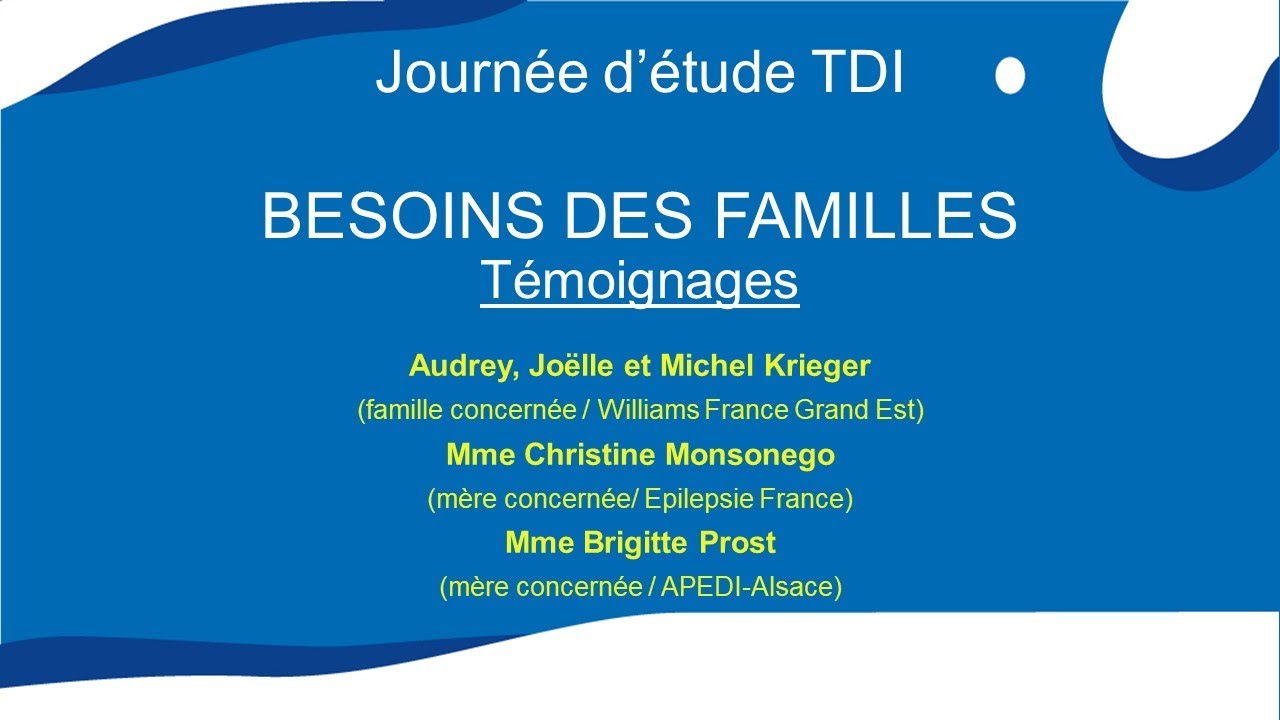
Journée d'étude TDI _ Besoins des familles _ Session témoignages
Keywords
Summary
151 words
Critical Evaluation
Value of the Information & Strength of the Argument
The value of the information lies in its authentic, first-hand accounts of navigating the healthcare and social systems for individuals with intellectual disabilities. The parents provide detailed narratives of diagnostic processes, educational placements, and transitions to adult services, offering practical insights that are often missing from clinical literature. The argumentation is based on personal experience rather than systematic evidence, but it effectively highlights systemic gaps, such as the lack of genetic testing and the emotional burden on siblings. The inclusion of a sibling’s perspective adds depth, emphasizing the need for support for the entire family unit.
Scientific Rigor, Source Quality, Title Accuracy
The video does not cite specific scientific sources, but it references the Haute Autorité de Santé’s good practice recommendations, which are credible. The title accurately reflects the content, as it is a session of testimonies. The content is not rigorously scientific but is valuable as qualitative evidence. The absence of citations is a limitation, but the personal stories are credible and align with known challenges in disability care.
179 words
Title / Content Match
The title accurately reflects the content: a session of testimonies about the needs of families during a study day on intellectual disability.
Quality & Reliability
7/10
The video is a testimony session from a study day on intellectual disability, featuring personal accounts from parents and a sibling. It is not a scientific study but provides valuable experiential insights. The information is anecdotal and not peer-reviewed, but it is authentic and relevant for understanding family needs.
Key Moments
Markers derived by PSI from the transcript: the creator did not define chapters.
- Introduction and presentation of the session
- First testimony: Audrey's father describes her birth and early medical issues
- Audrey's father details her educational journey and eventual diagnosis of Williams-Beuren syndrome
- Second testimony: Robin's mother describes his severe epilepsy and educational placements
- Robin's sister's written testimony on the sibling experience
- Third testimony: Vincent's mother discusses good practice recommendations and ethical considerations
Cited Sources
- Haute Autorité de Santé - Good practice recommendations — Referenced by the third speaker as the basis for her reflections on best practices in disability care.
Concurring Sources
- Haute Autorité de Santé - Good practice recommendations — The recommendations are referenced as a framework for professional practice, aligning with the speakers' emphasis on person-centered care.
Contribution & Novelties
The video provides a unique compilation of personal testimonies that highlight the real-world challenges faced by families of individuals with intellectual disabilities, including diagnostic delays, educational struggles, and the emotional impact on siblings. It underscores the need for better coordination among healthcare professionals and the importance of support networks.
Pour aller plus loin :
- Williams-Beuren syndrome — Overview of the syndrome mentioned in the first testimony.
- Epilepsy — Background on epilepsy, relevant to the second testimony.
- Sibling support in disability — Resource for siblings of individuals with disabilities, addressing the concerns raised in the sibling testimony.
96 words
Radar Profile
The radar profile shows moderate scores across all dimensions, with slightly higher scores in information quantity and reliability, reflecting the authentic but non-scientific nature of the content. The low technical level indicates that the video is accessible to a general audience.