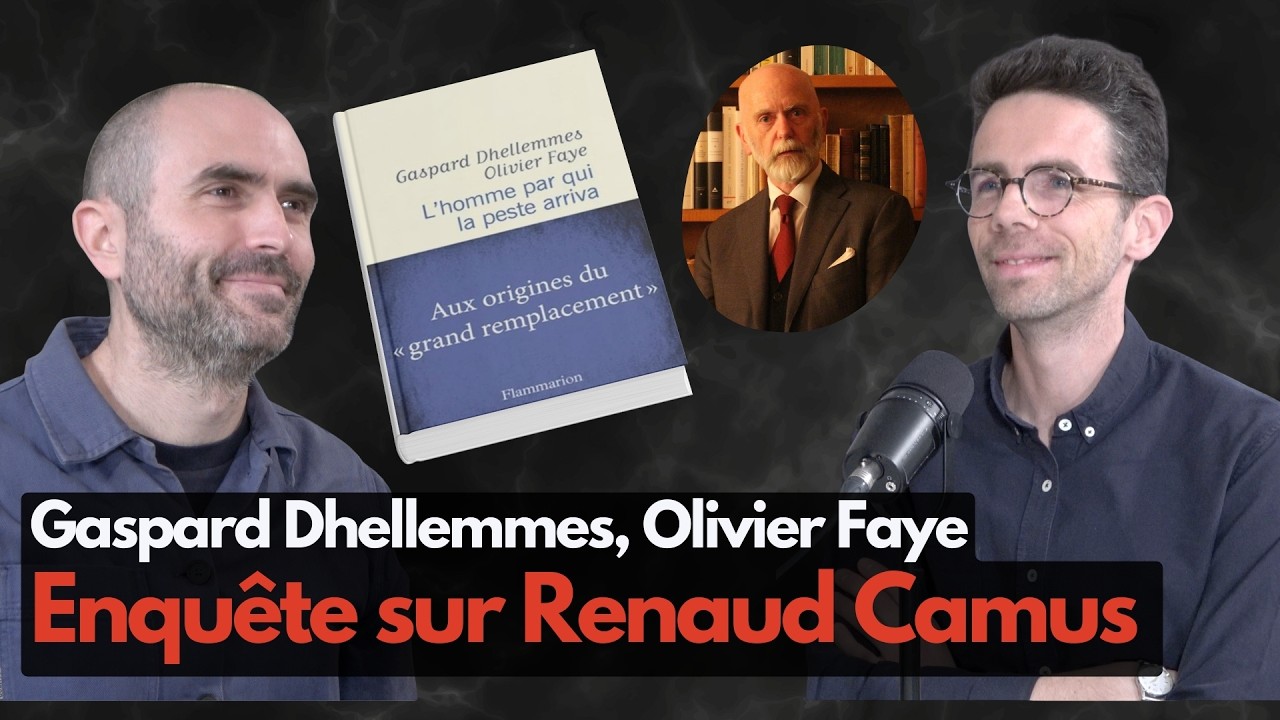
Enquête sur l'inventeur du « Grand Remplacement »
Keywords
Summary
168 words
Critical Evaluation
Value of the Information & Strength of the Argument
The value of the information is high, as it is based on a three-year investigation with unprecedented access to primary sources, including Renaud Camus’s personal journals, correspondence, and interviews with his associates. The guests provide detailed, evidence-based accounts of Camus’s evolution, supported by specific examples and dates. The argumentation is solid, as they systematically connect Camus’s personal grievances and literary failures to his ideological radicalization, and trace the dissemination of his ideas through media and political channels. They also contextualize the ‘Great Replacement’ within the broader landscape of conspiracy theories, citing data from Brandwatch. The discussion is well-structured and avoids sensationalism, offering a sober and analytical perspective.
Scientific Rigor, Source Quality, Title Accuracy
The scientific rigor is commendable, as the guests are journalists from Le Monde who have conducted extensive research, including reading hundreds of pages of Camus’s journals and interviewing numerous individuals. They clearly distinguish between facts and interpretations, and they acknowledge the limitations of their sources, such as Camus’s psychological biases. The quality of sources is high, with references to primary documents and interviews. The title accurately reflects the content, as the episode is indeed an investigation into the origins of the ‘Great Replacement’ theory. The discussion is well-structured and stays on topic, providing a comprehensive analysis without digressing.
220 words
Title / Content Match
The title accurately reflects the content, which is an in-depth investigation into the origins and trajectory of Renaud Camus and the 'Great Replacement' theory.
Quality & Reliability
8/10
The video features two journalists from Le Monde who have conducted a three-year investigation based on extensive primary sources (Renaud Camus's journals, correspondence, and interviews). The discussion is well-structured and grounded in documented facts, though it remains an interview and opinion-based analysis rather than a peer-reviewed study.
Key Moments
Markers derived by PSI from the transcript: the creator did not define chapters.
- Introduction to the topic and the guests; why they became interested in Renaud Camus.
- Discussion of Camus's trajectory from avant-garde writer to far-right ideologue.
- Conditions under which the concept of 'Grand Remplacement' emerged.
- Discussion of 'Remigration' and 'Décivilisation' concepts.
- Analysis of current media and political relays of Renaud Camus's ideas.
- Positioning of the Rassemblement National regarding the 'Grand Remplacement'.
- Where the 'Grand Remplacement' theory has spread internationally.
Cited Sources
- Le Grand Remplacement est-il un concept complotiste ? — Referenced in the video description as a resource for further reading on the conspiracy theory nature of the concept.
- Qu'est-ce que le Grand Remplacement ? — Referenced in the video description as a resource for understanding the concept.
Concurring Sources
- Le Grand Remplacement est-il un concept complotiste ? — The video's discussion aligns with this article's analysis of the concept as a conspiracy theory.
- Qu'est-ce que le Grand Remplacement ? — The video's explanation of the concept is consistent with this resource.
External References
Contribution & Novelties
This video provides a unique, in-depth journalistic investigation into the origins of the ‘Great Replacement’ theory, based on unprecedented access to Renaud Camus’s personal archives. It offers a nuanced psychological and historical analysis of how a marginal writer’s ideas became a global political phenomenon. The discussion highlights the role of personal resentment, literary failure, and political opportunism in the development of conspiracy theories.
Pour aller plus loin :
- Renaud Camus — Wikipedia article on the author, providing biographical context.
- Great Replacement conspiracy theory — Wikipedia article on the theory, its origins, and spread.
- Conspiracy Watch — Organization monitoring conspiracy theories in France, referenced in the video.
106 words
Radar Profile
The radar profile shows high scores in quantity of information, quality of information, and global reliability, with a slightly lower score in technical level. This indicates a well-researched and reliable discussion that is accessible to a general audience, with a strong emphasis on factual reporting and analysis.
💬 No comments were provided for analysis.