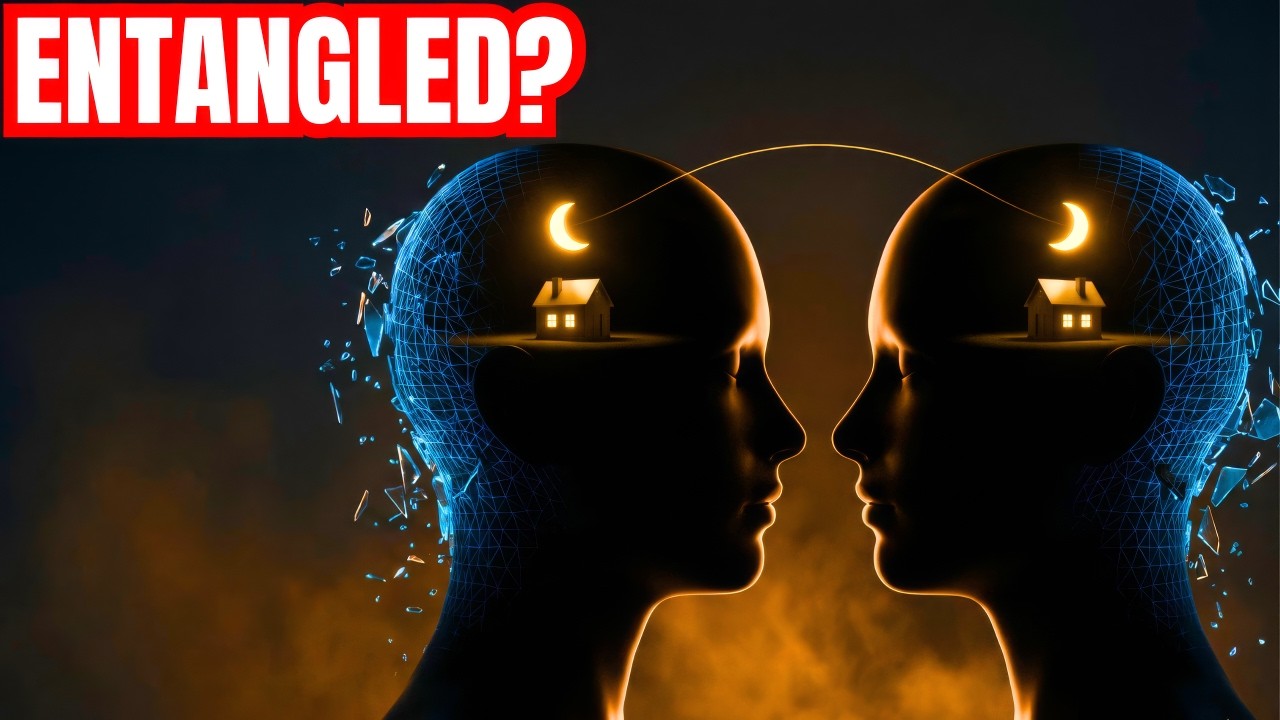
Quantum Synchronicity — Why You and Your Loved Ones Dream the Same Things
Keywords
Summary
141 words
Critical Evaluation
Value of the Information & Strength of the Argument
The video provides substantial value by presenting both sides of the synchronicity debate fairly. It explains complex quantum concepts like entanglement and the no-signaling theorem in an accessible manner, and it gives a thorough overview of historical and modern research, including the PEAR experiments and the Global Consciousness Project. The argumentation is solid: it first builds the case for a quantum connection, then systematically dismantles it using established physics and the replication crisis, and finally offers a plausible, evidence-based alternative. The reasoning is logical and well-structured, though it occasionally relies on anecdotal evidence to illustrate points, which is clearly flagged as such.
Scientific Rigor, Source Quality, Title Accuracy
The video demonstrates a good level of scientific rigor by correctly referencing key concepts and experiments, such as the no-signaling theorem and the PEAR lab, and by acknowledging the replication crisis. It distinguishes between established physics and speculative interpretations, and it does not overstate the evidence for synchronicity. The title accurately reflects the content, which is a balanced exploration of the topic. The video does not cite specific academic papers, but it mentions the relevant experiments and theories, and it provides a nuanced view of the evidence. The adequacy between title and content is strong, as the video directly addresses the question of shared dreams and offers a scientific explanation.
227 words
Title / Content Match
The title accurately reflects the content, which explores the phenomenon of shared dreams and synchronicity through the lens of quantum physics and neuroscience.
Quality & Reliability
7/10
The video presents a balanced narrative, first detailing the quantum entanglement hypothesis for synchronicity and then debunking it with the no-signaling theorem and replication failures. It correctly cites historical figures and experiments, but relies on anecdotal evidence and popularized accounts, and the scientific rigor is moderate, with some oversimplifications.
Key Moments
Markers derived by PSI from the transcript: the creator did not define chapters.
- Introduction to the phenomenon of shared dreams and the central question.
- Carl Jung's scarab anecdote and the birth of synchronicity.
- Wolfgang Pauli's background and his collaboration with Jung.
- The Princeton PEAR experiments and the random event generator.
- The Global Consciousness Project and its findings.
- Daryl Bem's experiments on precognition and the replication crisis.
- The no-signaling theorem and why quantum entanglement cannot explain synchronicity.
- The mathematics of miracles and the law of truly large numbers.
- The real channel: physiological synchrony and the science of dreaming.
- Twins as the biggest clue and the conclusion.
Cited Sources
- PEAR Lab — Mentioned as the Princeton laboratory that ran 28 years of experiments on mind-machine interaction.
- Global Consciousness Project — Mentioned as an experiment that attempted to detect correlations in random number generators during global events.
- Daryl Bem's experiments — Mentioned as the psychologist who conducted controversial experiments on precognition.
- No-signaling theorem — Mentioned as the theorem that prohibits using quantum entanglement for communication.
- Bell's theorem — Mentioned as the theorem that proved quantum entanglement is real.
Concurring Sources
- No-communication theorem — Supports the video's claim that quantum entanglement cannot be used for communication.
- Replication crisis — Supports the video's discussion of the failure to replicate Bem's and PEAR's results.
Dissenting Sources
- PEAR Lab results — The video presents the PEAR results as statistically significant, but the scientific community largely considers them as methodological artifacts and they have not been replicated.
Contribution & Novelties
The video’s original contribution lies in its balanced synthesis of the quantum synchronicity hypothesis and its scientific debunking, culminating in a naturalistic explanation based on physiological synchrony and statistical laws. It effectively communicates complex physics and psychology to a general audience, and it offers a nuanced perspective that avoids both mysticism and dismissive skepticism.
Pour aller plus loin :
- No-communication theorem — Explains why quantum entanglement cannot transmit information, directly relevant to the video’s core argument.
- Physiological synchrony — The phenomenon of biological rhythms aligning between individuals, which the video presents as the real connection.
- Law of truly large numbers — A statistical principle that explains why improbable coincidences are expected, supporting the video’s debunking of paranormal explanations.
118 words
Radar Profile
The radar profile shows high scores in information quantity and quality, with a moderate technical level and good reliability. This indicates a well-balanced video that provides substantial content with a solid scientific basis, though it may require some background knowledge to fully appreciate the technical aspects.
💬 No comments were provided for analysis.