L2 Introduction to ML (continued), Simple & Multiple Linear Regression
Keywords
Summary
226 words
Critical Evaluation
Value of the Information & Strength of the Argument
The video provides a comprehensive overview of machine learning paradigms, effectively using analogies and examples to explain complex concepts. The argumentation is coherent, building from basic definitions to more advanced topics like self-supervised and reinforcement learning. However, the depth of explanation is limited; for instance, the mathematical foundations of linear regression are only briefly touched upon. The instructor’s conversational style aids understanding but sometimes lacks precision, and the lack of visual aids or formal derivations may leave some learners wanting more rigor.
Scientific Rigor, Source Quality, Title Accuracy
The video does not cite specific sources or references, relying on the instructor’s expertise. The content is generally accurate and aligns with standard machine learning curricula, but the absence of citations reduces its scientific rigor. The title accurately reflects the content, which continues the introduction to ML and covers linear regression. The description contains no additional links or references, so no external sources are provided. The video is a tutorial, so it is expected to be educational rather than research-oriented.
177 words
Title / Content Match
The title accurately reflects the content, which continues the introduction to ML and covers simple and multiple linear regression.
Quality & Reliability
7/10
The video provides a structured overview of machine learning types and introduces linear regression, but lacks depth in mathematical derivations and references. The content is accurate but presented in a conversational style with limited formal rigor.
Key Moments
Markers derived by PSI from the transcript: the creator did not define chapters.
- Recap of previous session: AI, ML, DL, and when to use ML.
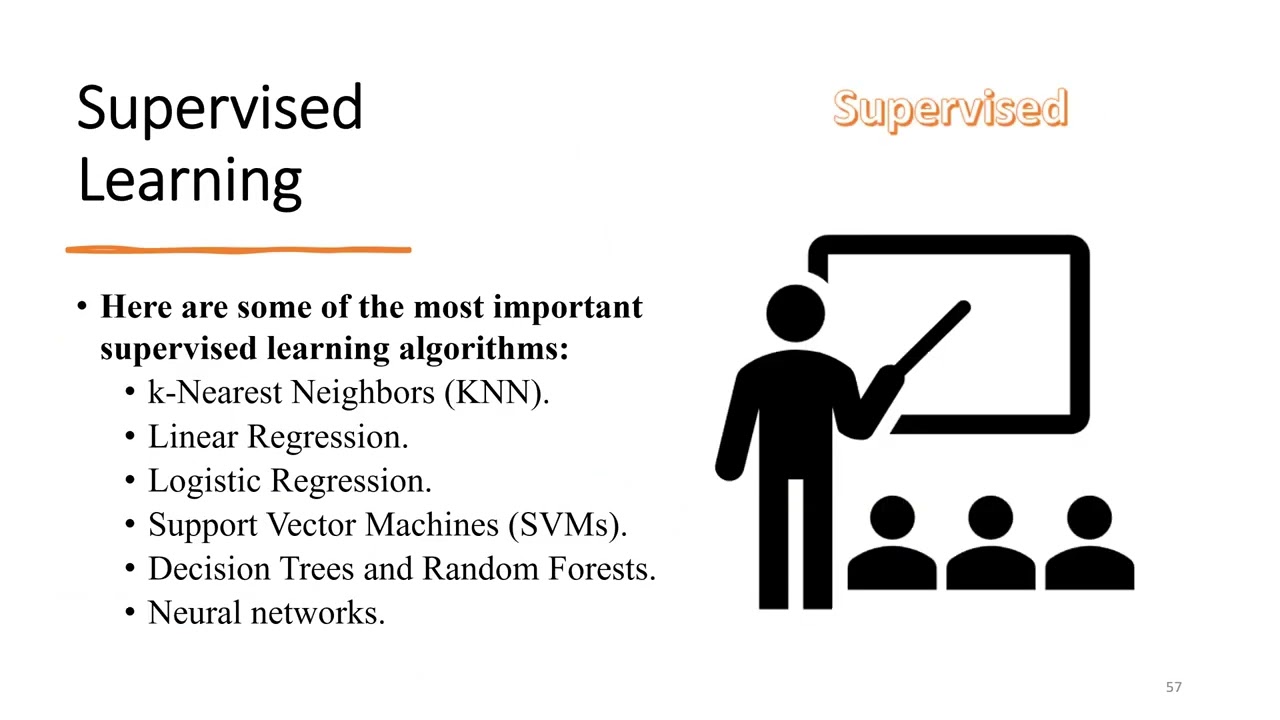
- Review of supervised learning: regression and classification.
- Unsupervised learning: clustering, anomaly detection, dimensionality reduction.
- Semi-supervised learning and self-supervised learning (pretext tasks).
- Reinforcement learning: agent, environment, rewards, and penalties.
- Batch vs online/incremental learning, model drift, and transfer learning.
- Parametric vs instance-based approaches, introduction to linear regression.
- Example: predicting life satisfaction from GDP per capita, setting up linear regression.
Contribution & Novelties
The video offers a clear and structured introduction to machine learning concepts, particularly useful for beginners. It effectively explains the differences between various learning paradigms and introduces linear regression in an accessible manner. The use of real-world examples, such as predicting life satisfaction, helps ground the concepts.
Pour aller plus loin :
- Linear regression (Wikipedia) — Provides a comprehensive mathematical treatment of linear regression.
- Supervised learning (Wikipedia) — Explains the supervised learning paradigm in detail.
- Reinforcement learning (Wikipedia) — Offers an overview of reinforcement learning, including algorithms and applications.
89 words
Radar Profile
The radar profile shows a balanced performance across all dimensions, with slightly higher scores in information quantity and reliability, reflecting the video's comprehensive yet accessible nature. The technical depth is moderate, suitable for an introductory audience.