L5 Gradient Vector Cost Functions MSE MAE LR Effect SGD Minibatch
Keywords
Summary
185 words
Critical Evaluation
Value of the Information & Strength of the Argument
The video provides a solid conceptual foundation for understanding gradient-based optimization. It clearly explains the gradient vector as a direction of steepest ascent and the update rule. The argumentation is logical, progressing from simple to complex concepts. The use of visual examples (contour plots, 3D surfaces) aids comprehension. However, the presentation is informal and lacks rigorous mathematical derivations, which may be a limitation for advanced learners. The discussion on learning rate effect is particularly valuable, illustrating the trade-offs between large and small values. The introduction of SGD and minibatch is well-motivated, addressing computational and convergence issues.
Scientific Rigor, Source Quality, Title Accuracy
The video is a tutorial with no external sources cited. The mathematical content is standard and appears accurate, but the lack of references reduces its scientific rigor. The title accurately describes the content, covering all major topics discussed. The presentation is clear and well-structured, but the informal style and lack of citations are notable weaknesses.
166 words
Title / Content Match
The title accurately reflects the content, covering gradient vector, cost functions (MSE, MAE), learning rate effect, SGD, and minibatch gradient descent.
Quality & Reliability
7/10
The video provides a clear and structured explanation of gradient descent, cost functions, and optimization variants. The mathematical formulations are standard and correctly presented. However, the presentation is informal and lacks citations to external sources, which limits its scientific rigor.
Key Moments
Markers derived by PSI from the transcript: the creator did not define chapters.
- Introduction and overview of topics: gradient vector, cost functions, learning rate effect, SGD, minibatch.
- Explanation of gradient vector as partial derivatives and its direction.
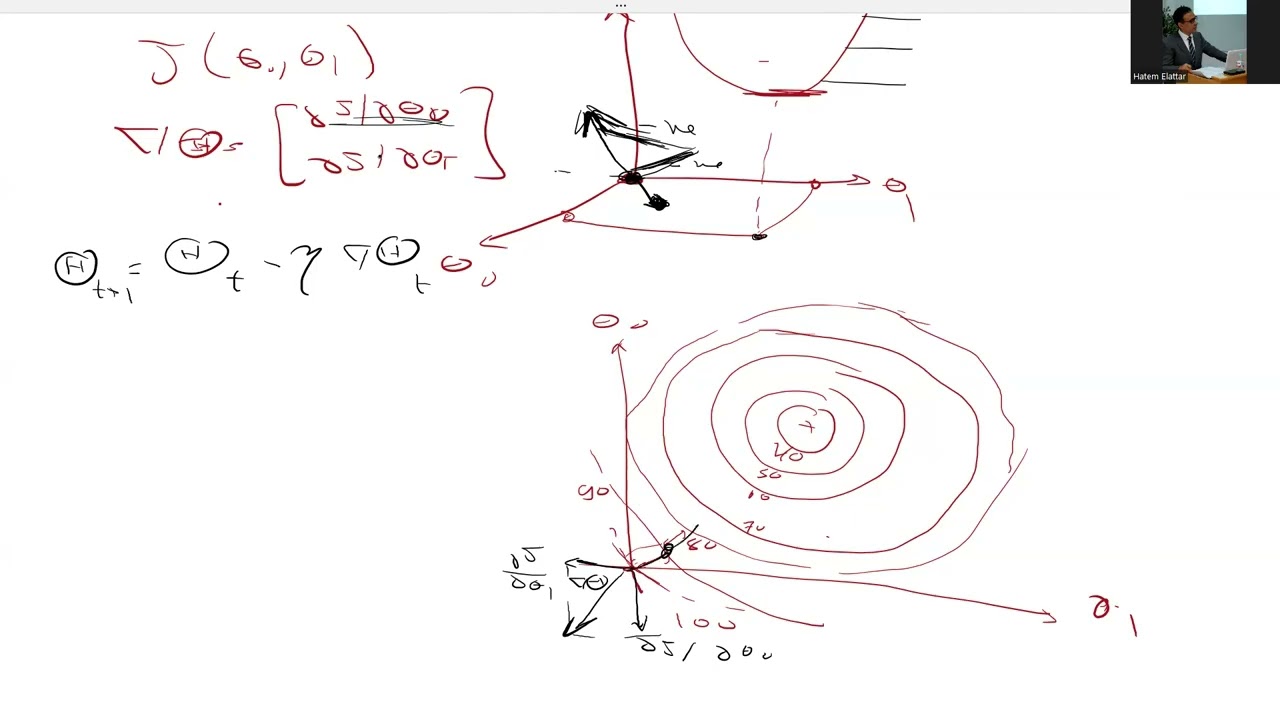
- Illustration of gradient vector in 2D and 3D, and the update rule.
- Discussion on convexity of MSE and local vs global minima.
- Introduction of saddle points and their challenges.
- Comparison of MSE and MAE cost functions, including robustness to outliers.
- Effect of learning rate: too large causes divergence, too small leads to slow convergence.
- Introduction to stochastic gradient descent (SGD) and its advantages.
- Explanation of minibatch gradient descent and its practical benefits.
- Comparison of batch, SGD, and minibatch in terms of smoothness and speed.
Contribution & Novelties
The video provides a clear and accessible introduction to gradient-based optimization, covering key concepts such as gradient vector, cost functions, and optimization variants. It effectively explains the trade-offs between different cost functions and the impact of learning rate. The discussion on saddle points and the role of SGD in escaping them adds depth. For further exploration, consider the following resources:
- Gradient descent - Wikipedia — Provides a comprehensive overview of gradient descent algorithms.
- Stochastic gradient descent - Wikipedia — Detailed explanation of SGD and its variants.
- Mean squared error - Wikipedia — Mathematical definition and properties of MSE.
- Mean absolute error - Wikipedia — Overview of MAE and its characteristics.
- Saddle point - Wikipedia — Mathematical concept of saddle points and their relevance in optimization.
125 words
Radar Profile
The radar chart shows a balanced profile with high scores in information quantity and technical level, but slightly lower in information quality and reliability due to the lack of citations. The video is informative and technically sound, but could benefit from more rigorous sourcing.