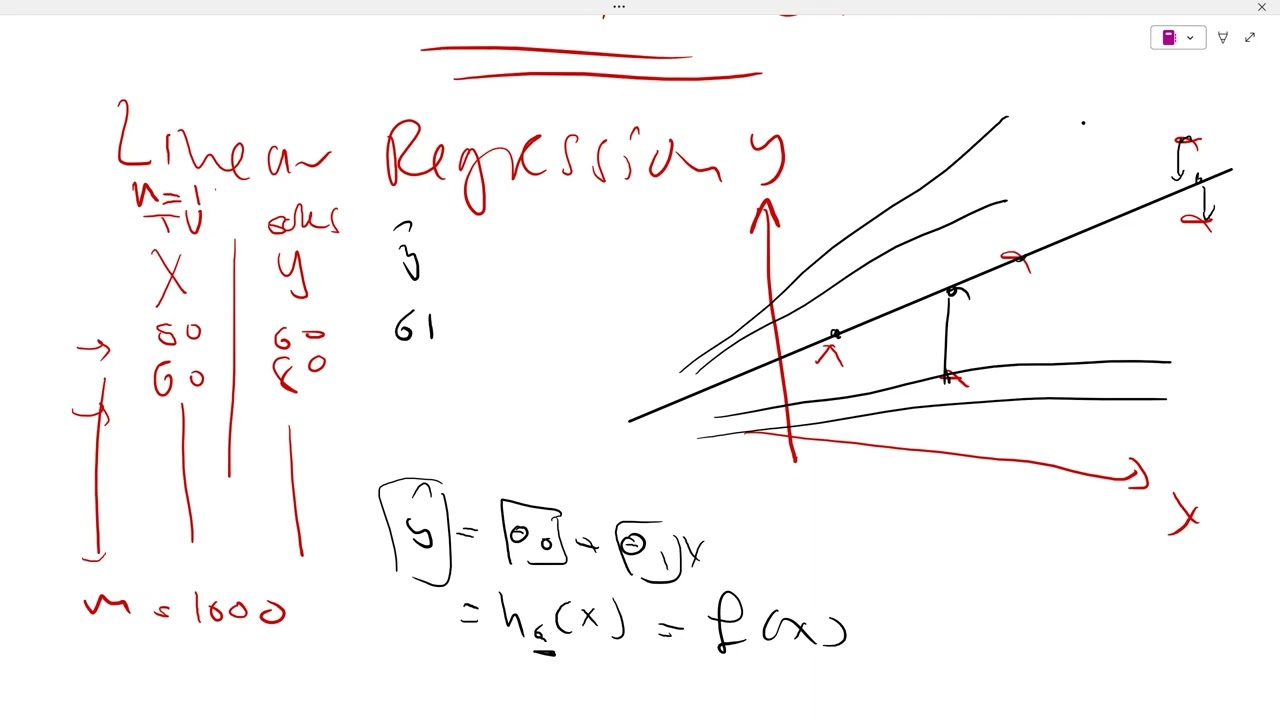
L4 Gradient Descent GD Part 1
Keywords
Summary
173 words
Critical Evaluation
Value of the Information & Strength of the Argument
The video provides a solid conceptual foundation for gradient descent. It clearly explains why the normal equation becomes impractical for high-dimensional data, using a concrete example of image pixels. The step-by-step breakdown of iterative methods is valuable, and the instructor uses intuitive visualizations and analogies. The argumentation is coherent, building from linear regression to the need for optimization. However, the presentation is informal and lacks mathematical rigor, with some derivations glossed over. The instructor does not discuss learning rate selection or convergence criteria in detail, which are crucial for practical application.
Scientific Rigor, Source Quality, Title Accuracy
The video does not cite any external sources, which is typical for a tutorial. The content is accurate and aligns with standard machine learning textbooks, but the lack of references reduces its scientific rigor. The title accurately reflects the content, which is a lecture on gradient descent. The instructor mentions that the normal equation is implemented in libraries like scikit-learn, but does not provide specific references. The video is part of a structured course, and the instructor references previous lectures, indicating a coherent curriculum.
190 words
Title / Content Match
The title accurately reflects the content, which is a lecture on gradient descent, part 1.
Quality & Reliability
7/10
The video provides a clear and structured explanation of gradient descent, building on previous lectures. It correctly identifies the limitations of the normal equation and motivates iterative methods. The mathematical derivations are accurate, though the presentation is informal and lacks formal rigor. No external sources are cited, but the content aligns with standard machine learning textbooks.
Key Moments
Markers derived by PSI from the transcript: the creator did not define chapters.
- Introduction and course objectives
- Review of linear regression and normal equation
- Limitations of normal equation: computational complexity
- Introduction to iterative methods and gradient descent
- Five steps of iterative methods explained
- Illustration of gradient descent on a simple linear model
- Cost function and its convex shape
- Role of derivative in gradient descent
- Update equation and iterative process
- Conclusion and preview of next lecture
Contribution & Novelties
The video provides a clear and accessible explanation of gradient descent, emphasizing the intuition behind iterative optimization. It effectively contrasts the normal equation with gradient descent, highlighting the scalability issue. The five-step framework for iterative methods is a useful pedagogical tool. The lecture is part of a comprehensive course, and it sets the stage for more advanced optimizers.
Pour aller plus loin :
- Gradient descent - Wikipedia — Overview and mathematical formulation.
- Stochastic gradient descent - Wikipedia — Variant used for large-scale learning.
- Normal equation - Wikipedia — Derivation and limitations.
91 words
Radar Profile
The radar profile shows balanced scores across information quantity, quality, technical level, and reliability, indicating a well-rounded educational video. The technical level is moderate, suitable for beginners, while the reliability is high due to accurate content.