Former des citoyen-nes : les conditions sociales de l’esprit critique
Keywords
Summary
147 words
Critical Evaluation
Value of the Information & Strength of the Argument
The value of the information lies in its empirical grounding: the study is based on a large representative sample, and the analysis of five dimensions provides a nuanced picture of political socialization. The argumentation is solid, systematically linking theoretical frameworks (e.g., Durkheim, Annick Percheron) to empirical findings. The speaker convincingly argues that individualistic approaches to critical thinking are insufficient and that context matters. However, the presentation is largely descriptive, and causal claims are carefully avoided. The discussion of solutions is more exploratory, which is acknowledged by the speaker.
Scientific Rigor, Source Quality, Title Accuracy
The scientific rigor is high: the methodology is transparent, and the results are interpreted with caution. The speaker cites relevant literature (e.g., Durkheim, Percheron, Muxel) and references their own publications (Fouquet-Chauprade, Charmillot, Felouzis, 2024). The title accurately reflects the content, focusing on the social conditions of critical thinking. The presentation is well-structured and evidence-based, though it is an expert opinion rather than a systematic review.
168 words
Title / Content Match
The title accurately reflects the content, which focuses on the social conditions of critical thinking and citizenship education.
Quality & Reliability
8/10
The speaker is a sociologist of education presenting findings from a large-scale survey (16,000 students) conducted under the aegis of CNESCO. The methodology is clearly described, and the results are contextualized within existing literature. However, the presentation is an expert opinion based on a specific study, and some interpretations are debatable.
Key Moments
Markers derived by PSI from the transcript: the creator did not define chapters.
- Introduction: presentation of the speaker and the topic of citizenship and critical thinking.
- Definition of critical thinking as individual cognitive capacity and proposal to extend it socially.
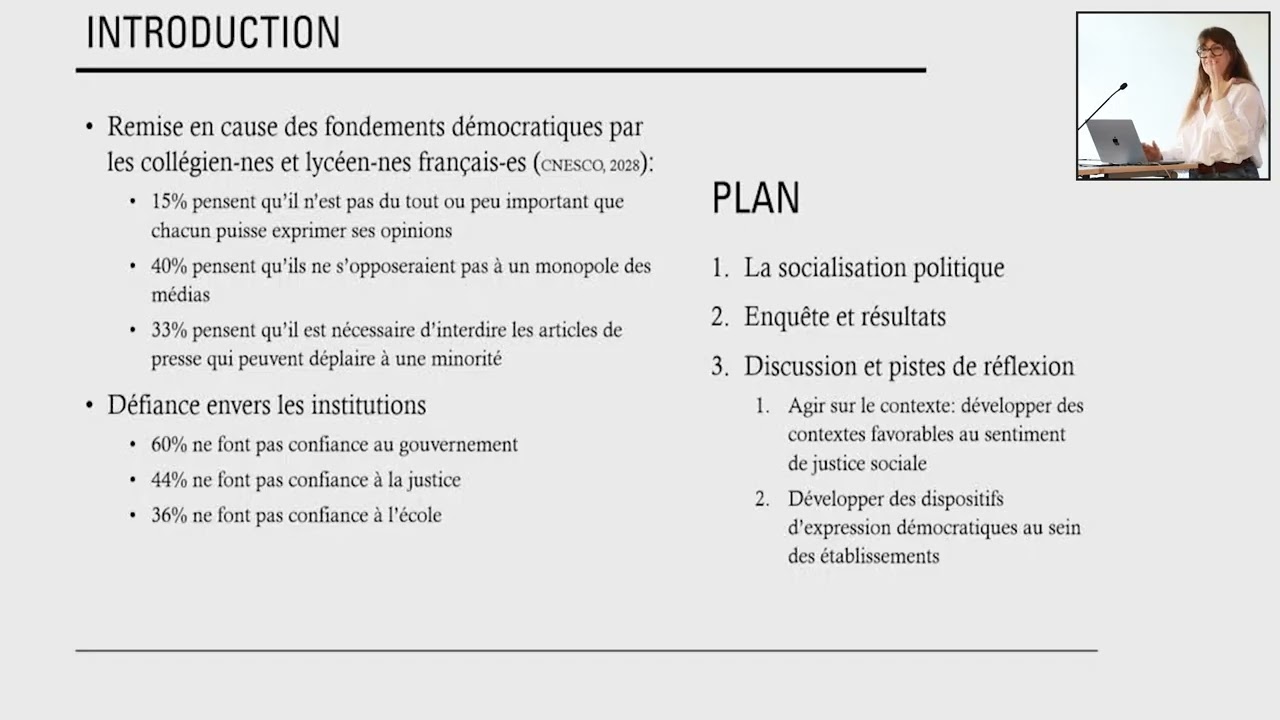
- Presentation of alarming statistics on youth disengagement and distrust in institutions.
- Introduction of the concept of political socialization and its three dimensions.
- Discussion of the role of school in citizenship education, highlighting its ambivalence.
- Presentation of the CNESCO survey methodology and the five dimensions of political socialization.
- Analysis of correlations between dimensions, showing weak links between knowledge and participation.
- Examination of variations in political socialization according to individual characteristics and school context.
- Discussion of the importance of school context and segregation in shaping civic attitudes.
- Proposal of two avenues: creating deliberative spaces and rethinking school practices.
Cited Sources
- Fouquet-Chauprade, Charmillot et Felouzis, 2024 — Reference to their own work on political socialization of students.
- Felouzis, Fouquet-Chauprade et Charmillot, 2016 — Reference to their work on segregation as systemic discrimination.
- CNESCO survey 'École et citoyenneté' (2018) — The survey data used in the study.
Concurring Sources
- Durkheim's work on moral education — Cited as foundational for citizenship education.
- Annick Percheron's work on political socialization — Her definition of political socialization is adopted.
Contribution & Novelties
The presentation offers a sociological perspective on critical thinking, emphasizing its social and contextual nature. It challenges the individualistic view and provides empirical evidence from a large-scale survey. The five-dimensional model of political socialization is a useful framework. The discussion of school as an ambivalent institution and the need for deliberative spaces is insightful.
Pour aller plus loin :
- Political socialization — Provides background on the concept.
- Critical thinking — Overview of the concept.
- Deliberative democracy — Relevant to the proposed deliberative spaces.
83 words
Radar Profile
The radar profile shows high scores in information quantity, quality, and reliability, with a slightly lower technical level. This reflects a well-supported expert presentation that is accessible to a broad audience.