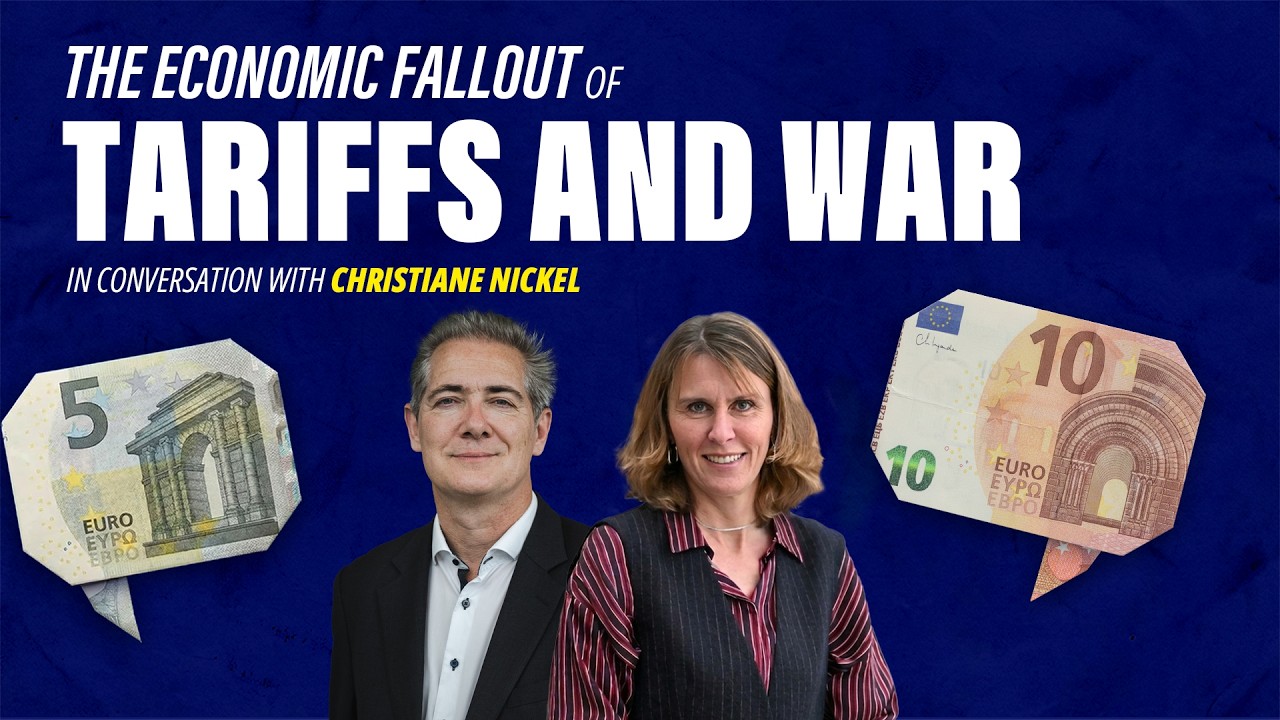
The economic fallout of tariffs and war: In Conversation with Christiane Nickel
Keywords
Summary
173 words
Critical Evaluation
The podcast provides a high-quality, expert analysis of the economic implications of tariffs and geopolitical conflict for the euro area. Christiane Nickel, as Deputy Head of the ECB’s Economics Department, offers authoritative insights grounded in the ECB’s own projections and data. The discussion is well-structured, moving from the specifics of tariff rates to the broader uncertainty they create, and then to the additional shock of the Iran war. The use of concrete figures, such as the effective tariff rates (1.5% to 13% to 10.5%), adds credibility and precision. Nickel’s explanation of the transmission channels—through exports, investment, and consumer prices—is clear and accessible without oversimplifying. The argumentation is solid, acknowledging both the resilience of the euro area economy in 2025 and the heightened risks going forward. However, the analysis is inherently forward-looking and subject to significant uncertainty, as Nickel herself admits when discussing the difficulty of assigning probabilities to the baseline scenario. The sources cited are authoritative (ECB projections, Paul Krugman’s Substack), but the podcast does not engage with alternative viewpoints or potential criticisms of ECB policy. The title accurately reflects the content, and the episode maintains a professional tone throughout. Overall, this is a valuable resource for understanding the ECB’s perspective on current economic challenges, though it is not without limitations in scope and depth.
215 words
Title / Content Match
The title accurately reflects the content, which focuses on the economic impact of tariffs and war on the euro area.
Quality & Reliability
8/10
High-quality expert discussion from a senior ECB economist, grounded in official ECB projections and data. The content is well-structured and balanced, though it reflects institutional perspectives and relies on assumptions that may change.
Key Moments
Markers derived by PSI from the transcript: the creator did not define chapters.
- Introduction: Host Paul Gordon sets the stage, referencing the anniversary of 'Liberation Day' tariffs and the Iran war.
- Christiane Nickel recalls watching the tariff announcement and the immediate questions for Europe.
- Nickel explains the calculation of effective tariff rates, rising from 1.5% to 13% by September 2025.
- Discussion on the historical context of tariffs and who actually bears the cost.
- Nickel explains why the euro area economy was less affected than feared, citing front-loading, monetary policy, and fiscal measures.
- Sectoral impact: autos, machinery, and chemicals are hardest hit; policy uncertainty is the key constraint.
- The Iran war adds a new layer: energy prices spike, feeding into inflation and downside risks to growth.
- Nickel describes the challenge of updating the March 2026 projections amid the war, working late into the night.
- Discussion on the difficulty of assigning probabilities to the baseline scenario given extreme uncertainty.
- Nickel recommends Paul Krugman's Substack for further insights; episode concludes.
Cited Sources
- ECB Macroeconomic Projections, March 2026 — Referenced as the source of the latest projections discussed in the episode.
- Paul Krugman's Substack — Recommended by Christiane Nickel as a 'hot tip' for further reading on economic issues.
Concurring Sources
- ECB Macroeconomic Projections, March 2026 — The projections discussed in the podcast are consistent with the ECB's official data.
Dissenting Sources
Contribution & Novelties
The podcast offers an insider’s view on how the ECB assesses the economic impact of tariffs and geopolitical shocks, providing specific data on effective tariff rates and the process of updating projections under uncertainty. It highlights the role of policy uncertainty as a key constraint for businesses, beyond the tariffs themselves.
Pour aller plus loin :
- ECB Macroeconomic Projections — Official source for the latest euro area economic forecasts.
- Paul Krugman’s Substack — Ongoing commentary on trade and economic policy.
- Trade Uncertainty and Its Economic Effects — IMF blog discussing the impact of trade policy uncertainty on global growth.
99 words
Radar Profile
The radar profile shows high scores in information quantity and quality, reflecting the expert content and data-rich discussion. The technical level is moderate, suitable for a general audience, while reliability is high due to the institutional source.