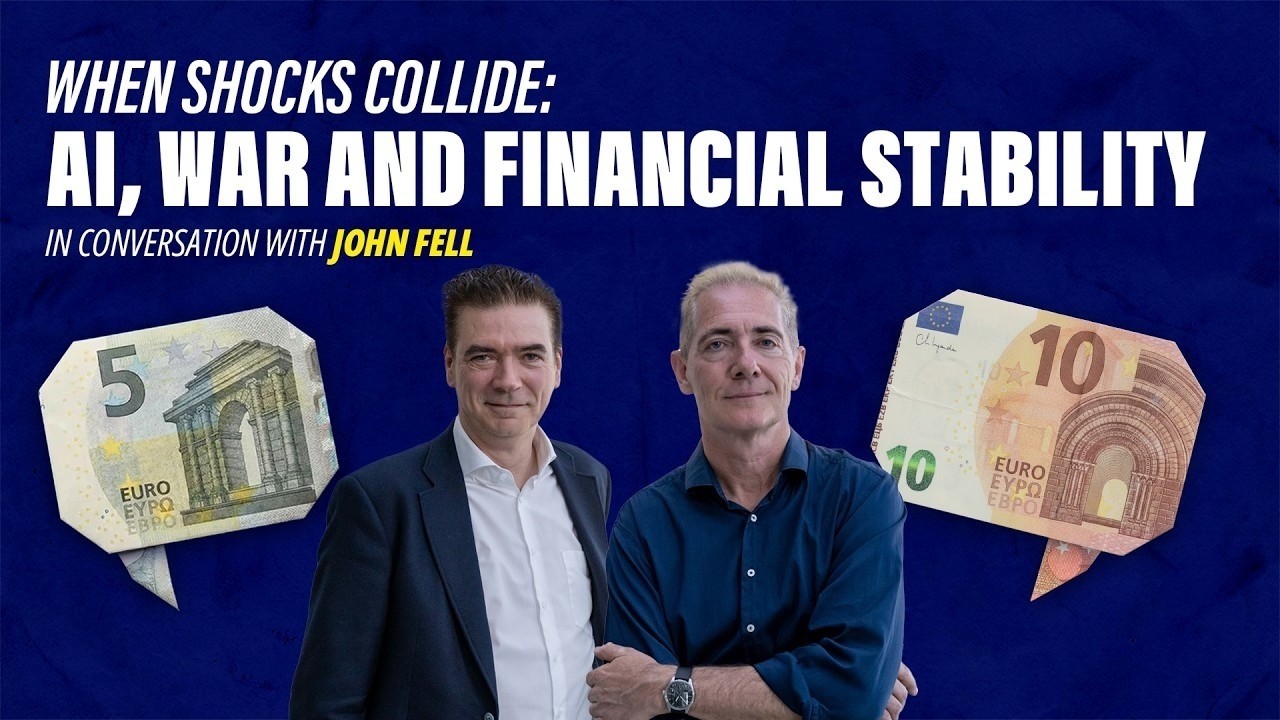
When shocks collide: AI, war and financial stability – In Conversation with John Fell
Keywords
Summary
165 words
Critical Evaluation
The podcast provides a high-quality, expert analysis of the current financial stability landscape in the euro area. The discussion is grounded in the ECB’s Financial Stability Review, lending authority and rigor. The speakers demonstrate a deep understanding of the subject, articulating complex interactions between AI disruption, energy shocks, and financial vulnerabilities. The argumentation is solid, with clear reasoning and appropriate caveats. For instance, when discussing private credit, Fell carefully distinguishes it from subprime 1.0, citing specific structural differences such as patient capital, lower leverage, and reduced maturity transformation. This nuanced approach enhances credibility. The use of an AI-generated sentiment indicator is innovative, though its methodology is not detailed, which could be a minor limitation. The sources cited are official ECB publications, which are reliable and directly relevant. The title accurately reflects the content, focusing on the collision of shocks. The discussion is balanced, acknowledging uncertainties and potential risks without overstating them. The podcast is aimed at a professional audience, but the content is accessible. The main strength is the authoritative perspective from within the central bank, offering insights not readily available elsewhere. The main weakness is the lack of critical examination of the ECB’s own policies and potential blind spots. Overall, the podcast is a valuable resource for understanding financial stability challenges in Europe.
214 words
Title / Content Match
The title accurately reflects the content, which focuses on the interaction between AI disruption, geopolitical shocks, and financial stability.
Quality & Reliability
8/10
The discussion is led by ECB staff, grounded in the institution's Financial Stability Review, and reflects expert analysis. The views are clearly presented as those of the speakers, and the content is consistent with official ECB publications.
Key Moments
Markers derived by PSI from the transcript: the creator did not define chapters.
- Introduction to the podcast and the topic of financial stability.
- John Fell introduces the two colliding shocks: AI disruption and energy shock.
- Discussion on the AI sentiment indicator and its negative reading.
- Analysis of AI's impact on business models and market valuations.
- Comparison of private credit to subprime 1.0 and why it's not a systemic threat.
- Discussion on data gaps and opacity in private markets.
- Addressing the market's underpricing of geopolitical risks and cognitive dissonance.
- Conclusion and overall message: system is resilient but facing unprecedented shocks.
Cited Sources
- Financial Stability Review, May 2026 — The primary source discussed in the podcast, providing the basis for the analysis.
- Financial Stability Review at a glance — Overview page for the Financial Stability Review, mentioned as further reading.
Concurring Sources
- Financial Stability Review, May 2026 — The podcast directly aligns with the findings and analysis in this report.
Dissenting Sources
- No discordant sources identified — The podcast does not reference any sources that contradict its claims.
Contribution & Novelties
The podcast offers an expert perspective on the intersection of AI disruption and geopolitical shocks, highlighting the novel combination of these risks. It provides insights into the ECB’s assessment of private credit, distinguishing it from subprime 1.0. The use of an AI-based sentiment indicator is an innovative approach to gauging financial stability.
Pour aller plus loin :
- Financial Stability Review — Official ECB publication providing detailed analysis.
- Artificial intelligence and financial stability — Related ECB report on AI’s implications.
- Private credit: risks and opportunities — IMF Global Financial Stability Report covers private credit trends.
94 words
Radar Profile
The radar profile shows high scores across all dimensions, indicating a well-rounded and reliable source. The podcast excels in information quality and reliability, with slightly lower scores in technical depth due to its accessible format.