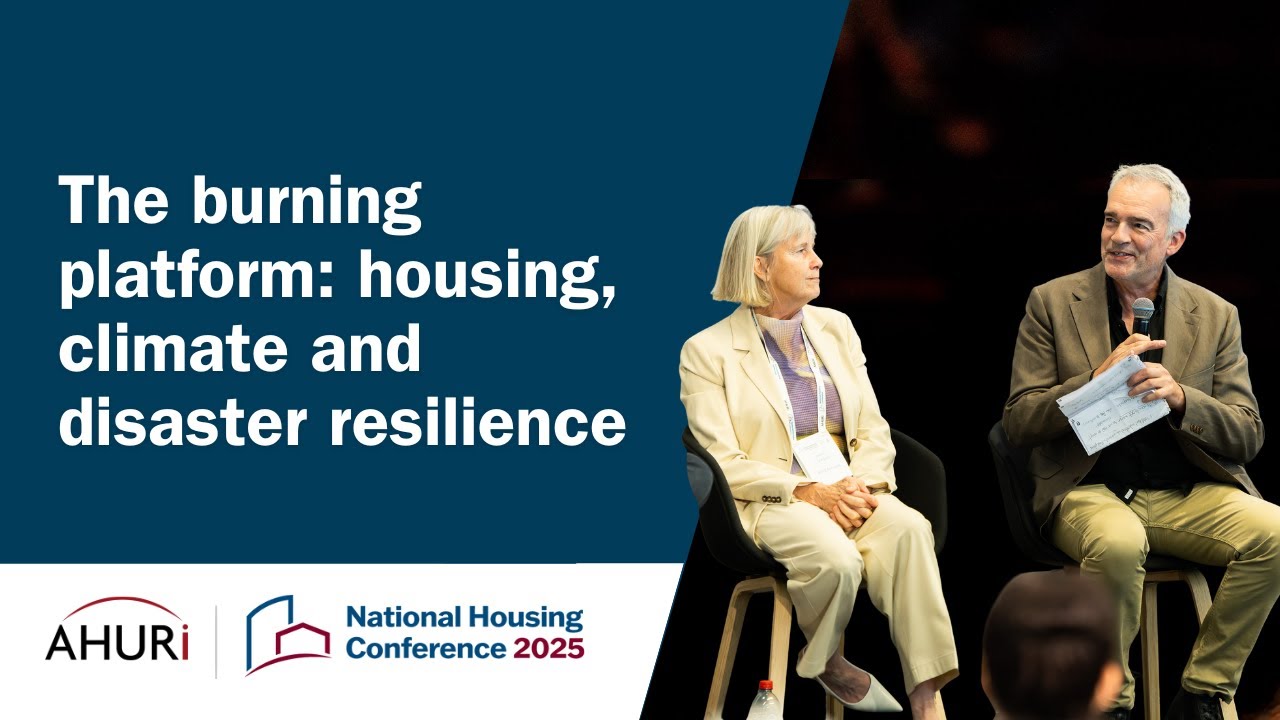
NHC25 | Major Concurrent 3 - The burning platform: housing, climate and disaster resilience
Keywords
Summary
175 words
Critical Evaluation
Value of the Information & Strength of the Argument
The panel provides valuable insights into the practical challenges and strategies for enhancing housing resilience in Australia. The argumentation is solid, drawing on real-world examples and recent research. The speakers effectively highlight the need for data-driven decision-making, targeted investments, and cross-sector collaboration. The discussion is well-structured, with each panelist contributing a distinct perspective, from government policy to community housing operations and academic research. The emphasis on prevention and the ‘disasters by choice’ framing adds depth to the argumentation, encouraging proactive measures rather than reactive responses.
Scientific Rigor, Source Quality, Title Accuracy
The session demonstrates scientific rigor through the involvement of experts and references to specific programs and reports, such as the AHURI research on housing and disasters. The quality of sources is generally high, with panelists citing their own institutional work and collaborative projects. The title accurately reflects the content, focusing on the urgent need to address housing, climate, and disaster resilience. The discussion is well-aligned with the conference theme ‘Time to Deliver’, emphasizing actionable strategies. No comments were provided for analysis.
181 words
Title / Content Match
The title accurately reflects the session's focus on housing, climate, and disaster resilience, with a strong emphasis on the urgent need for action.
Quality & Reliability
8/10
The panel consists of experts from government, community housing, and academia, providing a balanced and informed discussion. The content is grounded in practical experience and recent research, with references to specific programs and reports. However, the format is a panel discussion with limited time for deep technical detail, and some claims lack explicit citations.
Key Moments
Markers derived by PSI from the transcript: the creator did not define chapters.
- Chris Smith introduces the session and panelists, emphasizing the need for sector-wide targets.
- Alex Meek discusses the Department of Housing and Works' approach to improving climate resilience in social housing, including retrofitting and new builds.
- James Henry shares Housing Choices Australia's use of data and frameworks for strategic decision-making, including AON's hazard information platform.
- Jenny Gregory presents RACE for 2030 CRC's projects on energy upgrades, including the APY Lands retrofit pilot and initiatives for private rentals.
- David Sanderson discusses the AHURI report on housing and disasters, highlighting the concept of 'disasters by choice' and the need for better coordination.
- Q&A session begins, with panelists responding to audience questions on topics such as funding, data sharing, and community engagement.
Cited Sources
- AHURI Research Report on Housing and Disasters — Referenced by David Sanderson as a collaborative research project on housing and disaster resilience.
- RACE for 2030 CRC Annual Impact Report — Mentioned by Jenny Gregory as a source of information on energy upgrade projects.
- AON Combined Hazard Information Platform (CHIP) — Referenced by James Henry as a tool used for assessing climate and disaster risks.
Concurring Sources
- AHURI Research Report on Housing and Disasters — The report aligns with the session's themes and provides evidence-based insights.
- RACE for 2030 CRC — The CRC's work on energy upgrades supports the discussion on improving housing resilience.
Contribution & Novelties
The session provides a comprehensive overview of current initiatives and challenges in making social housing more resilient to climate change and disasters in Australia. It highlights the importance of data-driven decision-making, cross-sector collaboration, and community engagement. The panelists share practical examples from their work, offering valuable insights for policymakers and practitioners.
Pour aller plus loin :
- National Climate Resilience and Adaptation Strategy — Official Australian government strategy on climate adaptation.
- Disaster by Choice: How to Prevent Natural Disasters — Book by Ilan Kelman, referenced in the discussion, exploring the concept of disasters as choices.
- Social Housing Energy Performance Initiative (SHEPI) — Western Australian government program mentioned by Alex Meek.
109 words
Radar Profile
The radar profile shows high scores in information quantity, quality, and reliability, indicating a well-informed and credible discussion. The technical level is moderate, reflecting the panel's focus on practical strategies rather than deep technical details. Overall, the session is strong in providing valuable information and reliable insights.