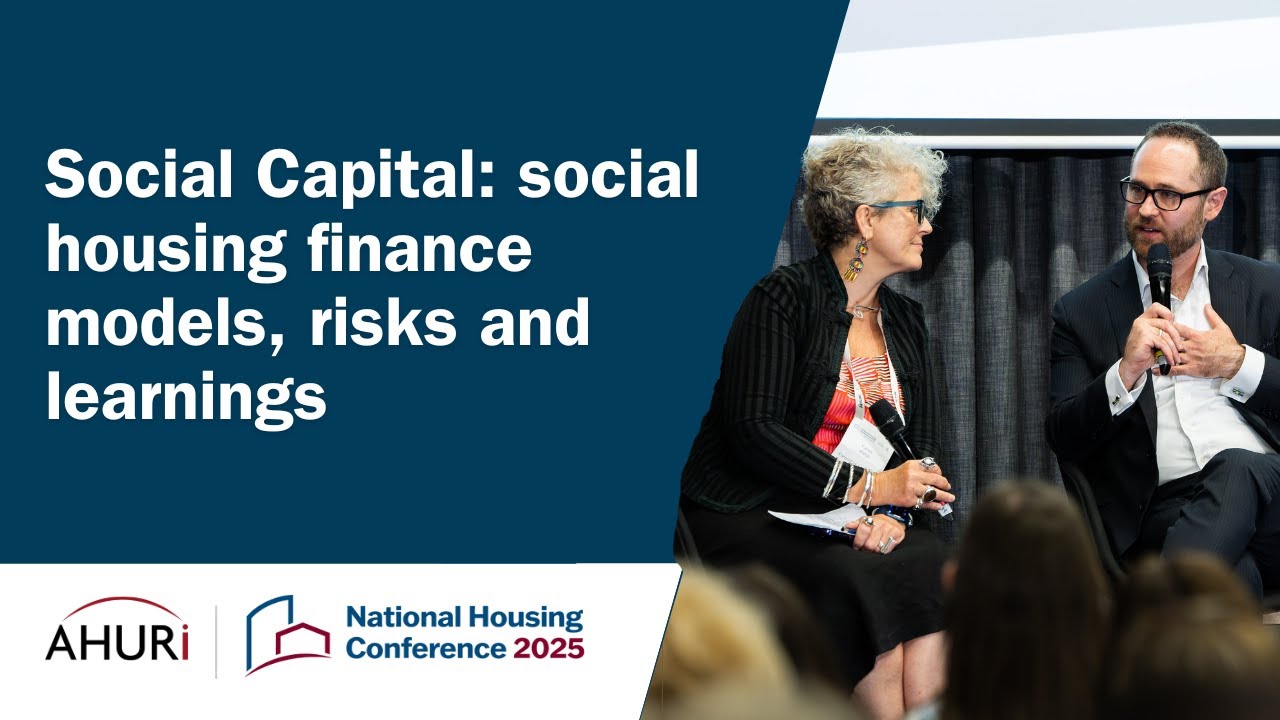
NHC25 | Major Concurrent 6 - Social Capital: social housing finance models, risks and learnings
Keywords
Summary
179 words
Critical Evaluation
Value of the Information & Strength of the Argument
The session provides valuable insights into the current state of social housing finance in Australia, drawing on the direct experience of key stakeholders. The arguments are well-structured, with each speaker contributing a distinct perspective: Langford focuses on the macro-level need for capital and the role of Housing Australia, Monik on the operational and governance challenges for community housing providers, and Whittaker on the legal and structural complexities. The discussion is pragmatic, acknowledging both the opportunities and the risks, such as the tension between procurement requirements and the need for efficiency. The panel’s collective expertise lends credibility to their observations, though the lack of quantitative data or formal analysis limits the depth of the argumentation.
Scientific Rigor, Source Quality, Title Accuracy
The session is a panel discussion rather than a formal presentation, so it does not cite specific sources. However, the speakers reference their own institutional experiences and programs like the Housing Australia Future Fund (HAFF). The title accurately reflects the content, which focuses on social housing finance models, risks, and learnings. The discussion is grounded in practical knowledge, but the absence of citations or references to external research reduces its scientific rigor. The speakers are recognized experts in the field, which adds to the credibility of the information presented.
218 words
Title / Content Match
The title accurately reflects the session's focus on social housing finance models, risks, and learnings, as discussed by the panel.
Quality & Reliability
7/10
The session features experienced professionals from Housing Australia, Community Housing Limited, and Hall & Wilcox, providing practical insights into social housing finance models. The discussion is grounded in real-world examples and acknowledges risks, but it is primarily opinion and experience-based rather than peer-reviewed research. The lack of formal citations and the informal panel format limit its scientific rigor, though the expertise of the speakers adds credibility.
Key Moments
Markers derived by PSI from the transcript: the creator did not define chapters.
- Introduction by Karen Walsh, acknowledging traditional owners and setting the session's context.
- Scott Langford begins his talk, sharing a personal story about his grandfather's experience with public housing.
- Langford discusses the need for private capital and the role of Housing Australia in stimulating investment.
- Lee Monik speaks about the shift from grant-based funding to availability payments and the need for scale.
- Monik highlights the importance of operational readiness and governance for community housing providers.
- Shaun Whittaker reviews various funding structures and the complexity of the current landscape.
- Panel discusses the challenges of procurement and the need for simplicity in tendering processes.
- Q&A session begins, with audience questions on funding certainty and risk management.
- Panelists respond to questions about the role of community housing and future directions.
- Concluding remarks and thanks to the audience.
Cited Sources
- AHURI Events — Link to discover more AHURI events, mentioned in the video description.
- AHURI News — Link to hear the latest through AHURI News, mentioned in the video description.
Concurring Sources
- AHURI Research — AHURI's research publications on housing policy and finance, which align with the session's themes.
Contribution & Novelties
The session provides a current, practitioner-level overview of social housing finance models in Australia, highlighting the shift towards availability payments and the growing role of community housing providers. It offers practical insights into the risks and benefits of different funding structures, drawing on the speakers’ direct involvement in major projects. The discussion emphasizes the need for operational readiness and sophisticated governance as the sector scales up.
Pour aller plus loin :
- Housing Australia Future Fund — Official government page on the HAFF, relevant to the funding programs discussed.
- Community Housing Industry Association (CHIA) — Industry body for community housing providers, relevant to the sector’s role.
- Low-Income Housing Tax Credit (LIHTC) — US program referenced by Langford as a model for scalable funding.
122 words
Radar Profile
The radar profile shows a balanced performance across all dimensions, with slightly higher scores in information quantity and quality, reflecting the panel's expertise and the breadth of topics covered. The technical level is moderate, suitable for a professional audience, and the overall reliability is solid due to the speakers' credentials.
💬 Sur les 0 commentaires analysés, aucune tendance n'est disponible.