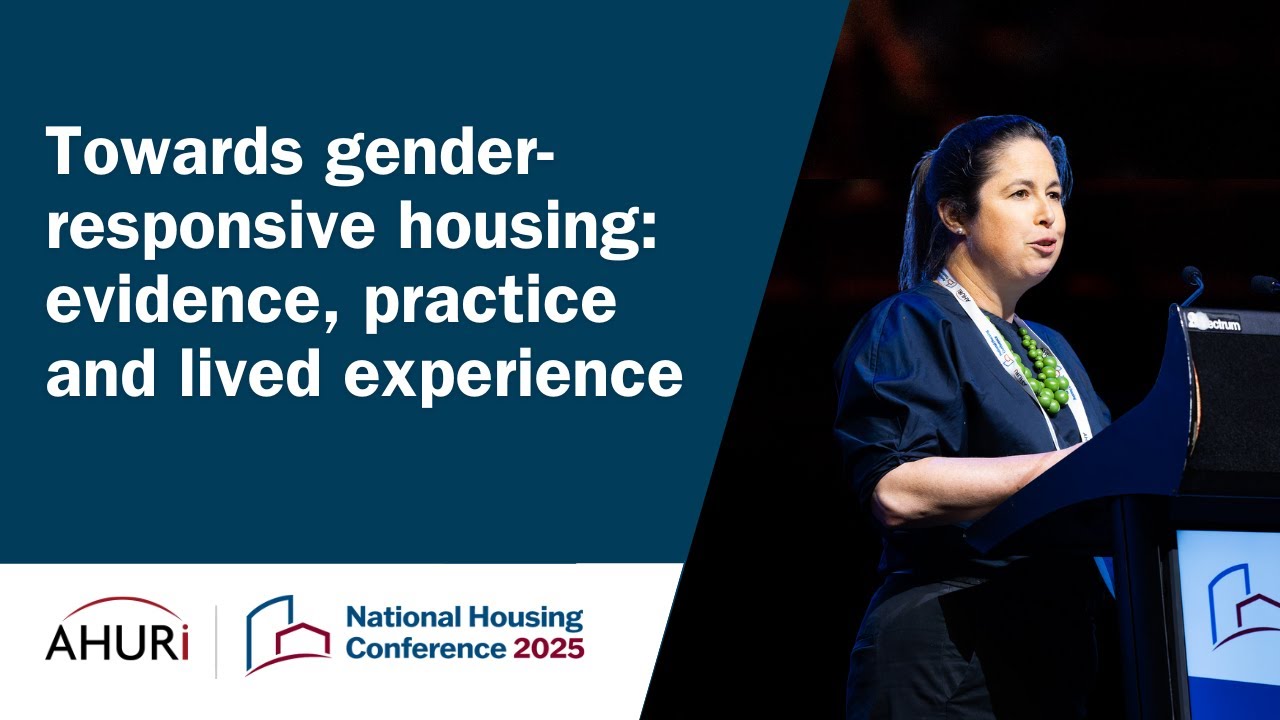
NHC25 | Concurrent 3 - Towards gender-responsive housing: evidence, practice and lived experience
Keywords
Summary
151 words
Critical Evaluation
Value of the Information & Strength of the Argument
The session provides valuable insights into the gendered dimensions of housing precarity, supported by recent research and compelling personal narratives. The argumentation is solid, combining quantitative data (e.g., census analysis, statistics on women’s homelessness) with qualitative lived experiences. The panel effectively demonstrates how gender-blind policies fail to address the specific needs of women and gender-diverse people, and advocates for more inclusive and transformative approaches. The discussion is well-structured, moving from evidence to practice, and highlights innovative solutions such as the YWCA’s women’s housing framework.
Scientific Rigor, Source Quality, Title Accuracy
The session references specific research projects (e.g., AHURI-funded study, ‘We’ve Been Robbed’ report) and data sources (e.g., 2021 Census, AIHW), lending credibility to the discussion. However, detailed citations are not provided in the video, and the reliance on anecdotal evidence from lived experience, while valuable, is not always systematically verified. The title accurately reflects the content, which focuses on gender-responsive housing from multiple perspectives. The panel includes recognized experts and practitioners, enhancing the overall reliability.
174 words
Title / Content Match
The title accurately reflects the session's focus on gender-responsive housing, combining evidence, practice, and lived experience as presented by the panel.
Quality & Reliability
8/10
The session features established researchers and practitioners from reputable organizations, presenting evidence-based findings and lived experiences. The discussion is grounded in recent AHURI-funded research and references specific data sources, though it lacks formal citations and peer-reviewed verification.
Key Moments
Markers derived by PSI from the transcript: the creator did not define chapters.
- Introduction and acknowledgments by Dr. Amity James.
- Professor Wendy Stone presents research on gender in housing policy.
- Wendy Morris shares her personal experience of housing precarity.
- Kate Whittle discusses YWCA's work and statistics on women's homelessness.
- Panel discussion on gender-responsive solutions and audience Q&A.
Cited Sources
- AHURI research on gender and housing — Mentioned by Professor Wendy Stone as the basis for her presentation.
- We've Been Robbed report — Referenced by Kate Whittle as a YWCA report on young women's housing insecurity.
Concurring Sources
- AHURI research on gender and housing — The research presented aligns with broader academic literature on gender and housing.
Contribution & Novelties
The session contributes to the discourse on gender-responsive housing by presenting a framework that categorizes approaches from gender-blind to gender-transformative, based on recent research. It highlights the systemic invisibility of gender in housing data and policy, and showcases practical examples of inclusive practices. The inclusion of lived experience adds depth and urgency to the discussion.
Pour aller plus loin :
- Gender mainstreaming — A key concept for integrating gender perspectives into policy.
- Intersectionality — Understanding how overlapping identities affect housing outcomes.
- Housing First — An approach that could be adapted to be gender-responsive.
93 words
Radar Profile
The radar profile shows high scores in quantity and quality of information, reflecting the rich content and expert panel. The technical level is moderate, making it accessible to a general audience. Overall reliability is high due to the use of established research and credible organizations.