Magic state cultivation on a superconducting quantum processor
Keywords
Summary
170 words
Critical Evaluation
Value of the Information & Strength of the Argument
The talk provides high-value information by presenting original experimental data on a cutting-edge quantum error correction technique. The argumentation is solid, with clear explanations of the theoretical background, experimental setup, and data analysis. Rosenfeld transparently discusses challenges, such as coherent noise leading to non-physical observables, and explains how they addressed them. The use of simulations to validate the experimental results strengthens the argumentation. The presentation is well-structured and accessible to a technical audience.
Scientific Rigor, Source Quality, Title Accuracy
The scientific rigor is high: the work is based on a peer-reviewed publication in Nature, and the talk includes detailed methodology and data. The sources cited are the original proposal by Gidney et al. and the experimental paper. The title accurately reflects the content. The talk does not include any promotional content.
140 words
Title / Content Match
The title accurately reflects the content: the talk focuses on the experimental implementation of magic state cultivation on a superconducting processor.
Quality & Reliability
9/10
Talk by a Google Quantum AI researcher presenting original experimental results on magic state cultivation, with detailed methodology, data, and simulations. The work is published in a peer-reviewed venue (Nature), and the talk includes technical depth and transparent discussion of challenges.
Key Moments
Markers derived by PSI from the transcript: the creator did not define chapters.
- Introduction and motivation for magic states and non-Clifford gates.
- Explanation of magic state distillation and the resource cost.
- Introduction to magic state cultivation and its advantages.
- Detailed circuit implementation of cultivation using color codes.
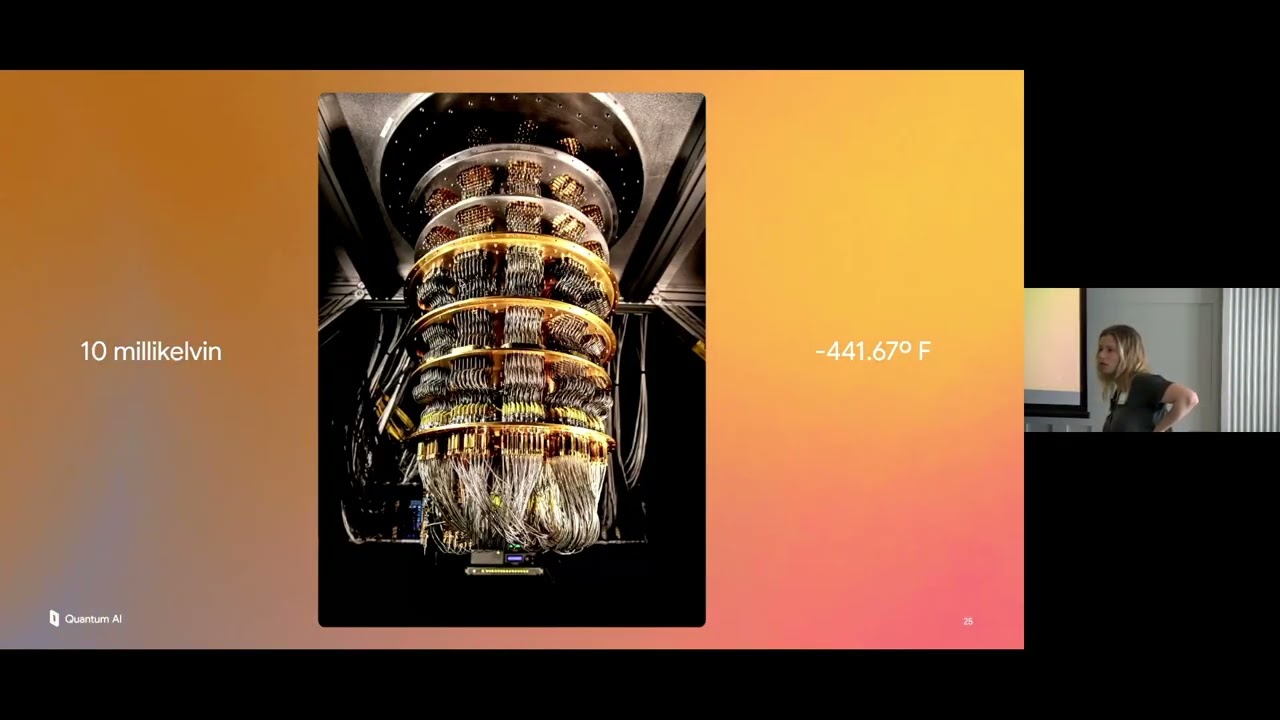
- Experimental setup: transmon qubits, control lines, and dilution refrigerator.
- Initial state injection and tomography results.
- Observation of non-physical observables due to coherent noise.
- Mitigation strategies: echoing and working in the XZ plane.
- Cultivation results showing improvement and post-selection rates.
- Development of kickback tomography for rigorous fidelity measurement.
- Final results: factor of 40 improvement, fidelity 0.9999(1).
- Discussion of implications and future directions.
Cited Sources
- Magic state cultivation: growing T states as cheap as CNOTs — Original proposal of magic state cultivation by Gidney, Shutty, and Jones.
- Magic state cultivation on a superconducting quantum processor — The experimental paper presented in the talk.
Concurring Sources
- Magic state cultivation: growing T states as cheap as CNOTs — Theoretical proposal that the experiment validates.
Contribution & Novelties
The talk presents the first experimental demonstration of magic state cultivation on a superconducting quantum processor, achieving a significant improvement in state fidelity. This is a novel contribution to the field of fault-tolerant quantum computing, as it validates a theoretical proposal and provides a practical pathway to reduce the resource overhead for non-Clifford gates.
Pour aller plus loin :
- Magic state distillation — Background on the standard approach for producing high-fidelity magic states.
- Surface code — The quantum error correction code used in the experiment.
- Transmon qubit — The type of superconducting qubit used in the experiment.
97 words
Radar Profile
The radar profile shows high scores across all dimensions, indicating a technically deep, reliable, and information-rich presentation. The lowest score is in quantity of information, but it remains high, reflecting the focused scope of the talk.
💬 Sur les 0 commentaires analysés, aucune tendance n'est disponible.