Keywords
Summary
157 words
Critical Evaluation
Value of the Information & Strength of the Argument
The talk presents novel results with a clear logical progression. The speaker motivates the need for single-shot error correction in topological codes, reviews the gauge color code construction, and then introduces the chiral color codes. The argumentation is rigorous, with explicit constructions and proofs sketched. The value lies in introducing a new family of codes with potential applications in fault-tolerant quantum computation and in providing a quantum information-theoretic definition of chirality for stabilizer states. The speaker addresses questions and clarifies technical points, enhancing the credibility of the presentation.
Scientific Rigor, Source Quality, Title Accuracy
The talk is based on original research, presumably published or in preparation. The speaker references prior work by Bombin and others, but does not provide explicit citations in the talk. The title accurately reflects the content. The technical depth is high, and the presentation is consistent with known results in the field. However, as a conference talk, it lacks the formal peer-review process, and some claims are presented without full proofs.
174 words
Title / Content Match
The title accurately reflects the content: a talk by Dongjin Lee at the Coogee '26 conference, hosted by the Perimeter Institute.
Quality & Reliability
8/10
The talk is given by a researcher at Perimeter Institute, a renowned institution, and presents original research with technical depth. The content is consistent with known concepts in quantum error correction and topological phases, though it is a conference talk without peer review.
Key Moments
Markers derived by PSI from the transcript: the creator did not define chapters.
- Introduction and motivation for topological codes in quantum computation.
- Discussion of measurement errors and the need for single-shot error correction.
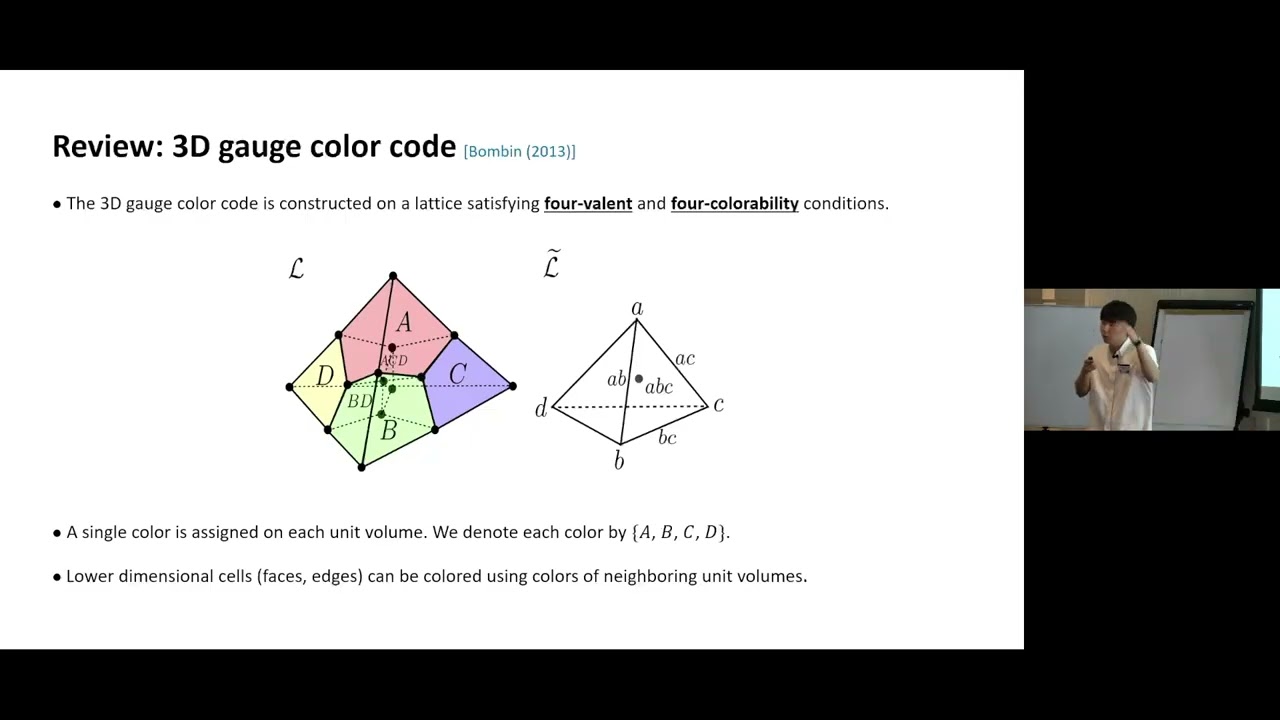
- Review of 3D gauge color code and its properties.
- Construction of chiral color codes via gauge fixing.
- Mapping to fermionic toric code and fermionic string operators.
- Discussion of excitation structures and loop-like excitations.
- Single-shot error correction via code switching.
- Generalization to qudit systems and dependence on local dimension.
- Proof of short-range entanglement for odd d and construction of local quantum channel.
- Definition of chirality for stabilizer states and discussion of mixed states.
Cited Sources
- 3D gauge color code — Mentioned as the basis for the construction.
- Hector Bombin's work on single-shot error correction — Referenced as the origin of single-shot error correction.
Concurring Sources
- Single-shot error correction in topological codes — Bombin's paper on single-shot error correction, foundational to the talk.
- Gauge color codes — Original paper introducing gauge color codes, which the chiral color codes are based on.
Contribution & Novelties
The talk introduces a new family of stabilizer codes, chiral color codes, that realize exotic topological orders and support single-shot error correction. It also proposes a novel quantum information-theoretic definition of chirality for stabilizer states, which may capture chiral properties not detected by traditional measures like modular commutator. This could have implications for fault-tolerant quantum computation and the study of topological phases.
Pour aller plus loin :
- Topological quantum error correction — Overview of topological codes and error correction.
- Fermionic toric code — Reference on fermionic toric code and its properties.
- Gauge color code — Original paper on gauge color codes by Bombin.
- Chiral topological order — General concept of chiral topological phases.
113 words
Radar Profile
The radar profile shows high scores in technical level and information quality, reflecting the advanced and detailed nature of the talk. The lower score in information quantity is due to the focused scope and lack of broader context. Overall, the talk is highly specialized and technically rigorous.
💬 No comments were provided for analysis.