Coogee '26 Talks - Grace Sommers (Princeton)
Keywords
Summary
167 words
Critical Evaluation
Value of the Information & Strength of the Argument
The talk provides valuable insights into the behavior of Haar-random quantum codes, a less-studied class compared to stabilizer codes. The argumentation is rigorous, combining analytic derivations with numerical simulations. The introduction of a microcanonical channel is a clever simplification that yields a clear physical picture. The speaker carefully explains the limitations of the ansatz and the role of finite-size effects. The connection to the hashing bound is well-motivated, and the discussion of postselection adds depth. The presentation is logically structured, building from simple models to the full depolarizing channel.
Scientific Rigor, Source Quality, Title Accuracy
The scientific rigor is high, with clear definitions and derivations. However, the talk does not cite specific sources or references, relying on established knowledge in quantum error correction. The title accurately reflects the content, focusing on spectral properties and coding transitions. The talk is self-contained and does not reference external literature, which is typical for a seminar presentation. The adequacy between title and content is excellent.
170 words
Title / Content Match
The title accurately reflects the content, which focuses on spectral properties and coding transitions of Haar-random quantum codes.
Quality & Reliability
8/10
Presentation of original research with analytic derivations and numerical simulations, but limited peer-review context and no external sources cited in the talk.
Key Moments
Markers derived by PSI from the transcript: the creator did not define chapters.
- Introduction and motivation for quantum error correction as phase transitions.
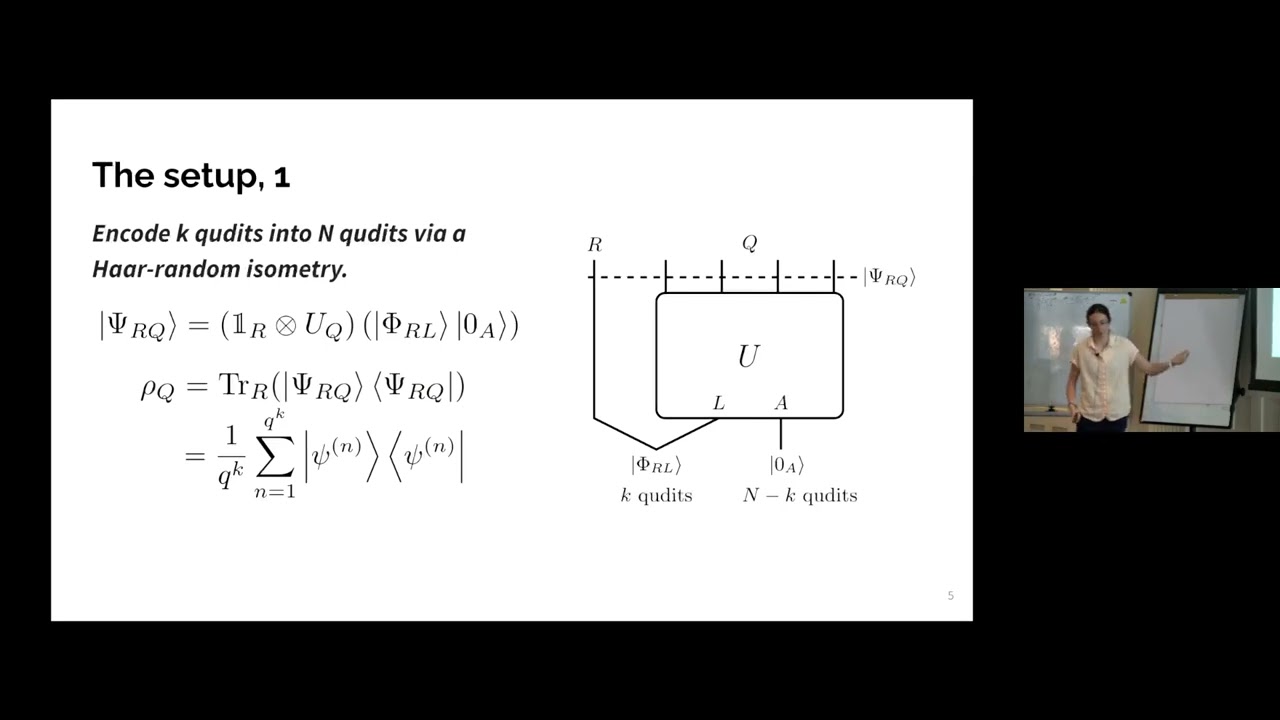
- Setup of Haar-random codes and depolarizing noise.
- Introduction of coherent information as a probe.
- Decomposition of depolarizing channel and microcanonical ensemble.
- Simple ansatz for spectrum and prediction of hashing bound.
- Numerical results showing Marchenko-Pastur distribution.
- Transition in canonical ensemble and scaling collapse.
- Postselection and detection threshold at p=1/2.
- Future directions and outlook.
Contribution & Novelties
The talk presents original research on Haar-random quantum codes, showing that their error threshold saturates the hashing bound, matching random stabilizer codes. It introduces a microcanonical channel to simplify analysis and provides a simple analytic ansatz for the spectrum. The work also explores postselected error correction beyond the hashing bound, identifying a detection threshold. This contributes to understanding mixed-state phase transitions in quantum error correction.
Pour aller plus loin :
- Quantum error correction — Overview of quantum error correction concepts.
- Hashing bound — Definition and significance in quantum information theory.
- Marchenko–Pastur distribution — Relevant to the eigenvalue distribution observed in the talk.
- Coherent information — Measure of quantum information recoverability.
110 words
Radar Profile
The radar profile shows high scores in technical level and information quality, indicating a specialized and rigorous presentation. The moderate scores in quantity and reliability reflect the focused scope and lack of external citations.