Embodied Language: Evaluating LLMs in the Real World
Keywords
Summary
141 words
Critical Evaluation
Value of the Information & Strength of the Argument
The talk provides valuable insights into the limitations of current LLMs in embodied settings, supported by concrete examples and references to key papers. Bisk’s argumentation is coherent, tracing the evolution of approaches and identifying persistent challenges. He effectively demonstrates that the symbol grounding problem is not solved by scaling data or adding modalities, but requires careful design of grounding mechanisms. The discussion of benchmarks like ALFRED and PIQA offers practical evidence of these challenges. The talk is persuasive in advocating for more research on embodied AI, though it is more of an expert opinion than a systematic review.
Scientific Rigor, Source Quality, Title Accuracy
Bisk references several influential papers, including his own work on ALFRED and PIQA, as well as the ‘Experience Grounds Language’ paper. These are well-known in the field and provide a solid foundation. The talk is scientifically rigorous, with clear explanations of technical concepts. The title accurately reflects the content, focusing on evaluating LLMs in real-world contexts. No comments were provided, so no analysis of public reception is included.
181 words
Title / Content Match
The title accurately reflects the content, focusing on evaluating LLMs in embodied, real-world settings.
Quality & Reliability
8/10
The talk is given by a recognized expert in embodied AI and NLP, referencing multiple peer-reviewed papers and benchmarks. The content is well-structured and grounded in established research, though it is a seminar presentation rather than a formal peer-reviewed publication.
Key Moments
Markers derived by PSI from the transcript: the creator did not define chapters.
- Introduction: Bisk introduces the topic of embodied language and his lab's research areas.
- Discussion on the progression from corpus-based analysis to embodied interaction, referencing 'Experience Grounds Language'.
- Explanation of the symbol grounding problem and why adding modalities is not sufficient.
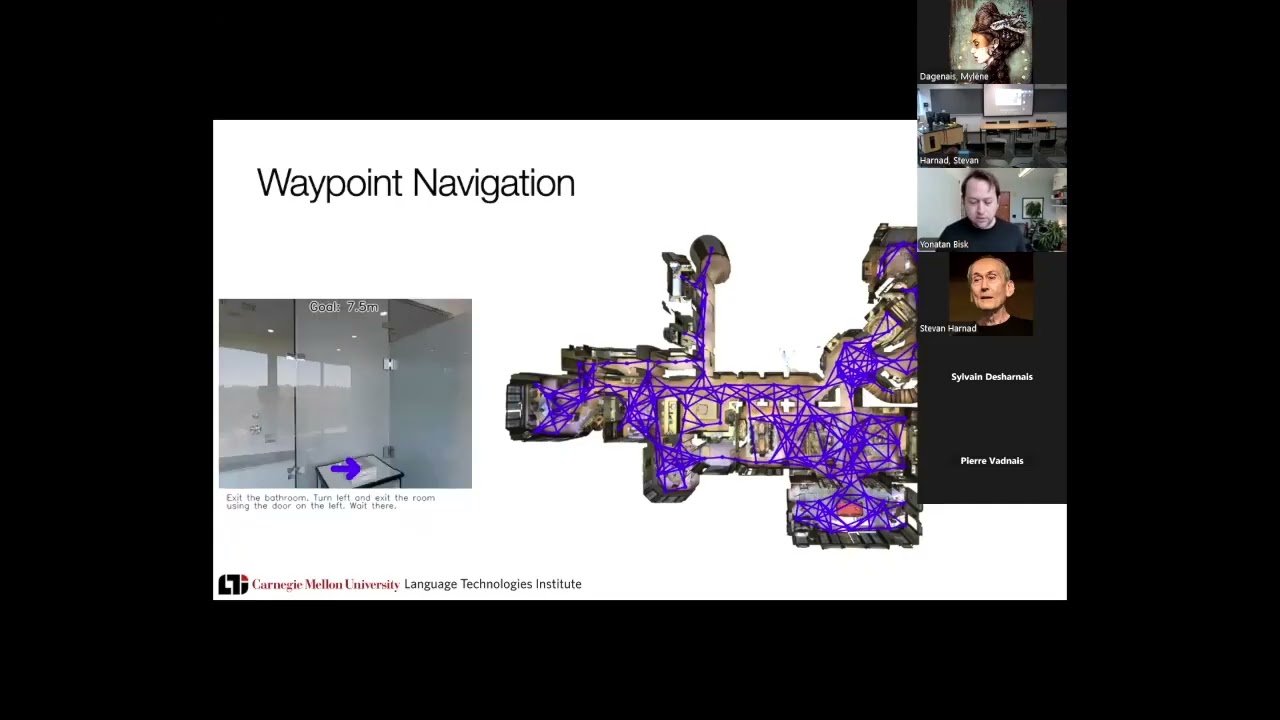
- Overview of early navigation systems, including Chen and Mooney's work and vision-language navigation.
- Introduction of the ALFRED benchmark and its focus on high-level goals and low-level actions.
- Discussion on the challenges of grounding language to actions, using the faucet example.
- Transition to manipulation tasks and the use of language models for action selection.
- Comparison of language-centric and robotics-centric approaches, referencing legibility in HRI.
- Recent advances in robot learning, including diffusion policies and large behavior models.
- Conclusion: Reiteration of the importance of grounding and open questions for future research.
Cited Sources
- A little less conversation, a little more action, please: Investigating the physical common-sense of LLMs in a 3D embodied environment — Referenced as recent work on physical common-sense of LLMs in embodied environments.
- Plan, Eliminate, and Track – Language Models are Good Teachers for Embodied Agents — Referenced as work on using LLMs to guide embodied agents.
- PIQA: Reasoning about Physical Commonsense in Natural Language — Referenced as a benchmark for physical commonsense reasoning.
- ALFRED: A Benchmark for Interpreting Grounded Instructions for Everyday Tasks — Referenced as a benchmark for grounded instruction following.
- Experience Grounds Language — Referenced as a position paper on the importance of embodiment for language understanding.
Concurring Sources
- ALFRED: A Benchmark for Interpreting Grounded Instructions for Everyday Tasks — The talk's description of ALFRED aligns with the paper's content.
- PIQA: Reasoning about Physical Commonsense in Natural Language — The talk's discussion of physical commonsense aligns with the paper's findings.
Dissenting Sources
- No discordant sources identified — The talk does not present conflicting evidence; it is a synthesis of existing research.
Contribution & Novelties
The talk provides a comprehensive overview of the challenges in evaluating LLMs in embodied settings, synthesizing research from NLP and robotics. It highlights the persistent symbol grounding problem and argues for a shift towards more interactive and physically grounded evaluation. The speaker’s perspective as a language researcher turned roboticist offers a unique interdisciplinary viewpoint.
Pour aller plus loin :
- Symbol grounding problem — Foundational concept discussed in the talk.
- Embodied cognition — Theoretical background for embodiment in AI.
- Vision-Language Navigation — Key benchmark referenced in the talk.
87 words
Radar Profile
The radar profile shows high scores in information quantity, quality, and reliability, with a slightly lower technical level, indicating a well-balanced seminar that is accessible yet informative.