Epistemological challenges in the study of “Theory of Mind” in LLMs and humans
Keywords
Summary
149 words
Critical Evaluation
Value of the Information & Strength of the Argument
The talk provides valuable insights into the use of LLMs as model organisms for studying human cognition, particularly Theory of Mind. Trott presents empirical evidence from his own studies, showing that LLMs exhibit some sensitivity to belief states but fall short of human performance. He carefully discusses limitations, such as data contamination and reproducibility, and proposes a nuanced framework (differential construct validity) for interpreting LLM performance. The argumentation is solid, building from specific experiments to broader epistemological considerations, and he acknowledges the work-in-progress nature of his theoretical contributions.
Scientific Rigor, Source Quality, Title Accuracy
Trott demonstrates scientific rigor by referencing his published papers (Jones et al., 2024; Trott et al., 2023) and discussing methodological details. He addresses potential criticisms of the false belief task and the challenges of studying closed-source models. The title accurately reflects the content, focusing on epistemological challenges. The talk is well-structured and grounded in empirical evidence, though some parts are based on unpublished work, which is clearly indicated.
171 words
Title / Content Match
The title accurately reflects the content, which focuses on epistemological challenges in studying Theory of Mind in LLMs and humans.
Quality & Reliability
8/10
The talk is given by a researcher with relevant expertise, presents empirical studies with published results, and discusses methodological limitations. However, it is a seminar presentation, not a peer-reviewed article, and some claims are based on unpublished work.
Key Moments
Markers derived by PSI from the transcript: the creator did not define chapters.
- Introduction to the talk and the concept of LLM-ology.
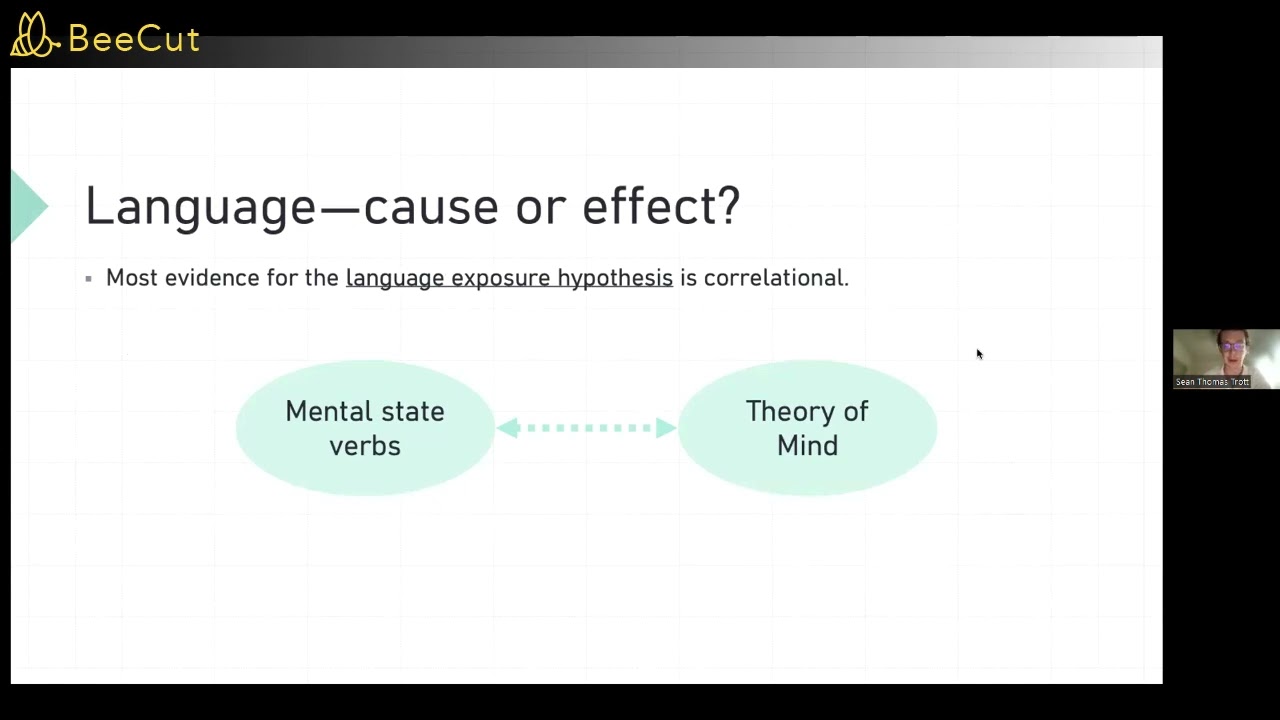
- Discussion of Theory of Mind and the language exposure hypothesis.
- Explanation of using LLMs as model organisms and the false belief task.
- Description of the 2023 study with GPT-3 and the results.
- Replication with 55 open-weight models and findings.
- Discussion of three interpretive views: duck test, axiomatic rejection, differential construct validity.
- Theoretical perspectives: plausibility and face validity.
- Empirical perspectives: convergent validity and process mechanisms.
- Conclusion and call for methodological innovation.
Cited Sources
- Comparing humans and large language models on an Experimental Protocol Inventory for Theory of Mind Evaluation (EPITOME) — Referenced as a publication by Jones, Trott, & Bergen (2024) in the talk.
- Do large language models know what humans know? — Referenced as a publication by Trott, Jones, Chang, Michaelov, & Bergen (2023) in the talk.
Concurring Sources
- Theory of Mind — General reference for the concept.
- False belief task — Background on the task used in the studies.
Contribution & Novelties
The talk contributes to the ongoing debate on whether LLMs can have Theory of Mind by proposing a framework of ‘differential construct validity’ to interpret LLM performance on human tasks. It also highlights the importance of using open-weight models for reproducibility and generalizability. The speaker’s perspective as a cognitive scientist using LLMs as model organisms offers a unique methodological angle.
Pour aller plus loin :
- Theory of Mind — Overview of the concept.
- False belief task — Description of the classic task.
- Large language model — Background on LLMs.
- Construct validity — Explanation of the concept.
96 words
Radar Profile
The radar profile shows high scores in information quantity, quality, and reliability, with a slightly lower technical level, indicating a talk that is informative and credible but accessible to a broader audience.
💬 No comments were provided.